
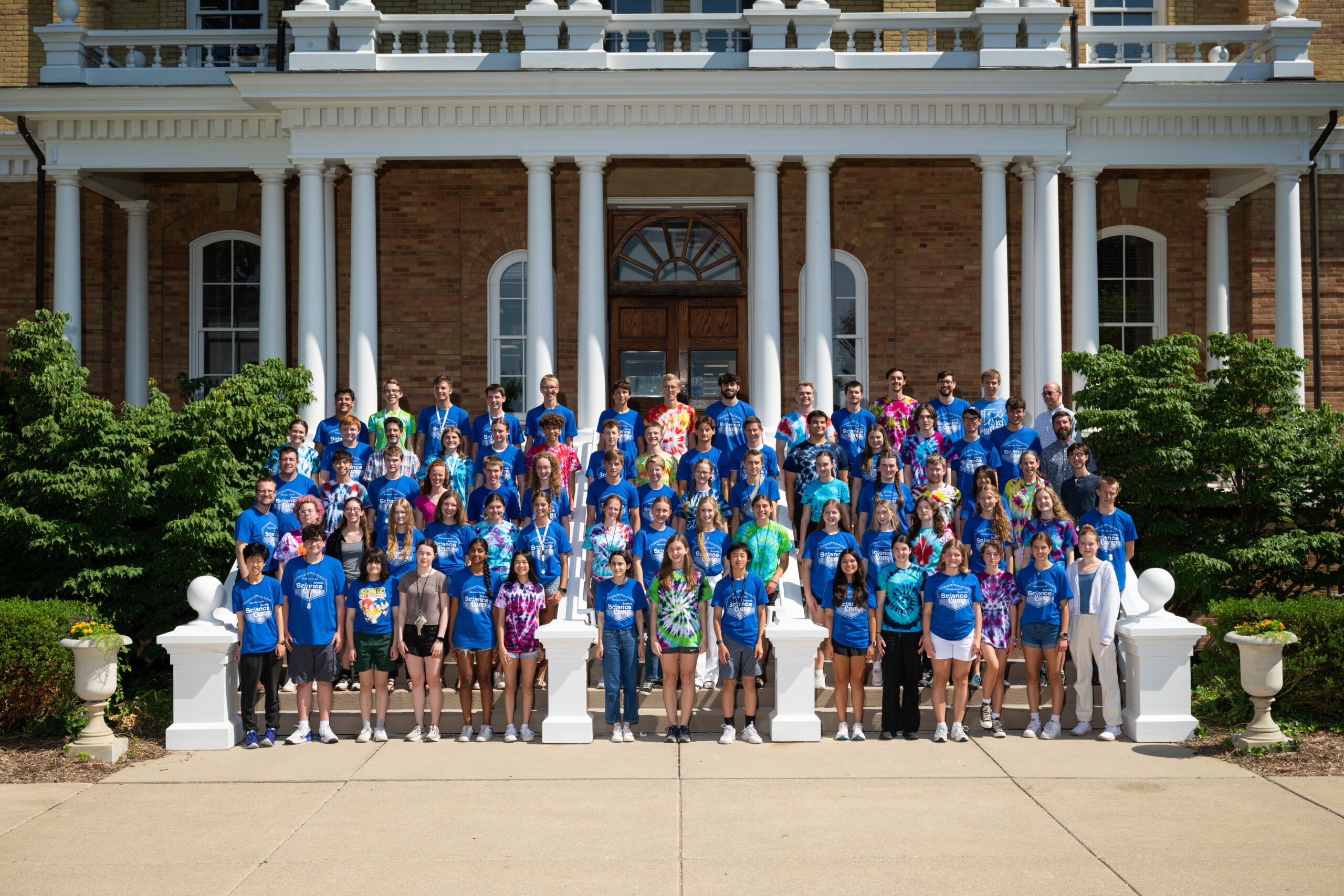
High school campers, professors, and teaching assistants from Hillsdale College’s summer science camp pose in front of Central Hall.
Courtesy | David Murphy
Biology majors at Hillsdale do not learn how to duplicate DNA until well into college — but Emmeline Peltzer, a high school senior from Arizona, spent a week learning upper-level molecular biology at one of Hillsdale College’s summer science camps.
“I was so excited to get to take such a deep dive into specific aspects of biology and really immerse myself in those areas,” Peltzer said. “And that’s exactly the experience that I had at the camp. I got to dive deep into those aspects that I was so interested in.”
Peltzer is one of 64 high schoolers who attended science camp this past summer in one of four disciplines — chemistry and biochemistry, physics, biology, and math. While a typical summer camp experience is filled with greasy sunscreen and cheesy camp songs, Hillsdale College summer science camps are filled with topography problems, textile dye experiments, and electronic kits, all designed to present complex scientific topics to high schoolers in an engaging and educational manner.
According to Professor of Mathematics David Murphy, the director of the science camp program, Hillsdale College established the camps in 1990 as a way to expose high schoolers to college-level science topics and labs, as well as to promote the college’s science programs. According to Murphy, about 11% of high schoolers who attend camp matriculate to Hillsdale as freshmen.
“From the students’ point of view, the purpose is to give them a good hands-on experience of doing real science and mathematics that is not just part of the standard K-12 curriculum, and to give them a chance to really see what is it like to do science or to engage with science in a meaningful way and to do it with like-minded students who are also interested in sciences,” Murphy said.
These camps are a staple of Hillsdale College’s academic programs and have run every year since 1990, except for the summers of 2020 and 2021.
According to Peltzer, one of her favorite aspects of the camp was how the time was structured.
“It’s definitely for students who are desiring a rich, edifying, immersive camp, where there’s no downtime, and you’re there to learn, and you’re there to learn from professors who expect you to take things seriously as well,” Peltzer said.
A typical day at summer camp includes morning lecture, lunch, afternoon lecture, free time, and an evening lecture or review period.
According to Peltzer, the camp gave her the chance to explore biology-focused topics like DNA much more deeply and creatively than she would in her high school classes.
“It was a whole camp about DNA and photosynthesis, which I was very excited about, because it’s sad how in some of my courses, it’s like, ‘No, we’re ending this way too early. I could spend three more weeks on this one topic,’” Peltzer said.
The summer camps are fun for more than students alone — the camps give professors the opportunity to be creative with how they teach the subjects they are passionate about.
Chairman and Associate Professor of Mathematics David Gaebler, who taught the math camp, said he aims to get high schoolers exposed to the big ideas of mathematics without the formal structure.
“We’re able to find a pretty accessible route into things that you might not learn in college until your junior year,” Gaebler said.
Because it is a summer camp and not a college class, the professors have more freedom to follow the rabbit trails of students’ curiosity. Gaebler said he uses more playful methods of teaching during camp.
“The experience of camp is even more playful than the Hillsdale College classroom, if you can believe it,” Gaebler said. “We spent a fair bit of time just with games and puzzles. I brought in a bunch of Rubik’s Cubes, and some of them were messing with them.”
Without the pressure of exams and getting through material, Gaebler said he enjoys teaching a group of enthusiastic students in a more free style.
“It’s something that I don’t get to experience really anywhere else, except research projects and things like that,” Gaebler said.
The summer camp is also an opportunity for Hillsdale College students to share their passion for their subject with high schoolers as teaching assistants and resident assistants during the camps. The dual role involves leading evening recitation sections and assisting with labs in the classrooms, as well as organizing activities and enforcing rules in the dorms.
Junior Benjamin Bassett was a TA and RA during the physics camp and said the experience helped him understand the subject at a deeper level.
“It’s really a different experience for physics to approach it from the perspective of a high schooler, instead of a college student,” Bassett said. “I feel like it helped me understand things on a deeper level.”
Bassett said he loved how enthusiastic the high schoolers were for physics.
“Some of them were very familiar with physics and had taken calculus and some physics courses before,” Bassett said. “And maybe half of them knew almost nothing about physics, which was awesome, because they were seeing all these things for the first time. They would discover this new concept and get really excited about it. It was really cool to talk to them about the ideas they found interesting.”
One of those high schoolers was current sophomore Brandon Meeks, who attended the biochemistry camp the summer before his junior year of high school. Meeks said the camp helped him feel confident about Hillsdale’s science programs.
“Even though the science department exists, it is a little glossed over when Hillsdale is presenting itself to the world,” Meeks said. “So the science camp was an opportunity for me to see more of the science and the professors here.”
Meeks said the camp pushed him to take organic chemistry in high school, which eventually prepared him to take the subject at college.
“The camp definitely helped me do better in organic chemistry. It was quite helpful for that. I felt like I had a very solid basic understanding of the language because of the camp,” Meeks said.
After attending the camp, Peltzer said she gained a better understanding of Hillsdale College and how it approaches education.
“The camp was able to simulate the experience of the Hillsdale student better than any of those prospective student experiences, because — although I’ve met with Hillsdale faculty on business before — having to be in a classroom environment with other students, understanding the professor’s lecture styles just really gave a taste into life as a Hillsdale student better than just a regular prospective student visit ever could have,” Peltzer said.
