
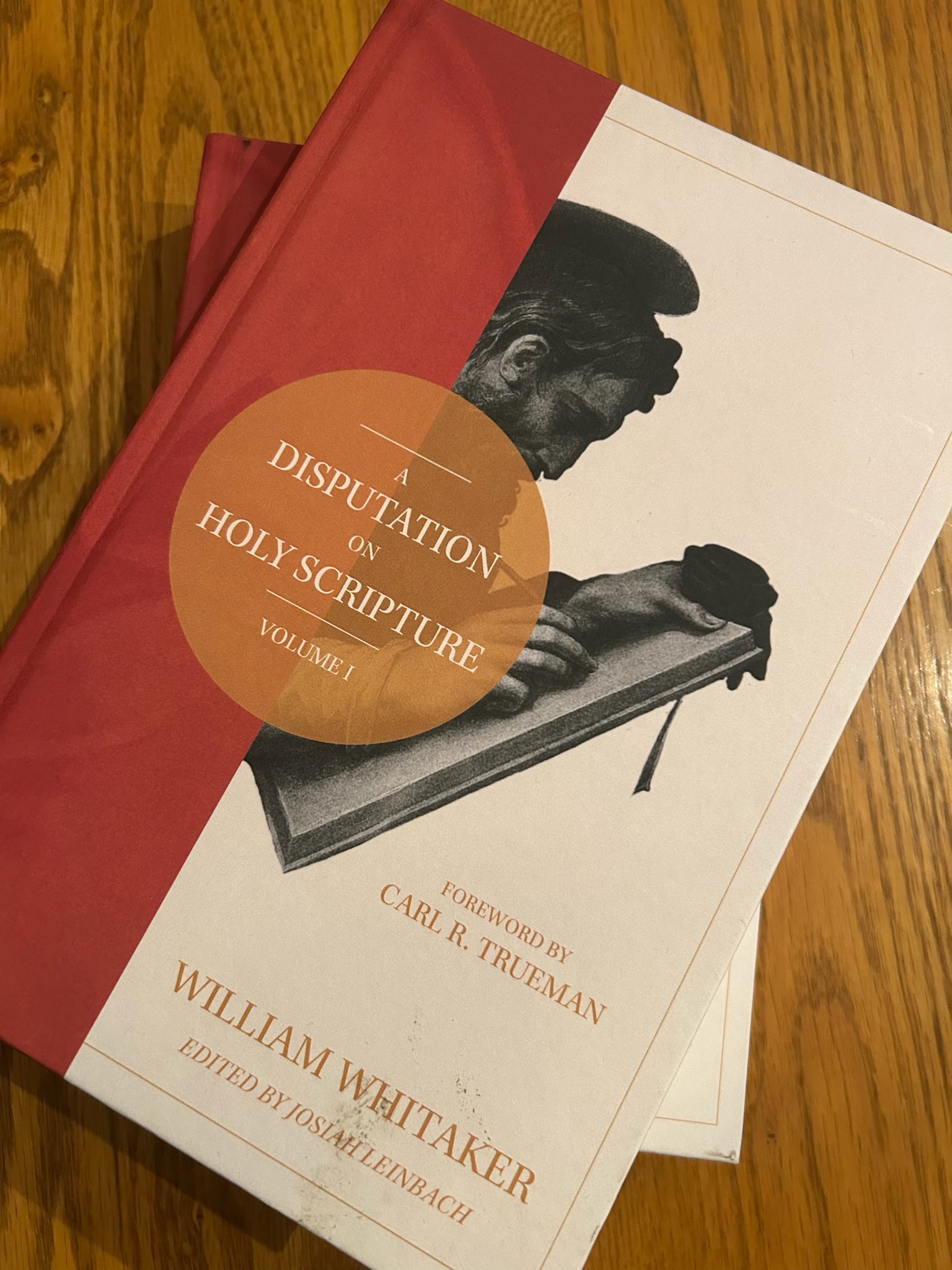
Hillsdale alumnus Ethan Greb ’19 designed the cover of “A Disputation of Holy Scripture.”
Courtesy | Josiah Leinbach
When Hillsdale alumnus Josiah Leinbach ’20 learned about a 16th-century book written by Anglican theologian William Whitaker, he invited fellow college alumni and affiliates to participate in a project to revive the widely overlooked text.
Whitaker wrote his book, “A Disputation of Holy Scripture,” in the wake of the Catholic response to the Reformation. It is a Protestant critique against the Catholic position on the Bible. In the book, Whitaker addresses various Catholic apologists, but focuses on Cardinal Robert Bellarmine’s defense of the Council of Trent.
“The monumental nature of the treatise and the fact that it was so influential in its own day and on through now, it’s a real shame that there hadn’t been additions since 1849,” Leinbach said.
Whitaker’s book was translated from Latin to English in 1849 and remained untouched until July 2023, when Leinbach began a project to modernize it. Leinbach partnered with Prolego Press, an Anglican publishing house, to release the new edition in May.
Nolan Ryan ’20, Hillsdale alumnus and co-editor on the project, said the book used to be standard reading in Protestant seminaries. Ryan added however, that a new movement called Protestant Retrieval seeks to return back to scripture, back to the works of the original reformers, and back to the second and third generations of reformers.
“William Whitaker fits in that space,” Ryan said. “He is in that later generation of reformers who’s picking up the work that a Calvin and a Luther did, and continuing that work but also ensuring that those same principles, those same ideas of the church, salvation, the Bible, are still being taught and proclaimed.”
Ryan said the team wanted to revise the Reformation-era book to get it into the hands of Christians, believing it would help create a historically informed and therefore healthy discussion between Christians of different beliefs.
“I think some of our hopes were that if you want to be informed historically in our discussions and our debates, let’s bring one more source into that ongoing conversation, and let’s make that more accessible not just to academics and theologians but to the people in the pews,” Ryan said.
Other co-editors on the project included Hillsdale alumnus Andrew Simpson ’20 and senior Emma Wilkinson. The foreword is by Carl R. Trueman, a theologian at Grove City College.
Leinbach said the co-editors worked on making light textual updates to the wording and punctuation so the average person could read the book and not struggle with its archaic language. Leinbach also said they added citations to define technical terms, scholarly annotations, and footnote source citations for scholars and clergy to follow what Whitaker was doing.
“It was a lot of fun to go into the library and get on the internet and try to find these really obscure things that I never heard of before,” Wilkinson said. “So I learned a lot of names of church fathers that I didn’t know.”
Leinbach said he brought in four other Hillsdale alumni who were friends of his to help proofread the book.
“There were something like 2,500 footnotes in it, excluding biographical and scholarly annotations,” Leinbach said.
Leinbach said he learned about the book while attending a conference for his diocese, the Anglican Diocese of the Living Word. One of the speakers at the event referenced the book, claiming that there are no new arguments in Rome regarding the authority of scripture that Whitaker has not addressed in some capacity in his book.
Leinbach said he later looked up the book and found there was no new version of it except for the reprint of the 19th-century translation, which inspired him to publish a modernized version of it.
“Most of everything in the last 400 years is largely derivative from Whitaker, and his contemporaries knew it,” Leinbach said. “He employed what was at the time a very new method of combining medieval scholastic philosophy and its analytical approach with Renaissance humanism.”
Leinbach said he sent print copies of the modernized version of Whitaker’s disputation to the Assistant Professor of History Miles Smith IV and the Assistant Professor of Religion Don Westblade before sending it to the press so the professors could write book reviews. Leinbach added the reviews have not been published yet.
“That will be one of the means by which we are promoting it to the scholarly community,” Leinbach said. “Having professors at a reputable institution like Hillsdale read it, write reviews, and show to the academic world that, hey, these Hillsdale guys actually put out a work that you should seriously consider buying.”
Following the release of Whitaker’s disputation, Leinbach founded the Whitaker Fellowship, which gives students the opportunity to work on other republications of Anglican texts. The inaugural class of Whitaker fellows participated in a 16-week course this summer.
“It was a fantastic experience. I definitely recommend it to anyone who is at all interested in that kind of thing,” Wilkinson, a Whitaker fellow, said.
In addition to the works in the Whitaker Fellowship, Leinbach said he is working with Prolego Press to republish Bishop Charles Petit Mcilvaine’s “The True Temple” and Edward Reynolds’s, “Meditations on the Holy Sacrament of the Lord’s Last Supper” early next year.
“I think the idea is, let’s keep reclaiming these maybe forgotten works or works that may have gone out of style and that have a lot of rich material,” Ryan said. “Let’s reclaim them and bring them back into the conversation.”
