
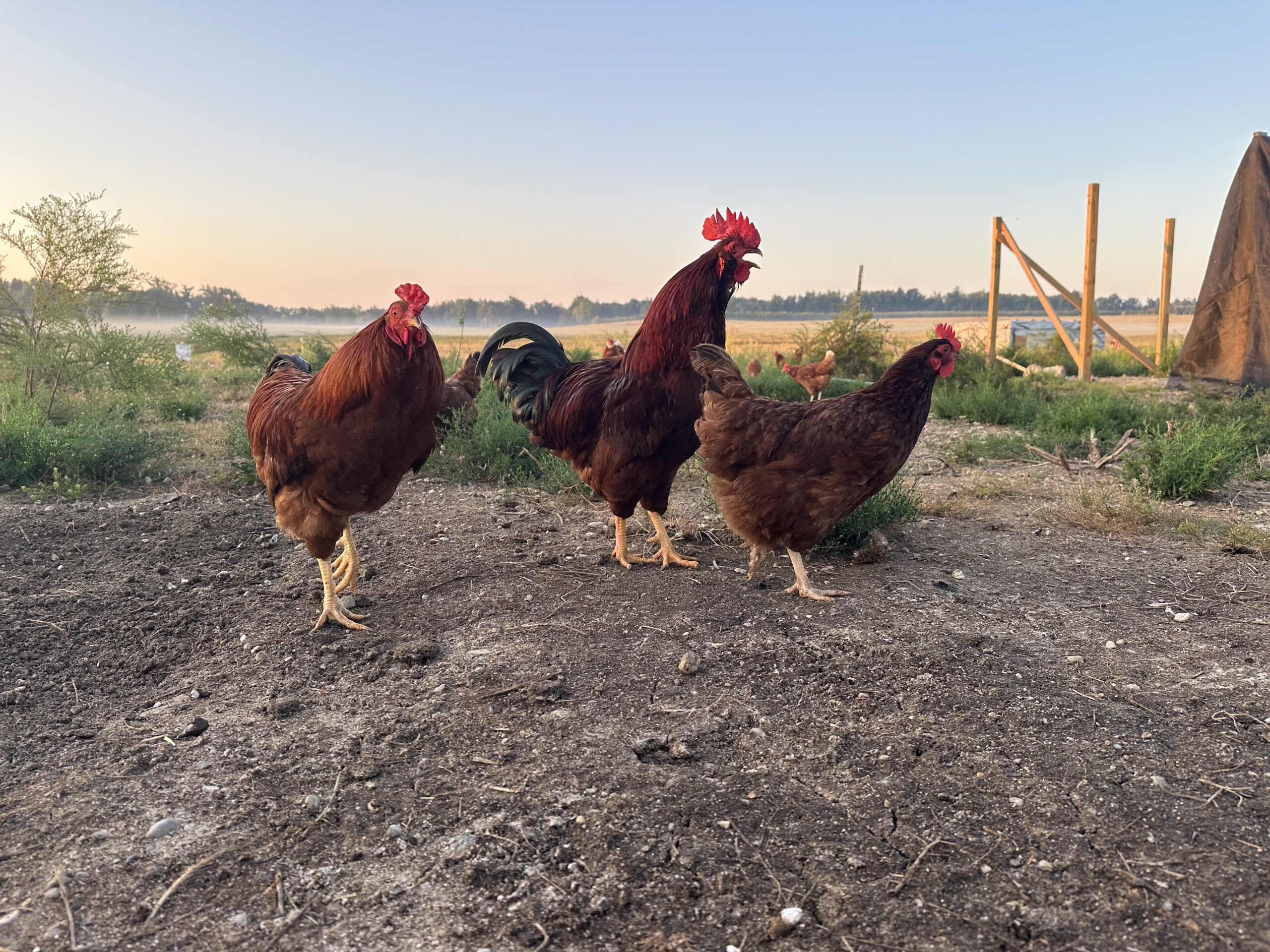
For those who hold fast to the irresponsible sleep schedule of a college student, 7 a.m. is an ungodly hour to begin one’s day. But the roosters at the Hillsdale Homestead are crowing, and they need feeding.
Less than 10 minutes away from campus, a small plot of land reveals the extent of the homestead, where 200 chickens peck about their coops, a hoard of honeybees swarm in their beehive, and a variety of veggies and herbs grow in the garden. The morning sun was just peeking out of the clouds as my roommate and I drove down the unpaved road that led to the homestead. After driving around the site of former Glei’s Orchards and Greenhouses we moseyed our way over to a greenhouse, where we found sophomore Liz Williams carrying a 50-pound bag of feed into the chicken coop.
After Glei’s closed in the spring of 2023, Hillsdale College bought part of the land and set aside space for the homestead, which is currently led by the Director of Club Sports and Campus Recreation Ryan Perkins. He officially began the homestead in the summer of 2024, and a year later, the farm continues to expand beyond its humble beginnings. Perkins said he envisions student leaders tending to the homestead as it grows.
“The lead team consists of students who are interested in learning the process themselves. They don’t have extensive experience in the farming world, but they are really eager to learn, and really eager to make the farm a great place,” Perkins said.
Williams, a shift leader for the morning, let me shadow her morning chores. First, we refilled the water and feed for the chickens. There were chickens at all stages of development — from nugget-sized chicks, to slightly more adolescent chicks, to maternal hens, and then to alpha roosters. We went into the coop area inside the greenhouse, which separates the different stages of chickenhood.
Do not be fooled — though they may look different, they certainly smell the same. A friendly barn-like stench fills the greenhouse, but you get used to it after a while.
As Williams went to refill their feed buckets, the chickens surrounded her in little hordes, fighting over the feed in front of them. The gentle but plentiful chirps of the chicks filled the room, and though rowdy, they were nothing but adorable. After feeding the chickens, Williams led us to the garden, to which I would return later for an afternoon shift.
As simple as the morning shift may seem, it can be difficult work, especially in the winter months. And for the early mornings alone, it can be tough, according to Williams.
“I’m kind of crazy by attempting to get ready for the day before going to the farm, so I’m up around 6 a.m. when I go to the farm. But every time I make it, it is normally the best part of my day,” Williams said. “The average person — the ones I’m normally jealous of at this time in the morning — are asleep, but I’m doing work. And in a way, it is the most beautiful and rewarding thing ever.”
For those who are especially night-inclined, mornings are just one of three daily shifts for which students can volunteer.
Depending on the day of the week, afternoon shifts start at either 1 or 2 p.m. This time is accessible to most students, but for those who cannot make this shift or the morning, there’s also an evening shift 30 minutes prior to sunset. Perkins referred to the closing shift as the “security team” as they check the grounds for holes or other indicators of unsavory creatures. Without this scouting, chickens could become prey to raccoons and other vicious vermin, making this task perfect for students with a serious and watchful eye. For those who desire a more entertaining farm experience, the gardening-focused afternoon shift has much to offer.
I returned to the homestead on a sunny Saturday afternoon. Perkins showed me to my task for the hour, which was to pick dead vines off tomato plants. He explained that pruning allows the plant to focus its energy on new growth. Though tedious, it was peaceful — the chickens were chirping, the cicadas singing their usual song, and the air had a comforting weightlessness. For people like me who grew up in the throes of suburbia, it was refreshing.
Lydia Jackson, a sophomore and afternoon shift leader, said she shares that sentiment.
“It’s all new to me. I grew up in Hillsdale Township, so I never had within the city limits any sort of interaction with gardening or caring for plants in the ground,” Jackson said. “So we’re all kind of learning together, and that’s very much the culture of Hillsdale Homestead right now.”
Perkins said the mission of the homestead reflects that of the college in a practical way.
“It’s in line with the college’s mission of shaping the hearts and minds of its students. I think one of the best ways to develop character is through the manual labor that we do on the farm,” Perkins said. “There’s a certain sort of patience, humility, and perseverance that you learn through farming and planting your own food and watching it grow for months before you harvest it.”
The mission of the homestead is embedded into the experience, and it has a place in any student’s life.
Williams said she had no idea what she got herself into with the homestead, but its peacefulness should be the final word.
“It is responsibility for the lives of hundreds of chickens. It is hard work. It is freezing temperatures at ungodly hours of the day. It is heavy bags of feed. It is constantly having a muddy minivan,” Williams said. “But it is also the early morning cuddles. The chickens running up to you in the morning. It is the grounding to the earth and God that I get every time I’m out there. It is the sheer awe of what can be accomplished in just a year of budget farming. It is those beautiful, beautiful sunrises that welcome me to the day. It is the most peaceful, gorgeous place on earth.”
