
Sharing one’s work is the most intimidating part of the playwrighting process, said senior Emily Griffith, one of this year’s playwriting finalists.
“The more you write, the more you learn about yourself in the process,” Griffith said. “In a way, it’s scary because you bear your soul when you write something, and it feels like you’re opening your heart.”
Christopher Matsos, chairman and professor of theatre, announced Griffith, senior Grace Bryant, and junior Moira Forrester as the finalists for the theatre department’s inaugural playwriting competition, April 1.
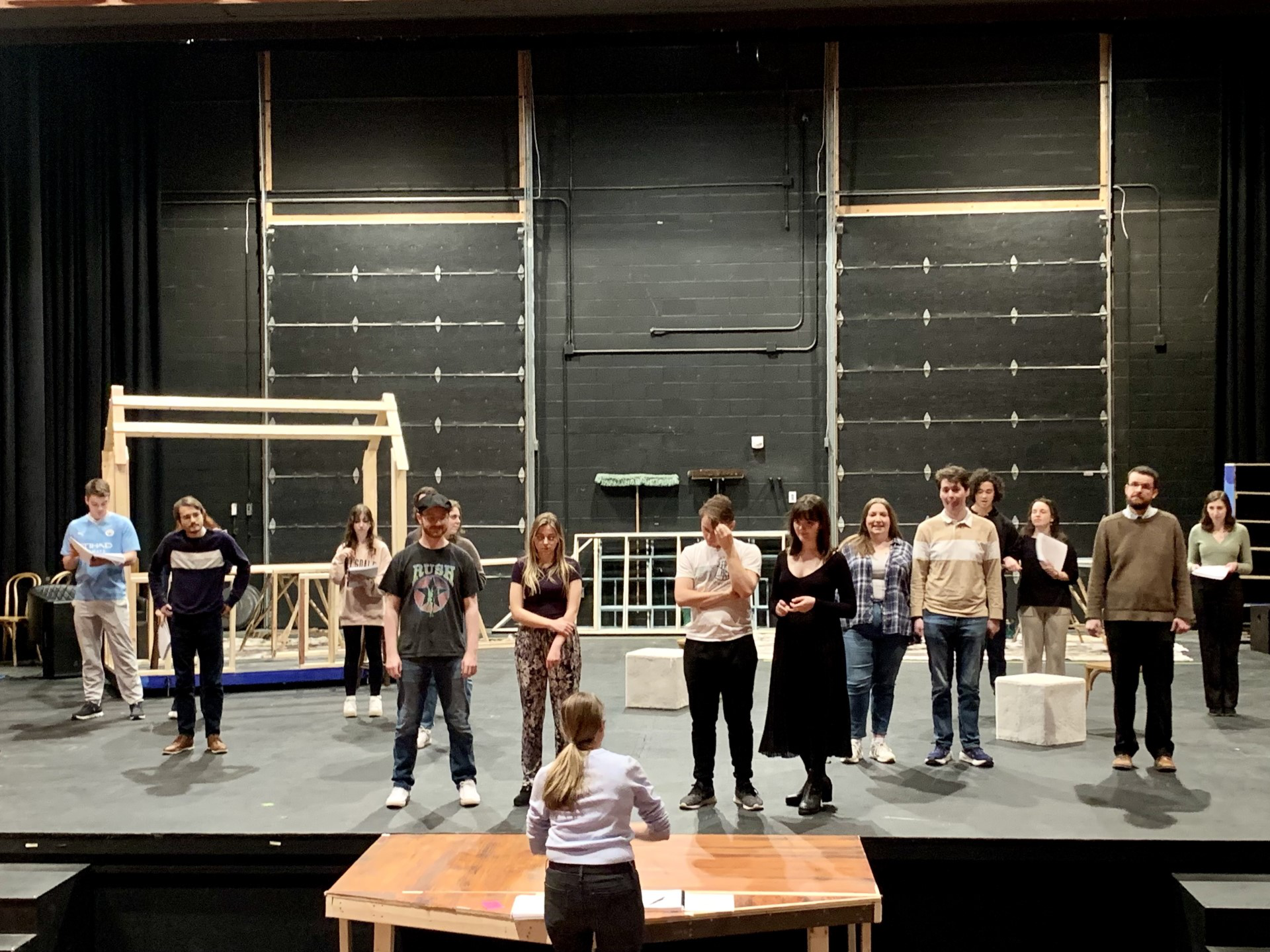
The three one-act plays will be workshopped by student actors and performed back-to-back as staged readings April 26 at 2 p.m.
Matsos said a panel of judges will review the plays and announce the winner, who will receive a prize of $1,000.
“I maintain that Hillsdale students are the best read students anywhere,” Matsos said. “It seemed like a natural thing that maybe Hillsdale students are great playwrights, so we decided to launch this competition and feature it at the end of the year.”
Bryant said she has spent most of her theater experience behind the scenes as either a dramaturg or stage manager.
Bryant’s play, “Pebble Cove, Maine,” reflects on the theme of change. The play takes place in Maine and centers around a character named Frederick.
“Frederick is trying to get over the death of his late father, who was an artist, and to learn how to cope with the changes in his life that his new stepfather is putting out,” Bryant said. “They are planning to move to Boston, so his stepfather can be a curator at an art museum, and Frederick struggles with trying to leave Maine.”
According to Bryant, the play’s setting in the Maine landscape represents the timeless theme of change.
“There’s a lot of imagery of these certain fictional cliffs that the main character identifies with a lot,” Bryant said. “He talks about how little they’ve changed, even if life around him has changed.”
Bryant said she experimented with having multiple settings onstage at once, which she said she felt she could do after learning the basics of playwriting in Matsos’ classes.
“There’s a kitchen, a bedroom, the beach, and the cliffs, which are all on stage simultaneously,” Bryant said. “The characters are all in different areas of the stage, even if they’re not talking.”
Forrester, who has been a stage manager and was recently the assistant director of “A Midsummer Night’s Dream,” wrote her play, titled “Dear Foreigner,” about two sets of friends on a day trip.
Cultural differences, comedic timing, and bad puns between the two groups create a light-hearted and eye-opening story of the Asian versus American experience, according to Forrester.
“It’s honestly just a small little story about my two backgrounds coming together, and I love it dearly,” Forrester said.
Forrester said her favorite part about writing the play was showing it to her family after completing the first draft and getting their feedback on it.
“They received it very well, and my dad especially, who is also a playwright, said the jokes and dialogue reminded him of his own writing,” Forrester said. “Like father, like daughter, I suppose.”
Forrester said she struggled with thinking it had to become the next great American play.
“I spent way too much time thinking I had to write a colonial or patriotic masterpiece,” Forrester said. “But after office hours with Dr. Matsos and discussion with fellow playwrights, I realized the main goal was to create a truthful piece.”
Matsos’ guidance in class went a long way in honing her skills and inspiring her passion for playwriting, she said.
“I hope to keep doing this for a very long time,” Forrester said.
Griffith’s play, “I’m Not A Mourning Person,” is about a girl named Penny who learns about death and comes to terms with it throughout her life.
Although she had other ideas for what to write her play on, Griffith said she chose the topic of the truth of death because it was the most personal to her.
“The idea of the truth about life and death was what spiraled into my play,” Griffith said. “I was able to write about it authentically and enjoy it, and it was almost therapeutic in a way.”
Matsos said although all of the playwriting entries were impressive, the committee was especially drawn to the messages of the finalist works.
“It was a really stiff competition,” Matsos said. “All of the entries were great. And in the end, I think the committee selected the finalists on what we hope the ethos of this competition will be in the years to come.”
