
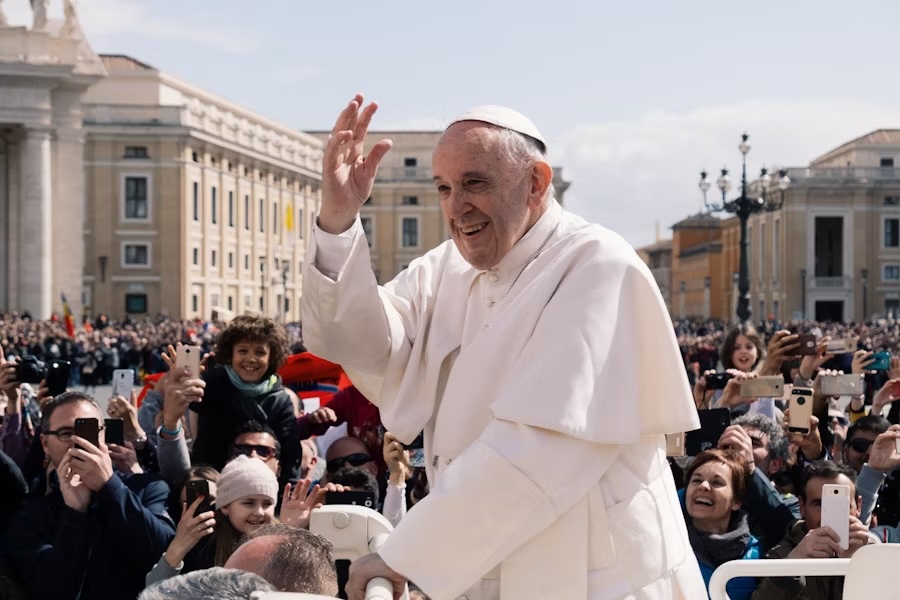
Following the death of Pope Francis on April 21, students and professors reflected on the legacy of his 12-year papacy as the Roman Catholic Church awaits the election of his successor.
“I especially appreciate his warnings against reducing human beings to functionaries within a profit-driven economy, his appreciation for the natural world as a theophany of divine wisdom, and his desire to bring to Christ those on the margins, most vividly practiced in his custom of washing prisoners’ feet every year on Holy Thursday,” said Jordan Wales, associate professor of theology. “This, for me, will be the image by which I remember him, as I return also to his writings to rediscover the unique lights they shed on the faith.”
David Whalen, associate vice president for curriculum and professor of English, said Francis’ heart for the marginalized is memorable, but he said it’s too close to Francis’ papacy to make many judgments.
“It takes time for a legacy to develop, so it probably is too soon to say much,” Whalen said. “However, he may well be remembered for his desire to champion the afflicted, to govern closely, and to promote certain critical ambiguities.”
One of 29 people confirmed in the Roman Catholic Church at St. Anthony of Padua Catholic Church this Easter, sophomore Bradley Haley said Francis’ death is an immediate reminder of Christ’s fidelity to Christians.
“On Saturday night, we all pledged to accept the beliefs and teachings of the Roman Catholic Church, and one of those important beliefs is that the church is the bride of Christ,” Haley said. “With the pope’s death less than 48 hours after the vigil and an upcoming conclave, I think this is a good opportunity for us all to keep in mind that ultimately Christ is in control and will protect and guide his church.”
Professor of Politics Ronald Pestritto said Francis’ papacy is an example of the decline in orthodoxy since the 1960s.
“Pope Francis represented one of the last gasps of that older generation of progressives who have urged compromise with some of the most destructive elements of our culture — and because he has stacked church leadership with the last remnants of this older generation, it is not unlikely that the old force will retain its position for a time yet,” Pestritto said. “Meanwhile, it is our duty to pray for the repose of the soul of the Holy Father — being pope is a job that I would not wish on anyone — and also our duty to pray for the guidance of the Holy Spirit in the selection of his successor.”
Sophomore Luke Hill, the incoming head of Catholic Society men’s outreach, said people will remember Francis’ humble papacy and his desire to remove any barriers between him and other people.
“I think what will be most emphasized was his radical humility,” Hill said. “Not only did he preach that humility was ‘at the base of Christian life,’ he actively lived that reality: Choosing the papal name Francis after St. Francis of Assisi, living in the Domus Sanctae Marthae (a Vatican guesthouse), wearing simpler liturgical vestments, driving a humble Ford Focus, and opting to greet crowds outside of the ‘Popemobile.’ On that last point, the pope said, ‘I cannot greet people and tell them that I love them from inside a sardine can, even if it is crystal.’ That line reflects the heart of love and charity he had for all the people of the world.”
Senior Paul Sri, current head of men’s outreach, said Francis had a beautiful perspective on encountering others.
“One particular quote from his apostolic exhortation ‘Evangelii Gaudium’ has stuck with me, where he calls the art of accompaniment ‘to remove our sandals before the sacred ground of the other,’” Sri said. “I hope the spirit of Christian accompaniment continues to grow in the church in Pope Francis’ wake.”
Sophomore Lizzie Putlock, incoming vice president of Catholic Society, said Francis’ emphasis on living with Christian charity has contributed to her life.
“He truly had eyes for and attention to the poor, calling us on to see Christ in each person we meet,” Putlock said. “I remember in middle school he instituted a Year of Mercy, and my school decided to do a ‘kindness challenge’ in response to it, the fruit of which I still see in my life today.”
After a 15-day mourning period, 135 cardinal electors will gather in the Vatican to vote on the next pontiff. They will vote in secret until one cardinal receives a two-thirds majority vote. When a pope is elected, white smoke rising from the Sistine Chapel will signal the cardinals’ decision.
Professor of Theology Mickey Mattox said Catholics should consider the blessings of Francis’ papacy while praying for his successor, remembering that Christ is guiding the church.
“We should remind ourselves the Lord holds his Church securely in his own hands,” Mattox said. “So, thank God for Pope Francis. And pray that God’s purposes for the church may be done in the ministry of the next Roman pontiff.”
