
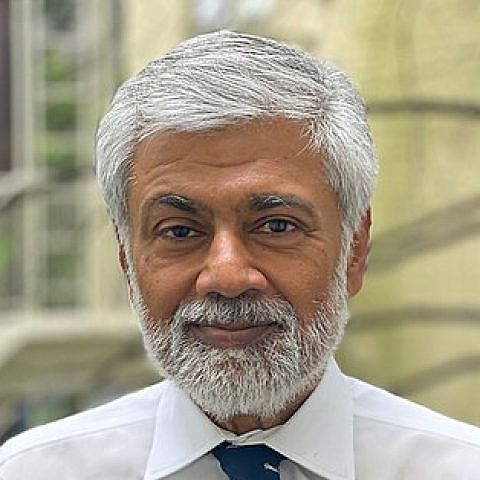
Tunku Varadarajan is a Wall Street Journal contributor who is this semester’s Eugene C. Pulliam Distinguished Visiting Fellow in Journalism. He taught a one-credit course called “The Art of the Review.” Courtesy | JNS
American Christians must defend Indian Christians, who face persecution from their government, said journalist Tunku Varadarajan in a lecture April 1 in Plaster Auditorium.
“It is my fervent hope that Indian Americans who are successful, persuasive, eloquent, self-confident citizens of a powerful, persuasive, assertive nation will form a cohort of political and cultural advocates who keep India the land of their ancestry,” said Varadarajan, a Wall Street Journal contributor who is this semester’s Eugene C. Pulliam Distinguished Visiting Fellow in Journalism.
India needs Western values, he said in his lecture titled “Is India Lost to the West?”
“These values are at the core: religious tolerance, including the right of every citizen to decide which religion he’d like to belong to, and including the right also to change his own religion if he wants to; the rule of law; and democracy,” said Varadarajan, who also taught a one-credit journalism course on “The Art of the Review.”
According to Varadarajan, 80% of Indians are Hindu, 14% are Muslim, 2.3% Christian, 1.7% Sikh, and the remainder includes Jews and other religions.
Varadarajan focused on India’s Christian population of 24 million people.
“I want to focus on the plight of India’s Christians, a majority of whom are converts to Christianity from India’s lower castes or the descendants of such converts. The same, incidentally, is true of the plurality of Indian Muslims,” Varadarajan said. “Why wouldn’t you convert to a creed that offers you dignity and that says that all are equal in the eyes of God, and yet of these Christians, 74% of all Christians in India, continue to be stigmatized by others as low caste.”
Varadarajan said although there is a stigma surrounding Indian Christians, the current prime minister, Narendra Modi, and his Bharatiya Janata Party have promoted persecution of Christian organizations.
“Modi and his party, the BJP, have governed India in ways that are unabashedly Hindu,” Varadarajan said. “This has been terrible for the country’s religious minorities, particularly Muslims and Christians, and for the millions of Indians who don’t wish to be told what they should eat, wear, read and watch by a religiously driven government.”
According to Varadarajan, India is losing its connection to the West as the government oppresses religious minorities and undermines religious tolerance, endangering Western values.
More recently, the Indian government has outlawed attempted Christian conversions. Varadarajan said the legislation has shut down more than two dozen religious groups. He pointed to the example of Compassion International, a Christian charity that Modi’s government shut down in 2017.
Through such action, Varadarajan said the Western values of India are being reshaped by the government’s suppression of religious minorities and must be stopped before being lost to the West entirely.
“Their refashioning of India’s political and civic norms, Modi and the BJP government are not reviving any traditional code of governance — modern India’s political values since the very first minute of its independence have essentially been western values,” Varadarajan said. “If these are stripped away, India will be lost in uncharted territory, lost not only to the West, but also to itself.”
Paul Krepps from Mason, Michigan said he visited Hillsdale to hear Varadarajan’s lecture and said the focus on religious persecution was informative.
“I really appreciated his description of the religious intolerance that’s happening in India since Prime Minister Modi came to power and the influence of the political party that he’s associated with,” Krepps said. “Compassion International, which we’re all familiar with, was kicked out of the country. All of those personal connections that Christians here and other parts of the world had with Christians in India were broken through that broken relationship.”
Junior Malia Thibado said the talk was different from what she had originally expected.
“I knew very abstractly about the persecution of Christians. I was surprised that he focused on that,” Thibado said. “I did believe it was going to be more of a cultural and geopolitical overview, but I do like that he tailored it to what he perceived his audience would prefer.”
