
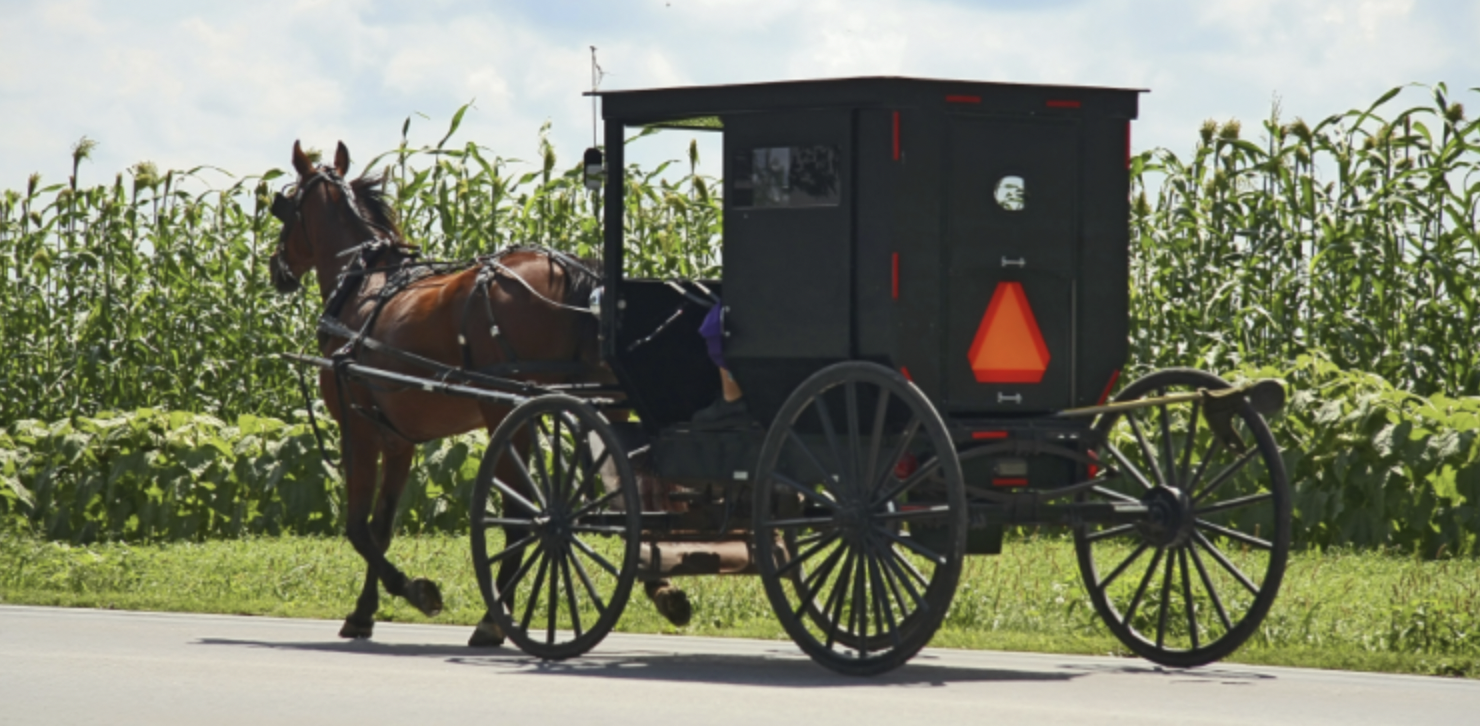
Amish communities in Michigan use buggies instead of vehicles for religious reasons. Courtesy | Wikimedia
Two Amish residents of Michigan died from cars colliding with their horse-drawn buggies in the past month — and now local officials are spending federal funds in an effort to improve buggy safety.
The Branch-Hillsdale-St. Joseph Community Health Agency is using a $70,000 federal highway safety grant to improve buggy safety by increasing law enforcement and implementing reduced speed zones in Amish school areas. The three counties are home to 30% of Michigan’s Amish population.
From 2016 to 2023, 261 similar crashes have occurred, causing 18 fatalities, according to the Michigan State Police. Branch, Hillsdale, and St. Joseph counties saw 78 crashes and four deaths in these years, which accounted for 30% of Michigan’s vehicle-buggy accidents and 22% of buggy accident deaths.
Michigan State Sen. Jonathan Lindsey, R-Coldwater, said legislation for buggy transportation is challenging, as the majority of the Amish population is concentrated in small areas of the state.
“Handing the topic of the safety with buggies and Amish transportation in our communities is something that is a tricky balance between state and local government,” Lindsey said.
Professor of Philosophy and Culture Peter Blum, who studies the sociology of the Amish community, said restricted technology is one of their community principles.
“The principle has to do with the idea of being a visible witness, of doing things differently and living in a different way,” Blum said. “They see that way as anchored in their understanding of what it’s like to be Christians.”
Martha and Emmanuel Yoder live in St. Joseph County and are members of the Centreville Amish Community, which contains 16 church districts and 2,000 people, making it Michigan’s oldest and largest Amish settlement. The Yoders said driving a buggy helps them maintain a quieter lifestyle.
“It’s just to keep a slower pace of life,” Martha Yoder said.
Emmanuel Yoder said driving vehicles would incline them to misuse their freedom to travel.
“Once we had vehicles, we’d probably use them for other purposes than we should,” Emmanuel Yoder said.
The government, Lindsey said, must be careful to preserve the religious rights of the Amish while ensuring safe transportation.
“Government should be there ultimately to protect the rights of the citizens it’s serving,” Lindsey said. “Where that becomes challenging is when you have what could be perceived as competing rights. The Amish certainly have a right to religious liberty, and on the other hand, protecting people’s property or their physical safety is part of the reason why it can be appropriate for the government to get involved in things like traffic laws in the first place.”
The Yoders said they feel safe riding in their buggy and try to accommodate other vehicles on the road.
“Everybody is very respectful, but I feel we need to be respectful too,” Martha Yoder said. “If there’s room to get off the road, that’s what I feel we need to do if there’s a highway.”
Emmanuel Yoder said he drives on the shoulder of the road whenever he can.
“I always try to get off on the shoulder if it’s at all possible,” Yoder said. “Because it’s our responsibility to cooperate.”
Blum said the Amish do not use technology such as motor vehicles or electricity because they are concerned with how it will alter their communal lifestyle.
“A lot of people assume that the Amish think of modern technology as evil and that they want to avoid it,” Blum said. “It may be that some Amish talk that way, but the principle is more that they want to preserve a certain kind of community. What they’re interested in is controlling the influence of modern technology so that it does not have a negative impact on their community.”
The Amish view advanced technology as a threat to their tightly-knit communities and slower pace of life, according to Blum.
“They’re afraid that the more that modern technology becomes a part of what they’re doing, the more it has its own kind of logic that could run away with what they want to preserve about a community,” Blum said. “They want things to be locally controlled. They want a church community that is small enough that everybody knows everybody else, and they want a pace of life that is not fast and not oriented primarily toward efficiency.”
Martha Yoder said she doesn’t mind traveling small distances in the buggy and hiring drivers to bring her on longer trips to visit her family in Indiana.
“I actually enjoy it,” she said. “I wouldn’t want it any other way.”
Branch County Road Commission Chairman Bob Mayer said legislation to regulate buggies is necessary for safety.
“In Branch County, we’ve talked to the bishops,” Mayer said. “We’ve met with them and until it’s mandated by the state it’s not going to change.”
The Yoders said practices for buggy lighting vary between communities.
“We aren’t all the same. Some are quite more conservative than we are,” Martha Yoder said.
Amish communities even differ in neighboring counties, according to Emmanuel Yoder.
“There’s communities in Branch County and further over in the Kinderhook and Reading that don’t have lights on their buggies,” Emmanuel Yoder said. “But I feel that is for our safety as well as the safety for vehicles, because if you don’t have lighting — very dangerous.”
Mayer said reflectors do not make buggies visible enough to other drivers.
“I have had instances where I have been driving down a road and all of a sudden you see a light flashing back at you, and they’re waving a flashlight to let you know they’re there,” Mayer said. “That’s not safe. If it’s mandated for a car not to have a broken taillight, it should be mandated for a buggy to have lighting.”
Martha Yoder agreed it is not advisable to drive a buggy without lights.
“We have blinkers plus lights,” Yoder said. “Most buggies in this area are very well lit.”
Lindsey said the government must be cautious in enforcing regulations.
“For the most part, I think the bigger danger here is the state of Michigan potentially stepping in and trying to take liberties away from a particular community,” Lindsey said. “That’s always the danger with government. Everything starts with a good idea, but implementation of laws usually involves the tradeoff that the government’s going to control one more aspect of people’s lives.”
The Yoders said they are content with the safety of buggy transportation.
“I feel they consider our ways and I’m happy how it is for us,” Martha Yoder said.
According to Emmanuel Yoder, current regulations for buggies have been effective in most situations.
“I feel if we have lighting and respect the traffic, the traffic 99% of the time will respect us,” Emmanuel Yoder said.
The Yoders said they realize that accidents are bound to happen, no matter what precautions they take.
“There will always be somebody that might be having a bad day,” Emmanuel Yoder laughed. “We’re all human.”
Send tips to the City News team: collegiancitynews@gmail.com
