

Todd Ritchey, owner of White’s Welding, said tariffs will level the global playing. Charles Hickey | Collegian
Some business owners call it “healing pain” as others fear the threat of more levies
The costs of supplies — from tomatoes to steel — are rising for Hillsdale businesses as President Donald Trump levied heavy import fees on goods from China, Canada, Mexico, and other countries last week.
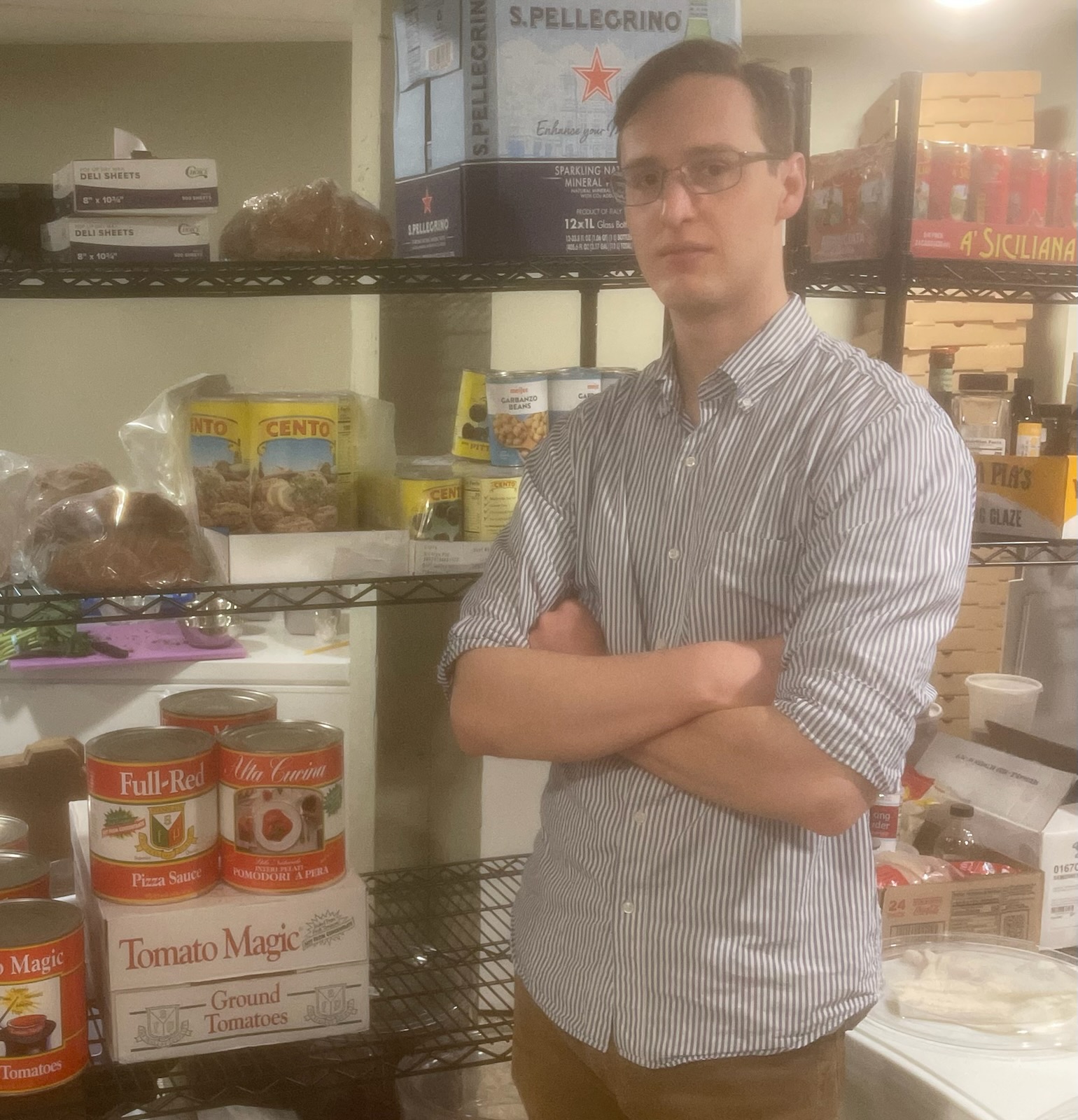
Joshua Mincio, owner of St. Joe’s Café, said he intentionally sources American produce for his restaurant, choosing tomatoes from California instead of Mexico. But Trump’s 25% tariff on Mexican goods will raise his costs anyway, since the cost of Californian tomatoes will go up.
“Because of these tariffs, those Mexican tomatoes a lot of folks buy are now more expensive than tomatoes grown in America,” Mincio said. “So the demand for the California tomatoes we use is going to be extremely high.”
Mincio agreed with Trump’s policy that more goods should be grown and made in America, but he also said Trump’s rapid tariff announcements and reversals have created an atmosphere of uncertainty.
“As it stands, I don’t think people were ready for such a sudden change in the economy, with this little warning,” Mincio said. “The general feeling is one of uncomfortable uncertainty.”
Abe and Ben Graves, co-owners of Jonesville Lumber, said they have been receiving vastly different quotes for materials from suppliers, due to Trump’s flip-flopping on tariff policy.
“Nothing is set in stone right now,” Abe Graves said. “The tariffs are on, they’re off, they’re on, they’re off, which creates a bit of instability in the market right now. What’s real and what’s not?”
But some business-owners say they are confident Trump can use the tariffs to create a fairer global trading environment for the United States.
“I think that there is a plan behind all this,” Abe Graves said. “Trump says a lot of stuff but you have to read between the lines on what he’s actually doing. Sure, he’s throwing out big tariffs, but at the end of the day, he just wants them to come to the table and talk so they can negotiate this out and actually get realistic rights, so that it’s good for both countries. My brother and I are definitely willing to give him a shot at figuring this out.”
Todd Ritchey, owner of White’s Welding, said the tariffs — while painful — are necessary to level the global playing field and encourage fair competition. He called them a temporary “healing pain.”
“People should look at why the tariffs are in place, and not panic over the price increases,” Ritchey said.
He acknowledged the impact of Trump’s steep aluminum and steel tariffs on his business, but said he trusts Trump to bring about a satisfactory conclusion for the nation.
“When there’s a plan in place, and there’s a goal to achieve, it’s hard not to be behind it,” he said.
Since taking office in January, Trump enacted substantial import tariffs of 20-25%, targeting China, Canada, and Mexico. These countries have invariably retaliated with reciprocal tariffs on American products, sparking a growing trade war. On March 12, Trump implemented a 25% tariff on all steel and aluminum entering the U.S., which the European Union responded to with steep tariffs on American exports like bourbon and beef.
Trump’s tariffs affect a broad swath of products, as American-made products are often assembled with global components. Andrew Gelzer, manager of Gelzer’s Hardware, estimated that “70% of our inventory mix will be affected to some degree, with costs rising 7% on the lower end, with some products as much as 40%.”
“The tariffs are painful,” Gelzer said. “While I’m completely in favor of strengthening the economy and making it work for us, the reality is that consumers and small businesses will be hurt by most of Trump’s tariffs.”
On March 13, Trump proposed a 200% tariff on European spirits and wine. Mincio said this “absurd number” would effectively put a complete halt to all such imports.
“No customer is going to pay three times the regular price for a bottle of wine,” Mincio said.. “We wouldn’t be able to sell any Italian or French wine.”
Ben Graves said Jonesville Lumber is trying to soften the blow of the tariffs, using material already in stock to average new costs down for customers and contractors.
“We’re doing our best to make sure we are all set to weather the storm,” Graves said. “Keeping the best price possible in front of your customers is all you can do.”
Gelzer said Gelzer’s Hardware will pursue the same course of action.
“We’re going to control our prices and absorb some of this, just to protect our community, to a degree,“ Gelzer said. “But if uncertainty continues, eventually we will have to raise those prices.”
Send tips to the City News team: collegiancitynews@gmail.com
