
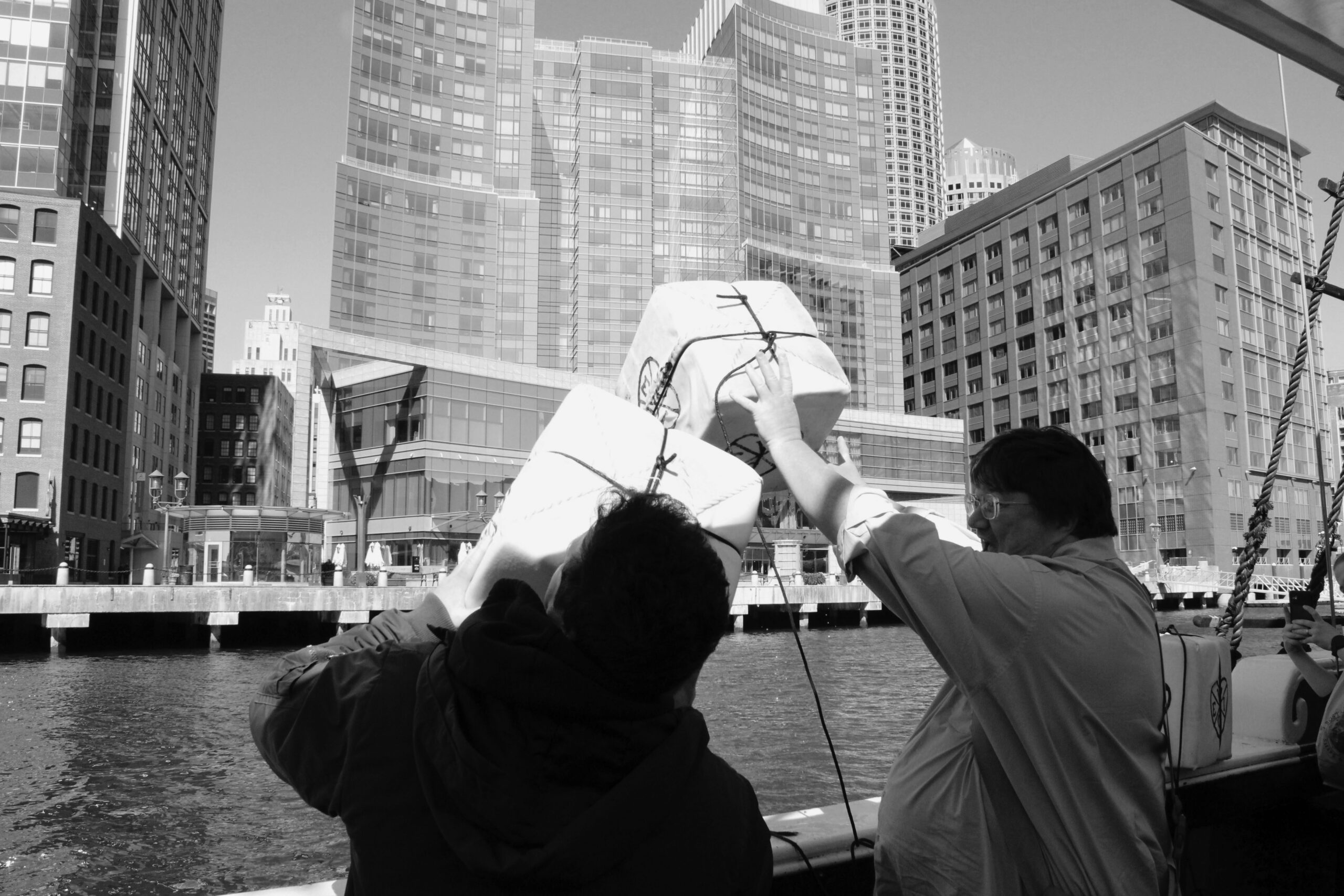
Students reenacted throwing tea into the Boston Harbor with Professor of History David Stewart and Assistant Professor of Medieval History Charles Yost during a spring break tour of historical locations in Connecticut, Massachusetts, and New York associated with the early years of the American Revolution.
The group visited the sites of the Boston Massacre, the Boston Tea Party, the Old North Church, Lexington and Concord, Bunker Hill, and the Saratoga Battlefield on the week-long trip sponsored by the Center for Military History and Strategy.
“Visiting historical sites makes stronger memories and provides clearer understanding than simply reading,” Stewart said. “A professor or book can relate facts, but standing in the Tea Party ship gives an impression of size you can’t get in a classroom. Visiting Concord’s bloody angle makes visceral the anguish of the retreating soldiers. Looking out from Bunker Hill makes plain its critical role in controlling Boston.”
Sophomore Ava Jolley said she liked being able to visualize historical events throughout the trip.
“The Saratoga Battlefield was probably where I learned the most,” Jolley said. “We got to walk all over the battlefield and read the signs and plaques.”
At the site of the Boston Tea Party, students witnessed actors do a historical reenactment of the Boston Tea Party in period costumes.
“They reenacted an assembly at a meeting house where they reviewed the history of British oppression lately visited on the colony,” Yost said.
As part of the historical reenactment, the students took turns throwing parcels of tea off a boat in the Boston Harbor.
Sophomore Grace Canlas said the “tea” was plastic crates shaped like boxes of tea with the East India Tea Company stamp on them. They were attached to a rope that enabled the ship to reel the boxes back in.
“It was just a great opportunity to celebrate being an American, and it satisfied something deep in my soul that I didn’t know was needed,” Canlas said. “I was like, ‘Oh my word, every American should have the opportunity to throw tea into the Boston Harbor.’”
Jolley said the Boston Tea Party Museum was one of the highlights of her trip.
“The museum was awesome,” Jolley said. “Because how many times do you get to throw a crate of tea into the Boston harbor? Not many.”
Canlas said she loved touring the U.S.S. Constitution, where a sailor took the group down to a restricted area in the lower deck.
“He showed us one of the original life oak beams of the U.S.S. Constitution, and the original copper sheets of it from 1797,” Canlas said.
Jolley said the trip helped her gain a better understanding of and appreciation for American history.
“Pretty much everything on the trip was new to me,” Jolley said. “The school I grew up in didn’t have a big emphasis on history, so American Heritage was my first American history class. I find the spring break trips helpful to learn because it’s difficult for me to visualize the documents I read, but visiting the places where it happened makes it all clearer.”
Canlas said she enjoyed learning from both Stewart and Yost and seeing New England for the first time.
“I’ve never laughed so much in a single week in my life than on this trip,” Canlas said. “They both brought a great perspective on it, because while it is an American Revolution trip, we’re looking at the American heritage that is also situated in the Western heritage at large. And so Dr. Yost was still able to contribute to the discussions on the Western heritage and on American heritage, which was really neat.”
Yost said he learned a lot from Stewart on the trip.
“He’s an expert, and he arranged readings from primary sources for us,” Yost said. “We had him there on site to give his perspectives and to answer questions. His knowledge is encyclopedic.”
Canlas said she enjoyed learning about the broader context of the American Revolution and what was happening globally and historically that led up to the present.
“To hear both of them discussing these topics with each other was really a privilege to hear, because they don’t get a lot of those opportunities to hear two professors necessarily discuss these topics with each other and deliberate about, ‘What is the Western heritage? What is the American heritage?’” Canlas said. “That was really special.”
Stewart said his favorite part of the trip was seeing students grow in their interest in history.
“Above all, I enjoyed witnessing the students’ excitement as they retraced the Founders’ footsteps and internalized the sacrifices, struggles, and triumphs which shaped our country,” Stewart said.
