
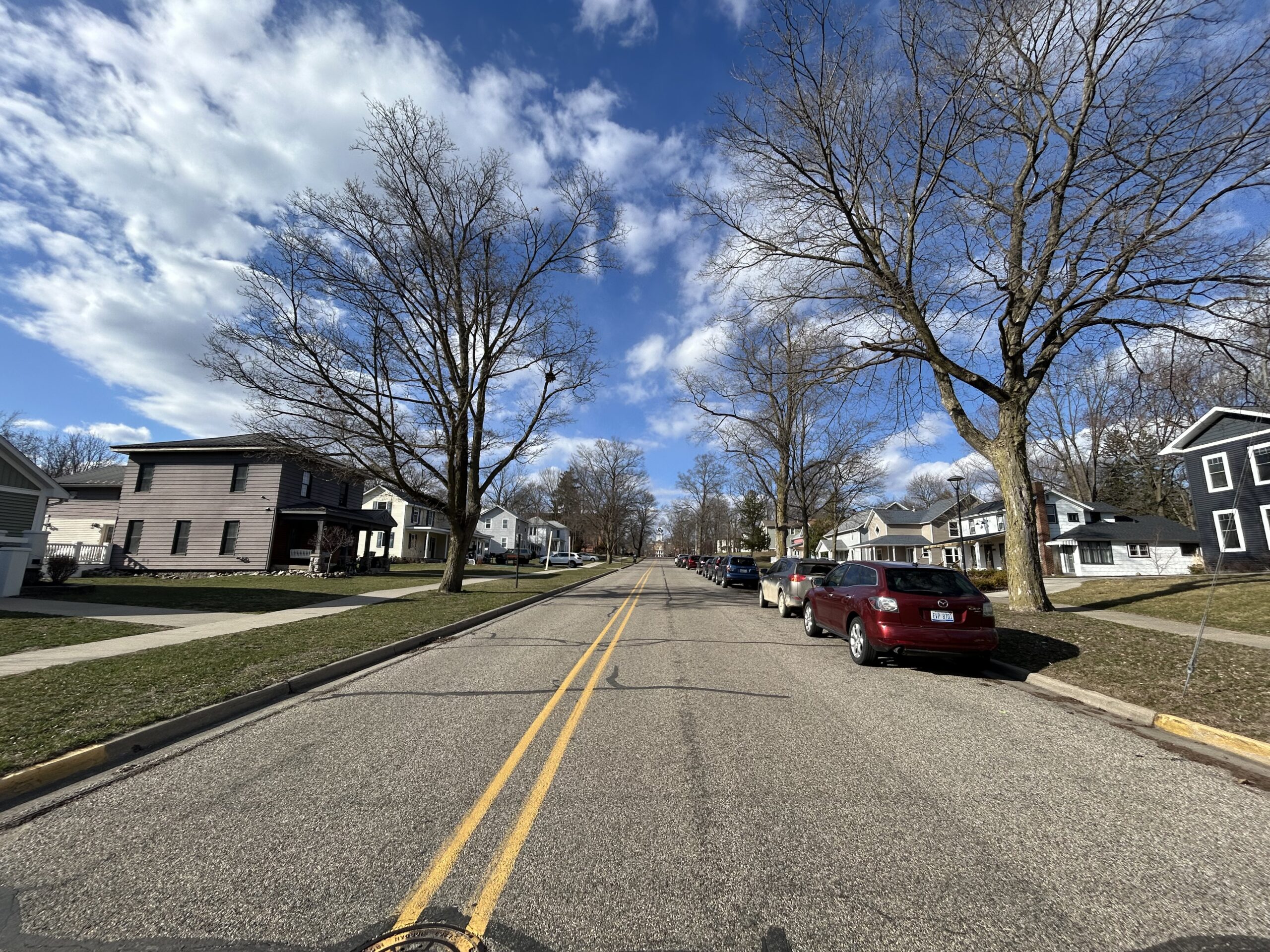
Off-campus houses on Manning Streeet. Caroline Kurt | Collegian
All four of sophomore Thomas Potter’s older siblings received permission to live off campus for their junior years. Though Potter applied for permission, too, he said he already has a roommate picked out for his third year in Simpson Residence.
“I was originally going to live in Donnybrook,” Potter said. “Then I was told to live in Park Place. And now I’m screwed.”
The college has stated it plans to demolish Donnybrook within the next few years and is considering doing the same for Park Place. Both on-campus houses have traditionally been places for sophomore and junior men to live.
“Last semester, almost the whole semester, I was very content to live in Donnybrook,” Potter said. “I had a good group of friends who I wanted to stay in Donnybrook with.”
Only when Simpson resident assistant applications were closing did Potter hear the news about Donnybrook. Potter said that Dean of Men Aaron Petersen directed him to Park Place.
“He gave me all the statistics for how to get the highest chance of getting in,” Potter said. “Then a week before the housing application opens, we hear that Park Place is getting torn down.”
Potter said he is resigned, but not excited, to spend his junior year in Simpson.
“Living in a dorm is not a natural state of living,” Potter said. “It feels like a very liminal state to me. I want to have a house, a place that is mine, with a nice porch, neighbors.”
In a year in which fewer sophomores have received permission to live off campus during their junior years, surprise and disappointment characterize the reactions of students who have and have not received permission.
Dean of Women Rebekah Bollen said after granting off-campus permission to all students with a high school graduation date of May 2022 or earlier, the deans started working through the list of students with a 2023 graduation date.
“The 10 women with the highest Hillsdale credits in that group have received permission,” Bollen said. “We had a very high acceptance rate this year, which impacted our ability to go further down on the request list.”
One factor in the high acceptance rate — the rate of students with a 2022 graduation date who accepted off-campus permission — is a higher-than-usual turnover of resident assistants, meaning more seniors (or those with 2022 high school graduation dates) are moving off campus than in recent years.
Junior and Waterman residence assistant Cecilia Jansen said this year, of the 54 women RAs, only 14 of them plan to return as RAs in the coming school year.
“We had the opposite problem last year,” Jansen said. “There’s a lot of different friend groups that are moving off campus, so a lot of girls who were RAs together on the same teams are wanting to move into the same houses together.”
According to Dean of Men Aaron Petersen, nine rising junior men have received off-campus permission so far.
For the rising juniors that did receive permission, many look forward to spending more time with senior friends.
Sophomore Evelyn Freedman said she and her friends were initially optimistic they would get off-campus permission.
“It seemed pretty plausible,” Freedman said. “I knew a lot of sophomores who were planning on a whole group of them moving off campus. The expectations were pretty high.”
Freedman received off-campus permission over spring break, after waiting through two previous rounds. In light of this, she said she decided to move off campus with senior friends.
According to Freedman, off-campus culture could stand to grow in the years to come.
“Having real homes to go to and enjoy a meal,” Freedman said, “is really good and makes for more intimate community.”
Sophomore Lucia Bachiochi, who has not yet received permission, said she was interested in living off campus to form stronger relationships with the senior class.
“It seemed like an awesome opportunity to live with a bunch of rising senior women who I don’t necessarily get to spend a lot of time with otherwise,” Bachiochi said. “When only seniors get off campus, it places a distance between the seniors and the juniors.”
Bachiochi said sophomores who receive permission in much later rounds — sometimes as late as April or May — can struggle to accept permission, even if they initially wanted it.
“No one wants to wait that long to figure out if they’re gonna get off campus,” Bachiochi said. “They have to make other plans, and even if they get off campus, then they ditch the people they’ve made the plans with.”
Sophomore Ava Jolley had a week to decide whether to accept her off-campus permission, which she got in the second round.
“Going into the first round, I didn’t think I was going to get it,” Jolley said. “I don’t have a lot of credits.”
Jolley said she weighed the pros and cons of moving off campus without her fellow sophomores.
“None of my friends have off-campus permission,” Jolley said. “I don’t really know anyone who is of my year.”
Ultimately, Jolley turned down her offer and chose to remain on campus for her junior year.
“I decided to deny off-campus permission for a few reasons, but mostly because I haven’t really experienced dorm culture outside of Mac since I’ve lived there for two years,” Jolley said. “I want to give somewhere else a try before going off campus.”
Unlike Jolley, sophomore Viola Townsend accepted off-campus permission. Townsend said she didn’t consider applying until a friend offered her a spot in the off-campus house called The Nest, where she would be the only junior.
“I think it’s healthy to do off campus sooner rather than later, though I do understand the college wants to fill beds,” Townsend said.
For his part, Potter said he anticipates dorm culture suffering as a result of fewer juniors moving off campus.
“If there are people who are reluctantly living inside of dorms that are only there because they couldn’t get off campus, the quality of dorm culture I think will go down, because people aren’t staying there by will, they don’t want to invest in the dorm culture,” Potter said.
According to Potter, he has seen the ways off-campus living has helped his older siblings surround themselves with the right friendships and develop an intentional, responsible culture.
“I’m going to be a junior in college, meaning that I’ve already gone through all the annoyingness of figuring out who I want to be my friends,” Potter said. “If you live in a house and you have housemates, you still get to see everyone around campus. But the majority of the time they’re investing in friendships is into relationships you actually want to invest in.”
Townsend said she looks forward to living off campus, where she said she anticipates a lot of growth.
“I think it’ll change the way I think about Hillsdale,” Townsend said. “It’ll make me more human in the best possible way.”
