
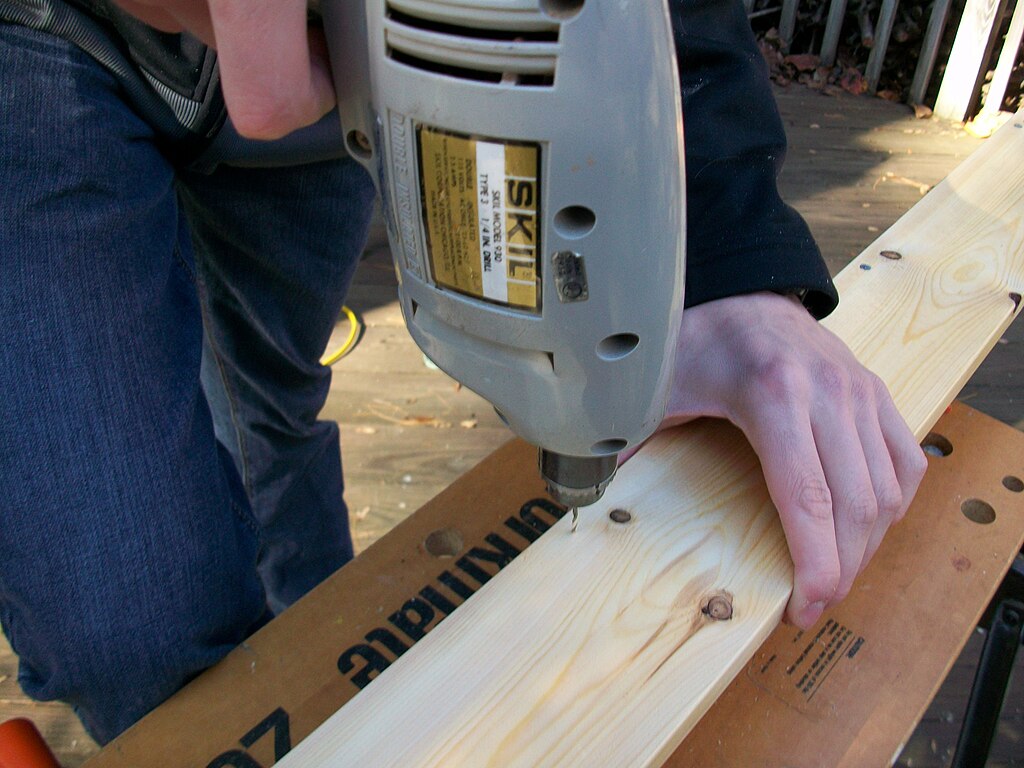
The smell of Douglas fir as 2x4s are sawed in half. A metallic aroma from nails baking in the sun. The whining whirr of an old electric drill.
These were defining parts of my childhood as I helped my dad build a treehouse and a doll house, as I watched him repair old trucks on Sunday afternoons, as we took countless trips to Home Depot. Yet these sounds and sensations are a fading part of the American memory.
My dad learned his skills through shop class — today known as Career Technical Education — an elective choice that’s increasingly less available in U.S. public schools. The National Center for Education Statistics reports that CTE enrollment declined by 27% from 1982 to 2013, while academic credits rose by 36%. The mass decision to eliminate classes like woodworking, metalworking and auto shop poses a threat not just to blue-collar America, but to American culture as a whole.
Part of this national dilemma is purely practical. The rise of big business promised lifelong stability, a salary, and benefits for the entire family. Suburbs and the tech revolution meant more desk jobs. Schools in these new communities responded accordingly, promising college-prep education, further ingrained in the system by titans like the College Board and the Department of Education. In our space race of a tech battle against China, corporations like Google partnered with American public schools to teach coding through Minecraft and promote the ever-virtuous Woman in STEM.
At Folsom High School, my alma mater, we were practically bred to be computer engineers like the hundreds of parents who worked across the street from campus at Intel, the company that designs the CPU of the laptop I wrote this article on.
The dream died at the end of our teen years, as Intel announced a series of layoffs. Just this past fall, the company announced 272 layoffs at the Folsom campus. Last month, another 58.
The corporation said they were laying off my classmates’ parents to “cut costs,” but has since been at the heart of the recent H-1B visa debacle, addressed by Vice President J.D. Vance. Intel, alongside other big tech companies, has been accused of firing American workers and “replacing” them with foreign workers willing to work for half the pay, often with fewer credentials or experience. The job security preached to us since middle school was a lie.
When I arrived at Hillsdale College in the fall of 2021, it was during the wake of COVID, and only the beginning of my hometown’s troubles. Yet I immediately saw the toll removing shop class had taken on the Midwest. A region formerly known as the car factory capital of the world was now the “Rust Belt.”
I could see how Trump had won Michigan in 2016, with promises of a return to America First manufacturing, and how he won yet again in 2024. Those of us from the coasts were removed for years from the effects of our blue-collar decline. After COVID, with our tech industry in trouble, we are now forced to recognize the necessity of the working class man. There is a reason we are called “coastal elites,” so far flung from the heart of the issue, blinded by a stroke of temporary luck.
Statistics show wood and metalworking classes help increase graduation rates, especially for those who may feel left out by the traditional high school education model. The Michigan Department of Education reported in 2022 that 96% of Career Technical Education students received their diploma, a clear jump from the 81% state graduation rate.
According to the U.S. Bureau of Labor Statistics, 61.4% of the high school graduating class of 2023 were enrolled in college by October. Our public education system fails to account for the one in three who will not go on to higher education.
Technical education classes provide a sense of talent and stability for students who might otherwise feel discouraged by their more academic courses. My dad, who has ADHD, has always felt most comfortable accomplishing a project with his own hands. As someone who works in sales, it still provides an important creative outlet for him, despite not working in an industrial field.
In an increasingly digital age, young people feel this shared call to create something physical, to take a break from a screen. There is something inherently good about returning to the physical. In the first U.S. census of 1790, an astonishing 90% of Americans were farmers. The vast majority of the remaining 10% would have been skilled laborers or shopkeepers. Less than a century ago, human history was defined by the hand and the tool, not the screen and the microchip.
My high school later realized the importance of a well-rounded curriculum. During my senior year, they completed the construction of a new Career Technical Education building, headed by my former teacher Andrew Bias. Under his leadership, the school reestablished multiple wood and metal working classes and received a $50,000 grant from Harbor Freight Tools.
A classical education is not complete without remembering the body. Recent initiatives, like the expansion of campus fitness programs and the creation of the Hillsdale Homestead, are great examples of this. If we wish to preserve the Western tradition, we must also acknowledge the labor it takes to build it.
Carly Moran is a senior studying politics.
