
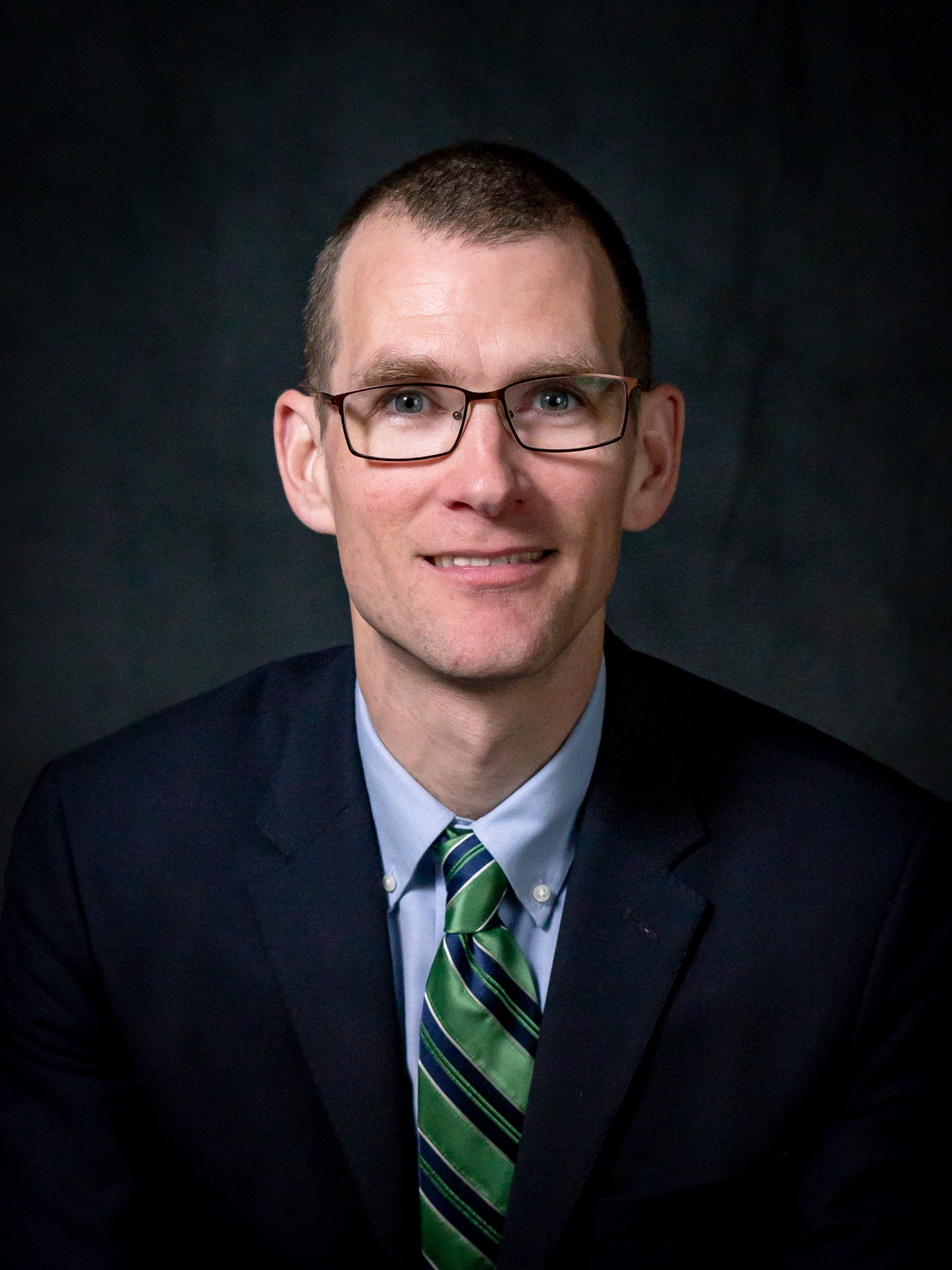
Christopher Martin is an associate professor of economics at Hillsdale College. Courtesy | Hillsdale College
Associate Professor of Economics Christopher Martin proposed an alternative to the modern polarized political environment in his talk entitled “Binary Choice Politics and a Conservative Alternative,” co-sponsored by Praxis and the Classical Liberal Organization of Hillsdale March 6.
“I want to propose to you another way of thinking about politics,” Martin said. “One that might apply most of the time. A reframing way.”
Martin advocated for an exchange of ideas rather than a battle of ideology, a conversation rather than an argument.
Traditionally, Martin said, people subscribe to a tribalistic group-think that automatically puts them in a group with like-minded individuals and pits them against the rest.
Martin posed the example of hoplites of Ancient Greek city-states, who fought on behalf of their respective cities because of their group affiliation to things like citizenship or ideology. Everyone needed to defend each other to defend their identities.
Nowadays, Martin said, this phenomenon encourages people to defend their “team’s” ideas, even if they might dissent if they were not affiliated with this “team.”
“This instinct of group affiliation might have served people well in the far off primeval, but it does not today,” Martin said. “I think we have to keep an eye on this group affiliation aspect of ourselves so that it doesn’t lead us astray.”
Sometimes, Martin said, individuals should focus on their similarities rather than their differences.
Most Americans agree that slaughtering children for political reasons is wrong. There are people, some of them state leaders, who perpetuate it.
“While we’re having our battle,” Martin said, “the orcs are on top of the hill looking down on us. This is melodramatic, but if you really have a lot of animosity, think about what we actually share.”
Martin discussed the Horseshoe Theory, which provides a blueprint for the alternative to the mainstream linear spectrum of political alignment. Shaped like a horseshoe, the graph depicts the spectrum of political thought with the far left and right closer to each other than the respective moderates of their parties.
“The reason I think this is useful is to address this idea of the binary choice,” Martin said. “There does come a moment in your life when you have to make a binary choice. You do have to decide which team you’re going to support, but it’s not just saying, ‘What are the worst things in the opposing coalition?’ Instead, ‘What’s the overall outcome in the short term and long run?’ Oftentimes you feel kinda bad about both choices.”
Throughout America’s history, Martin said when people worked across party lines, they improved the country. Slavery, the Jim Crow Laws, and many others were defeated through — in part — nonpartisan discussion. Additionally, according to Martin, if one works with the opposing team on agreed policies, he is in a better political position even if they win.
Martin prescribed a three-step program to help resist knee-jerk group affiliation: be patient with forming your opinion, stress test your theory, steelman your opponent.
“It doesn’t mean compromising our own principles, it’s an approach to dialogue,” Martin said. “It doesn’t mean that there’s only one path. There’s a range of prudent strategies that you can follow to get to a good destination. We can get into a trap where we think that going the low road is the only way to stop a hypothetical future dictator, but if there’s other paths that we forewent, then that’s kind of on us.”
Sophomore Brian Shia, president of Praxis and CLO, said his favorite part of Martin’s speech was the prescription of a stress test.
“It’s not just about temporary victories,” Shia said. “We have to think about long-term consequences. Will the other team also bend the roles to do worse things than what we are doing? You have to set a good precedent and not bend rules.”
Shia also agreed with Martin’s advocacy for a move toward more classical liberal principles in politics.
“These are ideas that the founders were supportive of,” Shia said. “We’ve seen a move away from that framework. I think we need to move back to that to have efficient work.”
Junior Anna MacPhee said she enjoyed the talk and found it specifically applicable to herself.
“A lot of times, the lectures surrounding President Trump are on his faults and his advantages,” MacPhee said. “Dr. Martin made you think about people relating to other people and what we can do to improve the society of people we live in.”
