
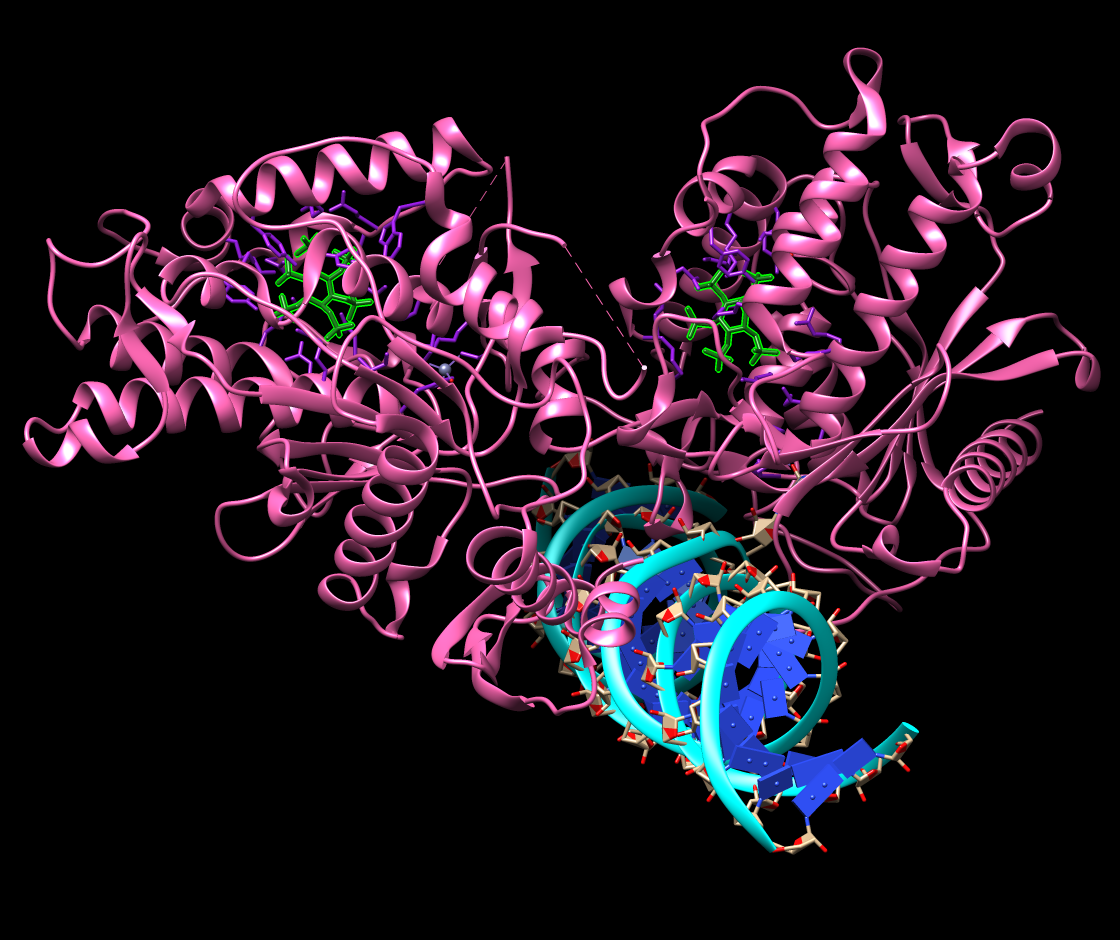
A representation of a protein. Courtesy | Wikimedia Commons
Breathing, eating, sleeping, running to Taco Bell in the middle of the night – none of these activities would be possible without molecules called proteins.
Found in every cell of every living thing, proteins are complex, twisty strands of molecules that build cell walls, store energy, defend against infections, and more. If a person is suffering from a disease, chances are, proteins are involved, making them the target of many drug treatments.
In order to develop the right drugs, scientists have to know what the protein looks like, which is a daunting task. The wrong method of imaging proteins might lead to an ineffective drug.
According to Hillsdale College research, this problem might be happening in protein studies today, and current drugs on the market might be completely dysfunctional. Kelli Kazmier, associate professor of chemistry, and Hillsdale students have gathered piles of evidence that one of the most popular methods of imaging proteins is misleading.
“If I had to assess where the field is right now, it’s probably that people are taking these protein structures as truth, despite how much we published about that,” Kazmier said. “You shouldn’t do that.”
The popular technique used to depict a protein is known as X-ray crystallography. The process requires that scientists “freeze” the proteins into crystal structures, and bounce X-rays off of them. But in order to crystalize proteins, sometimes scientists mutate or change the protein’s molecular structure.
As a result, Kazmier said the protein image is not the same protein that exists naturally, although scientists may treat it like it is natural.
“You are just not talking about the same thing as I am,” Kazmier said. “I’m looking at what the protein looks like. You are changing it to a different protein. It’s no longer the same protein anymore when you change its composition.”
Instead, Kazmier is an advocate for an imaging technique called electron paramagnetic resonance spectroscopy that looks at the protein as it moves in a simulated solution. She said this allows scientists to see the protein as it actually exists and moves instead of frozen and mutated.
“We basically study the dynamics of the system, and then that allows us to take this static picture of what the protein looks like, and imagine what it looks like when it’s doing its job in three dimensions across time,” Kazmier said.
X-ray crystallography data and EPR data should agree, but Kazmier said she and Hillsdale students are finding that they don’t, indicating that X-ray crystallography scientists are imaging proteins that have been mutated too much.
“So far, what we found, although it’s preliminary, is that both of those mutations completely change the system,” Kazmier said. “They break the protein, it’s no longer functional, and it’s not at all representative of what it looks like, so each of those mutations, every single one of them, has a massive deleterious effect on the function and structure of the protein.”
Kazmier said she thinks X-ray crystallography is very useful, but scientists have to be honest about the mutations they make to proteins.
“I think the scientists I respect, of which there are many, are people in this field who are like, ‘The very first thing I need to tell you is how I’ve modified this system, and then you can judge my results. But the very first thing you must know is that this is a modified system,’” Kazmier said.
Since the summer of 2017, a Hillsdale student has partnered with Kazmier to show that X-ray crystallography data for a protein called LeuT doesn’t match Kazmier’s EPR data for the protein.
Spencer Rothfuss ’21, a current doctoral student at Vanderbilt University, conducted his research with Kazmier in the summer of 2020. He investigated how a mutation on a protein called LueT for X-ray crystallography affected how the protein moved.
“Many proteins that are really vital for processes and mechanisms that we care about, both for basic science understanding and for clinical disease fighting, are in motion and move,” Rothfuss said. “They’re not structural or static, but they’re machines or motors.”
Rothfuss said his research added to the growing body of evidence that mutations on LueT fundamentally change the protein.
“We’re trying to have a very detailed picture available to other scientists of how this protein works,” Rothfuss said. “We found that, in fact, yes, this mutation did change the way the protein functions.”
The research launched Rothfuss into studying proteins on the Ebola virus for his Ph.D. Rothfuss said the Hillsdale education prepared him well for a career as a scientist.
“I came in with less science experience, or less hours in the lab than I maybe would have coming from a different school, but I think the things that I that those hours were replaced with were invaluable, and not things that I could make up as easily as I can make up experience in the lab,” Rothfuss said.
Senior Eva Lintereur, who worked on the project over the summer, said LeuT is an important protein to study because it is similar to proteins that transmit signals in the human brain.
“It’s a homologous protein to neurotransmitter sodium supporters, which are found in your neurons and play really important roles in helping your brain communicate with the rest of your body through neural signals,” Lintereur said.
Lintereur said several antidepressant drugs have already been designed to attach to these proteins, making it extremely important that the scientists use protein images cautiously.
“I was trying to figure out if the X-ray data is representing LueT well, because if it’s not, this is the data that they’re creating drugs to help cure these diseases,” Lintereur said. “Are the drugs actually being effective?”
Kazmier said students like Rothfuss and Lintereur get excited about this project because they want to take revenge on the X-ray crystallographers.
“I always tell students, if you feel like you’re a person that’s motivated by spite, join my lab, which is a joke,” Kazmier said. “No one ever thinks they’re that person. It’s just when they join my lab, they find out if they are or not.”
Kazmier said the problem of relying on X-ray crystallography methods will become even more of an issue when artificial intelligence can generate new proteins based on faulty data. AlphaFold is an example of a current AI model that could create flawed proteins.
“The implication is we don’t need to do experiments anymore because AI is as good as experiment. I’m like, you need experiments to call those things out,” Kazmier said.
Kazmier said she wants to move away from a structure-based understanding of proteins toward a sequence-based understanding, which is focused on the composition of the protein. But Kazmier said scientists are resisting this perspective.
“I think what is actually true for proteins, that every single one functions differently because the structure is not what’s important,” Kazmier said. “The sequence is what’s important, and every protein has a different sequence. When you change the sequence, you change the protein. I would argue sequence equals function. We don’t want that to be true, because then you have to study every protein individually to learn anything about it.”
Lintereur said although she loved the research project, she adored the community of chemistry people she worked with over the summer.
“I really enjoyed research, and the community of students that were there was awesome,” Lintereur said. “It was so awesome. The chemistry department here did a really fantastic job of bringing students together throughout the research process.”
