
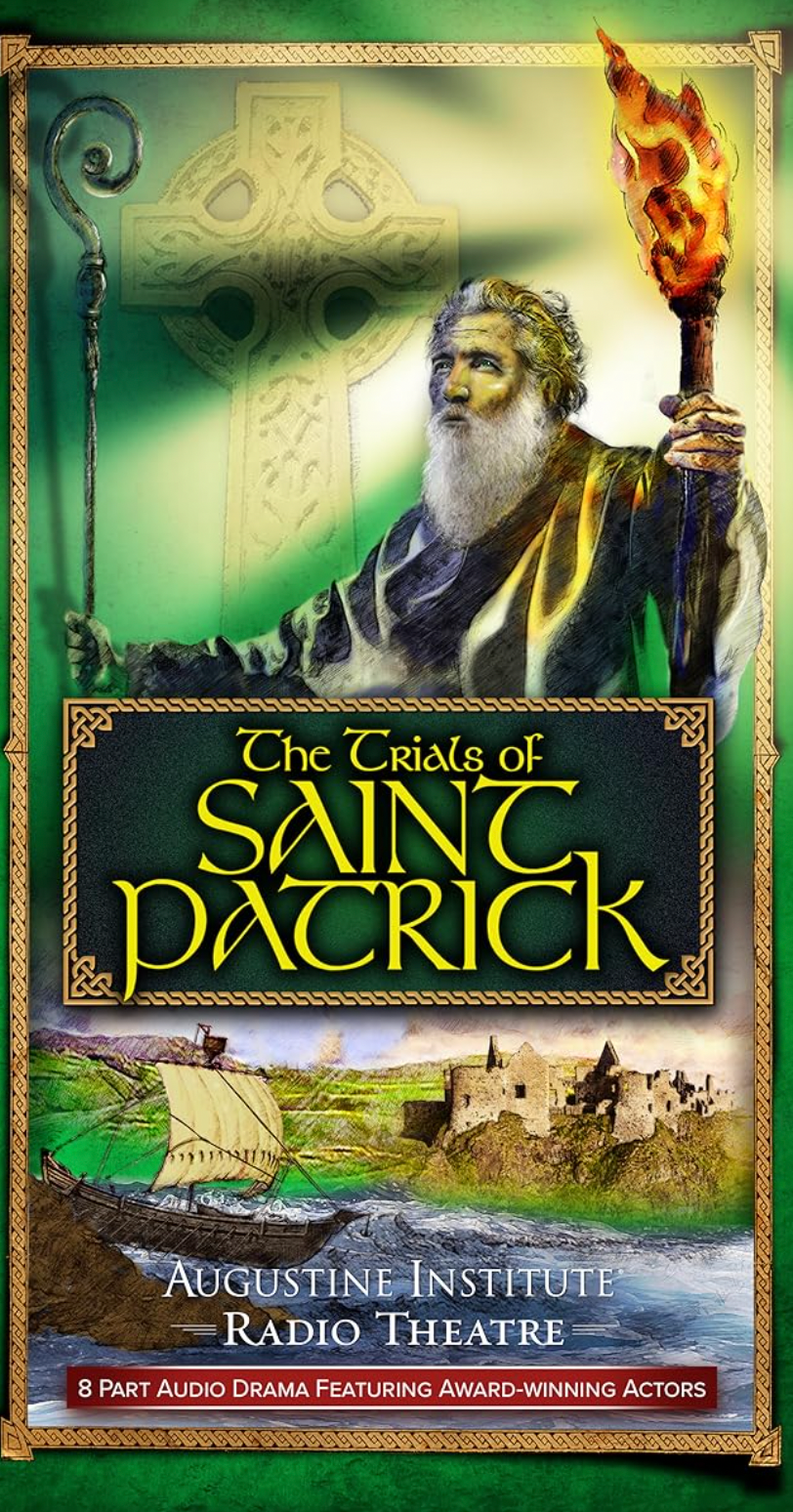
St. Patrick audio drama cover
COURTESY | Augustine Institute
Anyone who did not believe in spiritual warfare before now, perhaps might after listening to the Augustine Institute’s audio drama, “The Trials of St. Patrick,” written and directed by Paul McCusker with music by Jared DePasquale.
Far more than the childhood tales of banishing the snakes or teaching the Holy Trinity with a shamrock, this drama presents the real battle God waged, through Patrick, upon the darkness which reigned over Hibernia–modern day Ireland.
“I wish we could reclaim St. Patrick as a man of God,” McCusker said in an email, “rather than as a celebration of leprechauns and clovers and green beer and complete overindulgence.”
Growing up Catholic, I have always had a relatively solid knowledge of St. Patrick’s story, yet I have never encountered him so deeply as when I listened to this interpretation of the legend.
This story is filled with adventure and courage, and it is intense and frightening at times. In fact, for several years now, my mother did not let her youngest children listen to certain parts of the story, especially an exorcism scene, because they are so intense.
Among its most important characters are Patrick, the tale’s protagonist; Leary and Angus, the high king and queen of Hibernia; and Crom Cruach, the demon he must defeat.
The primary conflict of the story is the spiritual warfare Patrick faces. As a young man, he is lukewarm in his faith. Through his time of captivity, Patrick experiences his first taste of the demon oppression the people of Hibernia face.
After an attempt to escape, Patrick goes into the wilderness by himself to tend sheep, and it is here, in loneliness and isolation, that he learns what it means to rely on God.
He escapes captivity, but not long after returning home, he is called by God to return to Hibernia. The people, enslaved by the rule of their demon gods, are engulfed in spiritual darkness and shackled by the powerful influence of the druids.
“Oh holy boy. Oh holy boy,” said the words which come to him in a dream. “Come and walk amongst us once more.”
Patrick, in trying to bring the gospel to Hibernia, is blocked by druids, warlords, and the king. So entrenched are the people in spiritual darkness that only a show of power will open the door for Christianity.
“Even the Gentiles will come to God for refuge, departing from the heritage of lies and the idols of stone who are not gods,” said Honoratus, one of Patrick’s mentors. “God will act and act with power, and they shall learn the Lord’s name at last.”
I did not realize before listening to this audio drama that the Irish people’s babies were sacrificed to demons — Crom Cruach being the worst. Thirsting after the blood of the innocents, the demon, according to legend, devoured a third of the children of Hibernia in human sacrifice.
At the climax of the story — and the most powerful scene of the drama — Patrick performs an exorcism and banishes Crom Cruach to hell.
“In the name and by the power of the Lord Jesus Christ,” Patrick said, “be driven out from the creation of God and from the souls made in the image and likeness of God and who are meant to be redeemed by the precious blood of the Divine Lamb.”
My stomach clenches and I get chills every time I listen to the exorcism scene. With each listen, I am overwhelmed by the might and power of God. Each time I am struck and inspired by the combination of the powerful voice acting, the intentional soundtrack, and the intricate storytelling.
“We always choose actors based on how well they fit with the character,” McCusker said. “Patrick was from Roman Britain, was taken as a slave to Ireland (as it’s now known), then made his way back again. He most certainly didn’t speak with an ‘English accent,’ as we know it. We also couldn’t go with the Lucky Charms Leprechaun-type Irish accent. So we went for a workable middle ground.”
The script contains minute historical details, names, and geographical locations. One particularly engaging example is the scene where Patrick cuts down the tree of Germanus, a Christian duke, who persisted in the pagan practice of hanging animal heads from the tree.
“My writing process was the same for St. Patrick as any other historical drama,” McCusker said. “I read what I can about the person — as a character, not as a ‘saint’ or a good guy or bad guy, etc. — in the context of his or her time, and then piece together the best story the research revealed.”
The soundtrack, carefully designed, carries the imagination of the listener into the scene whether that be into the hills of Hibernia or into the spiritual warfare for souls.
Through the superb voice acting of John Rhys-Davies as the elder voice of Patrick, and Seán T.Ó Meallaigh as the younger Patrick, the veil of Patrick’s sainthood disappears. He becomes a real man with real failings and struggles but also with real courage and an unwavering faith in God.
“As with any drama about a saint, I’m struck by his humanity, his struggles, but mostly his faith to follow God no matter where he might lead,” McCusker said. “It’s reckless. Even a bit insane (from a strictly human point of view). Yet he did it.”
Interestingly, McCusker chose not to end the drama with Patrick’s death. Instead, we are left to ponder his work and its meaning in our own lives.
“Right before this project,” McCusker said, “we had produced a drama about St. Francis — which goes all the way to his death. I didn’t want to do that again, especially since we know so little about Patrick’s death. Also, Patrick was one of the few missionaries who was not martyred. So ending with his death seemed anti-climactic from a story point of view.”
As the feast of St. Patrick comes and goes this year, certainly celebrate the feast with beer, soda bread, and some Irish fiddle tunes, yet in the midst of the celebrations, remember the courageous battle waged on hell — a war waged by a simple man named Patrick.
“By the grace of God I’ve come a long way,” Patrick said, “and will go further still, until he calls me home.”
