
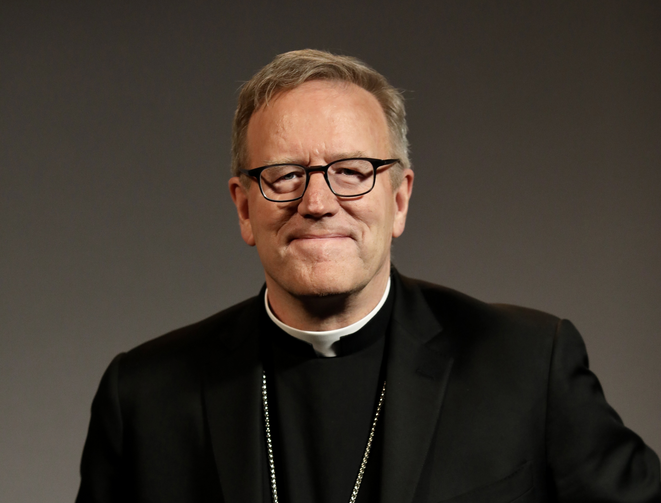
Bishop Robert Barron of the Diocese of Winona-Rochester in Minnesota and founder of Word on Fire Catholic Ministries, has nearly two million YouTube subscribers and three million followers on Facebook. Courtesy | American Magazine
Believers should remember that worship is “purposefully wasteful,” Bishop Robert Barron said at a lecture in Christ Chapel March 20.
“‘Why are you using so much incense? How much did you pay for that vestment?’ In a way, that’s the point,” Barron said. “I’m trying to be wasteful. I’m trying to be non-economic with the liturgical sacraments.”
Barron, bishop of the Diocese of Winona-Rochester in Minnesota and founder of Word on Fire Catholic Ministries, has nearly two million YouTube subscribers and three million followers on Facebook. He spoke at the college’s commencement in 2023.
“I believe in your mission,” Barron told the hundreds attending the Drummond Lecture. “In the course of my lifetime, we’ve seen increasing attacks on the fundamental values of the West that have come up out of our political and religious traditions. In a place like this where they’re revered and taught to people to become smart, articulate defenders of those values — I believe in it, and that’s a major reason I’m here.”
Barron said people in the West have forgotten the importance of contemplation and must recover it by making time for leisure. This philosophical act, he said, reaches its highest form in the festivity of worship, where one must put aside practical concerns.
“Celebration is tied to contemplation by which the soul turns to its infinite object and becomes aware of the illimitable horizon of reality as a whole,” Barron said. “To attain this, a sacrifice of time is necessary, a setting aside of a day or a week for impracticality.”
This time of contemplation allows a person to move beyond material concerns and explore how visible reality relates to the invisible, Barron said.
“When I can say, ‘This chapel is real’ and ‘The quadratic formula is real’ — once you make that move — you’ve begun to ask the question after meaning, because you’re wondering what possibly connects these two utterly different realities, one visible, one invisible,” Barron said. “You’ve now begun to ask the philosophical question.”
But this question is not an escape from the world, Barron said, but a more lively, intense experience of things around us. To make his case, Barron turned to the thought of German Catholic philosopher Josef Pieper and his 1948 work, “Leisure as the Basis of Culture.”
“The posing of this philosophical question involves no turning from the world of ordinary experience, but rather the awakening of authentic wonder in regard to it, since it seeks to know the being of things — their essence and ultimate meaning,” Barron said. “It is, Pieper says, ‘an act of marveling.’”
Returning to this practice requires us to make room in our lives for “leisure,” a time to put aside the practical tasks, wonder at creation, and develop a “culture” set apart from the practical.
“Culture is, for Pieper, largely a function of engaging in the philosophical act, and that act is possible only within a context of leisure, which is to say an ambience where the workaday has been at least provisionally set aside,” Barron said.
But formal, ritualized liturgy — once a time for wonder and contemplation — has been in decline, according to Barron. The loss of sense of wonder and meaning beyond material things, Barron said, helps explain the loss of religiosity and the rise of anxiety, depression, and suicide among younger generations.
“It should be obvious to anyone that the abandonment of liturgy, of formalized religious ritual, has had massively deleterious consequences in the West,” Barron said. “Why would we find this puzzling? If people are convinced they have come from nowhere, there are no objective moral values, human nature is utterly fluid, and death is tantamount to annihilation, why are we surprised that a general malaise marks the spirit of the West?”
Senior Justus Hume, a religion and psychology major, said he enjoyed the speech, even though some parts were difficult to understand.
“A lot of it went over my head,” Hume said. “It was also nice to see that other professors were kind of looking confused at a lot of points too, so I wasn’t the only one.”
Hume, who converted to Catholicism last year, said he has listened to many of Barron’s Sunday Homilies online.
“He was pretty influential in my conversion. He has a really amazing way of explaining beautiful but complicated things so simply,” Hume said. “I think a lot of people probably feel that way, hence his massive viewership on YouTube and other social media platforms.”
