
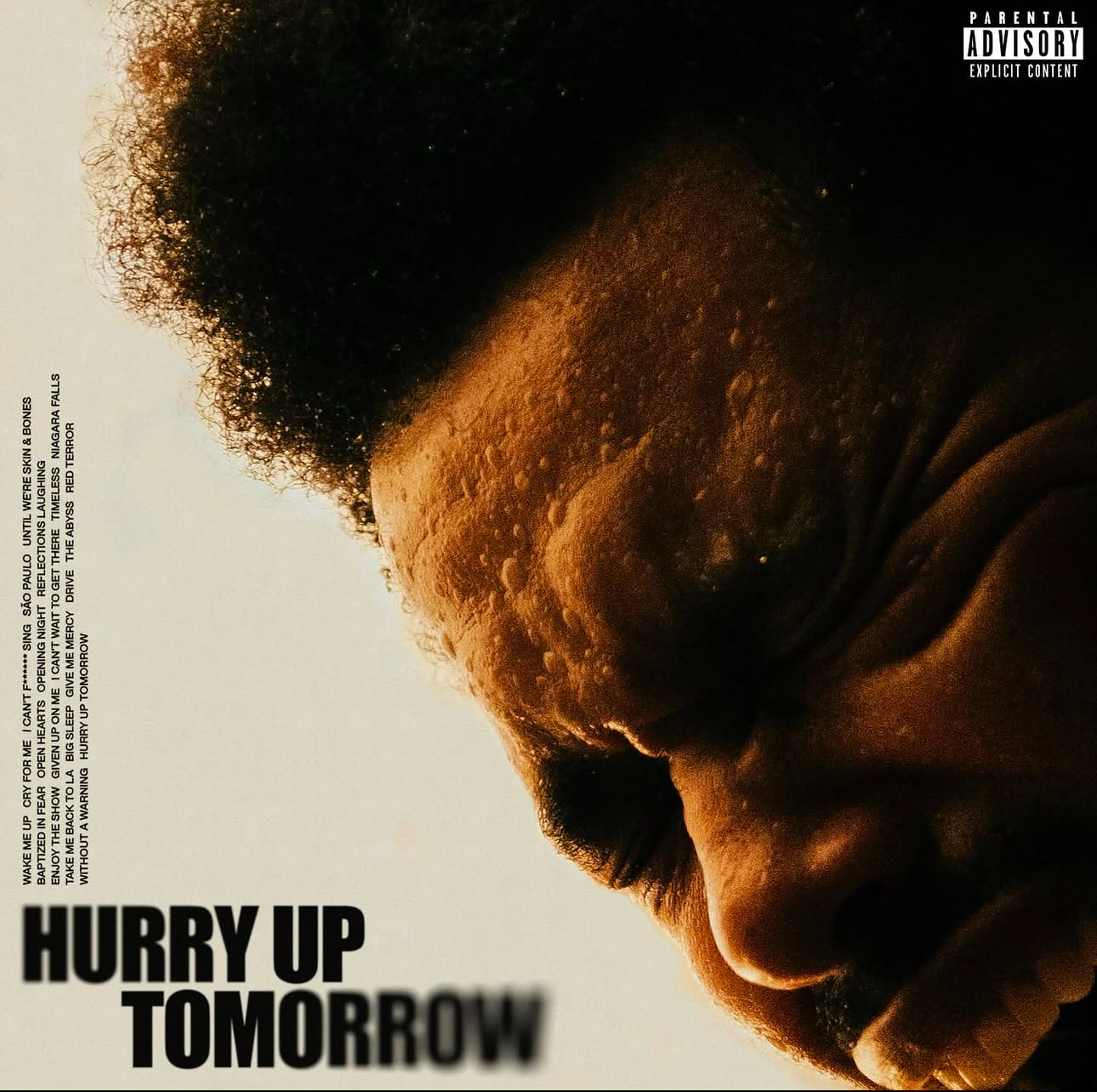
“Hurry Up Tomorrow” album cover
COURTESY | Instagram
While mentioning The Weeknd in conversation can spur nostalgia for his energetic and meme-worthy Super Bowl LV performance, his latest album’s ethos departs in piece from his former ones.
“Hurry Up Tomorrow” released Jan. 31, and considered the third album in the trilogy of albums following “Dawn FM” in 2022 and “After Hours” in 2020, now holds the title for his longest with 22 tracks.
Abel Tesfaye, known as The Weeknd, has brought fans Billboard No.1 Top 100 songs like “Blinding Lights,” “Can’t Feel My Face,” and “Starboy,” proving that his R&B music can appeal to a wide audience.
Previous albums addressed the ample challenges present in romantic relationships, but a darker strain of introspection and heavily implied substance abuse dominates the majority of the new album’s tracks.
The initial song, “Cry for Me,” captures listeners with a heavy, synth-laden contemplation of his own ephemeral nature as well as his profound loneliness without his would-be lover, eventually questioning “Are you real, or are you an illusion?” and responding “Cause I fear your love’s my delusion.”
About halfway into the song, drums are introduced which lift the tone, though The Weeknd’s mediations about the afterlife, his prospective relationship, and sleep demons continue to trend toward despair.
The Weeknd’s use of the pulsating synthesizer makes multiple appearances in the R&B-dominant album, though he does dabble in rap a few times.
Several of the early songs focus on calling out to his former lover, bemoaning the many tears he’s shed, and the once idyllic vision of life together, though he quickly comes to accept this is no longer reality. This realization coincides with heightened references to substances leading ludic listeners to see that a drug relapse is perhaps just around the bend.
Coincidentally, the bend comes at roughly halfway through the album with the track, “Laughing Reflections,” and the verbally ironic title betrays that the reflections are not joyful.
In the tracks immediately preceding this one, he explores the challenge of “falling in love again” as well as a forthcoming performance in which he sought reconciliation with his former flame via a subtle dial tone and wall phone voicemail sound.
“Laughing Reflections” mimics the same dial tone sound and features a message with what initially sounds like a woman’s voice.
“I know you’re up,” the voice on the answer machine declares, “You think I don’t know you’re staying up all night, cooped up in that hotel room? I know you.”
As the message proceeds, the speaker interjects statements of care about his condition and alludes to a relapse in drugs. All the while her words are punctuated by the sound of the listener vacillating between slurping sips and swirling ice in a cup while the soft whimpers of tears fill the foreground. Her voice slowly becomes distorted more and more until it is only Travis Scott speaking.
Other notable guests on the album include: Annitta, Justice, Florence + The Machine, Lana Del Rey, Playboi Carti, and Giorgio Moroder.
His seeming callback to the song “Escape from LA” on the “After Hours” album, which featured a boisterous Tesfaye who brashly described a sexual encounter with his “side” woman in the studio before he proclaims he wants to leave the city, makes a sharp transition with his song “Take Me Back to LA.”
The song offers a sharp inversion of the former by means of his tone, rhetoric, and message: that he deeply misses Los Angeles and hates being all alone.
Religious appropriations and imagery riddle the album, ranging from baptism to the Apostle Paul, and confessions to declarations of demons. These appear to be more than ornamental until the final track, the album’s namesake, where that intuition is confirmed.
Much like reading only the Inferno presents a incomplete understanding of Dante, listening through the the entire album is necessary to recognize Tesfaye’s eventual revelation:
“No, I need Heaven after life, I want Heaven, when I die.”
With just under two weeks since the album’s release, the album has demonstrably had great initial success, raising The Weeknd’s Spotify monthly listener count from 118.29 million in late January to a career high of 124.20 million on Feb. 12, according to data from ROSTR.
The Weeknd has also earned the biggest U.S. sales week of his career according to Chart Data on X.
“.@theweeknd’s ‘Hurry Up Tomorrow’ earns the biggest first week US unit sales debut for any album since @taylorswift13’s ‘THE TORTURED POETS DEPARTMENT,’” Chart Data said on social media.
While “Hurry Up Tomorrow” does not warrant breaking your Exodus 90 fast, the now somber “Starboy” may be looking up, despite all the weeping and gnashing of teeth.
