
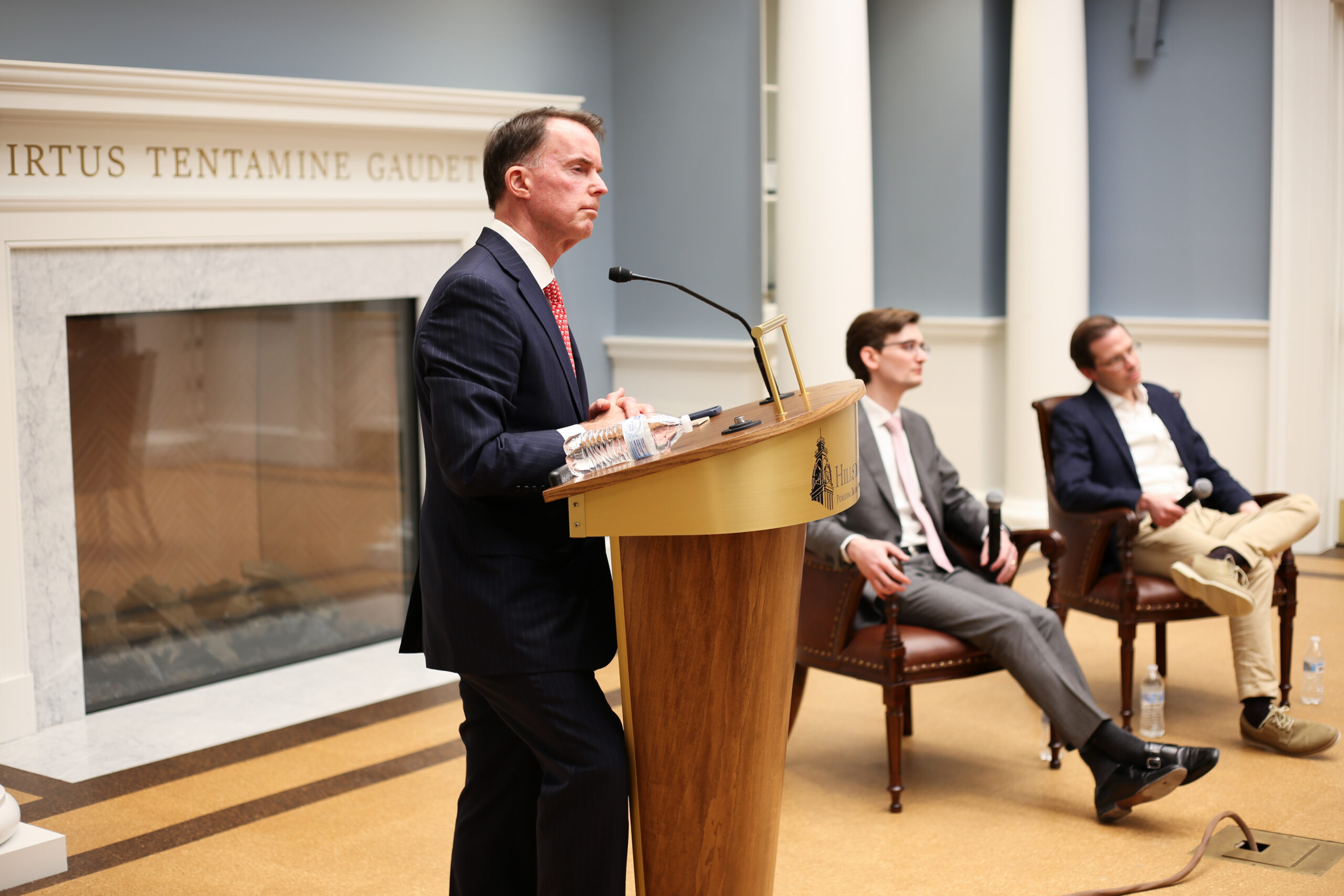
The future of the U.S. Department of Education likely spells some changes, said Heritage Foundation fellows during a panel hosted by The Federalist Society Feb. 30.
To a room of more than 70 attendees in the Elizabeth Hoynak Archive Center, Charles Stimson, deputy director of the Edwin Meese III Center for Legal and Judicial Studies, said the president does not have the authority to abolish the Department of Education on his own.
“The challenge to the administrative state, and in particular, dissolving a department like the Department of Education, is one that people in the conservative movement have talked about for a long time,” Stimson said.
Stimson reminded the audience that the DOE began in 1979 during President Jimmy Carter’s administration, growing out of a former department called the Department of Health, Education, and Welfare. This was subsequently split into the Department of Education and the Department of Health and Human Services, according to Stimson.
“The Department of Education began its operations in 1980, but HEW was crafted in 1953 and that predecessor agency was the federal security agency from 1939,” Stimson said. “Eliminating a federal department is a big task, and I can’t think of many that have ever happened in my lifetime.”
Paul Ray ’08, a Harvard Law school graduate and former clerk for Associate Supreme Court Justice Samuel Alito, addressed the president’s power over the rulemaking process and agencies issuing regulations.
“In effect, it is to say they look like laws and operate like laws. They have the force of laws,” Ray said. “Many agencies have regulatory power.”
Ray said the president has authority over the regulatory process in his ability to appoint leadership over the agencies, the use of executive orders, and the Office of Management and Budget, but also warned about the pros and cons of EOs.
“The presidents face a lot of pressure from their supporters to use their powers to the max rather than compromise with congress,” Ray said.
Stimson questioned whether the DOE would remain in its current form or a different form, by the end of Trump’s second administration.
GianCarlo Canaparo, a senior legal fellow in The Heritage Foundation’s Edwin Meese III Center for Legal and Judicial Studies, and current student at the Hillsdale Van Andel Graduate School of Government in D.C., shared Ray’s view that it would look different.
“I don’t think it’ll be eliminated,” Canaparo said. “My question is what sort of form are we talking about. Will its structure, organization, departments, and authorities still exist?”
Canaparo said the Department of Education may reduce its own power “to regulate schools” by increasing “competition among accreditors,” citing the American Bar Association as an example.
“Law schools have one accreditor and it’s the ABA, and it keeps trying successfully to force schools to use racial quotas,” Canaparo said. “To increase the competition among the accreditors means that the accreditors will be forced to compete on actual value added.”
Canaparo said funding may be another way of controlling the DOE.
“Grants to whom it gives its grants can really reshape the broader economy and education,” Canaparo said.
Stimson suggested students examine The Heritage Foundation’s Federal Budget in Pictures website, which shows how federal government’s mandatory spending is on the rise.
“You will see that the big three entitlement programs are eating more and more of the federal government and the pie of discretionary spending is getting smaller and smaller,” Stimson said. “Right now we’re paying more interest on the debt than we’re funding the Department of Defense. That’s a threshold that was just crossed in the last year — it’s disgusting.”