
Rarely do popes and American politicians spar over Catholic theology and national policy.
That changed Jan. 29, when Vice President J.D. Vance appeared on Fox News to justify border security and mass deportation with what Vance called an “old-school” Christian concept.
“You love your family, and then you love your neighbor, and then you love your community, and then you love your fellow citizens in your own country, and then after that, you can focus and prioritize the rest of the world,” Vance said, concluding the far left has completely inverted this concept of ordered priorities and obligations.
This clip went viral on social media almost immediately, sparking outrage from leftists and skeptics who accused Vance of dishonestly appropriating Christian principles to justify President Donald Trump’s immigration policies. Many took issue with Vance’s status as a 2019 Catholic convert, challenging his ability to explain his political stance through his religious beliefs.
Responding to one such accusation from British Member of Parliament Rory Stewart on X, Vance tweeted Jan. 30 his argument is based on “ordo amoris,” a millennia-old Christian theological and social teaching developed by St. Augustine and St. Thomas Aquinas.
St. Augustine explains the “ordo amoris,” which is Latin for “order of love,” in his book “On Christian Doctrine.”
“Since we cannot do good to all, we ought to consider those chiefly who by reason of place, time, or any other circumstance, by a kind of chance are more closely united to us,” Augustine wrote.
Nearly two millennia after Augustine, Vance brought this social teaching into the political limelight.
“The idea that there isn’t a hierarchy of obligations violates basic common sense,” Vance wrote on X. “Does Rory really think his moral duties to his own children are the same as his duties to a stranger who lives thousands of miles away? Does anyone?”
The idea was straightforward: A secure border and the defense of American rule of law upholds, not contradicts, the principles of Christian charity through our obligation to our own communities and citizens.
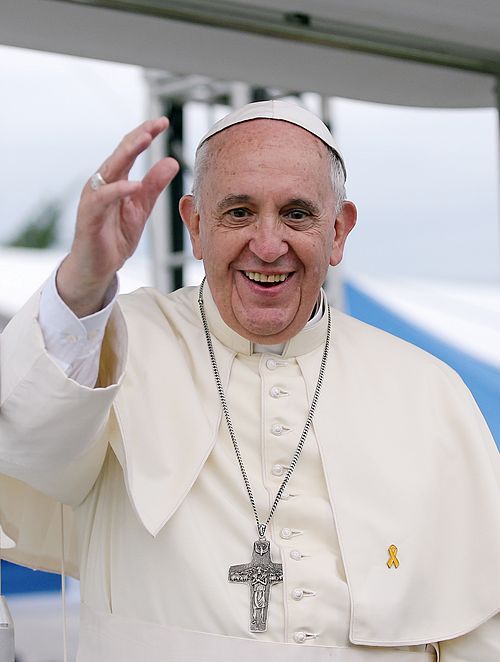
Pope Francis disagreed. In a strongly-worded letter addressed to the American bishops published Feb. 10, the pope clarified his stance on Trump’s immigration policy.
“I have followed closely the major crisis that is taking place in the United States with the initiation of a program of mass deportations,” Francis wrote. “The rightly formed conscience cannot fail to make a critical judgment and express its disagreement with any measure that tacitly or explicitly identifies the illegal status of some migrants with criminality.”
The pope stated that an “authentic” rule of law is verified through how a country affirms the dignity of the poor and most marginalized, who ought not to be labeled as criminals if they have not committed “violent or serious” crimes.
“What is built on the basis of force, and not on the truth about the equal dignity of every human being, begins badly and will end badly,” Francis writes. “The true ordo amoris that must be promoted is that which we discover by meditating constantly on the parable of the ‘Good Samaritan,’ that is, by meditating on the love that builds a fraternity open to all, without exception.”
Although the pope is correct in that nations must treat all migrants with dignity and care, the longstanding position of Catholic social teaching appears at odds with his stiff stance against the Trump border policy.
According to the Catechism of the Catholic Church, paragraph 2241, “the more prosperous nations are obliged, to the extent they are able, to welcome the foreigner in search of the security and the means of livelihood which he cannot find in his country of origin.”
In other words, the government must welcome the migrant, but not to the point that it harms its own people, as the government did under the Biden administration. The memory of ineffective border security and the violent crimes, homicides, and fentanyl deaths it brought into our communities remains crystal-clear in the American mind.
We cannot return to that. Our nation’s first responsibility is not to “all, without exception” but rather to the needs of its own citizens. People who violate our laws are criminals and must receive just punishment — not because they are unequal or lack dignity, but because it preserves a lawful society. If enforced, the American rule of law creates a society worth lawfully emigrating to.
This ordo amoris, when applied to national policy, never suggests we must only choose between those close to us or the poor and marginalized; such an understanding poses a false dichotomy. Rather, it teaches that we love those closest to us first and then those farther away, with the ultimate goal of benefiting both the citizen and the foreigner.
The beliefs expressed in the pope’s letter are not binding on Catholics, since it was a personal letter to the American bishops, not infallible doctrine promulgated to the laity “ex cathedra.” Still, Catholics are obliged to respect the pope, even when they take issue with his personal opinions. Pope Francis challenges us to treat the most vulnerable and marginalized with dignity, a reminder all of us need.
The principle of ordo amoris, however, can serve Francis’ vision for migrants and the poor. After first meeting the needs of our own citizens, we can continue doing what America has always done: offering the American dream to people of all nations.
Elijah Guevara is a freshman studying the liberal arts.
