
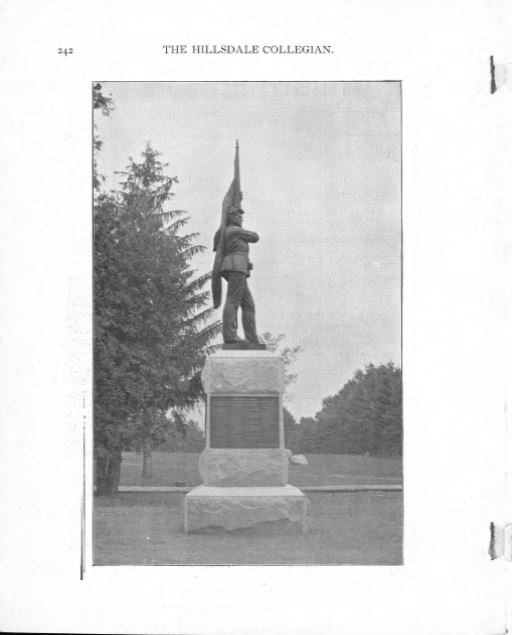
The Hillsdale Civil War Statue was erected in 1895. Courtesy | Hillsdale College Archives
The 1869 college graduate and nationally-acclaimed poet Will Carleton wrote a poem commemorating the dedication of one of Hillsdale College’s most iconic statues, the Civil War Memorial, 130 years ago.
“The careless world, as here it looks / The truth again may understand, / That student-boys can drop the books, / And die to save their native land,” wrote Carleton.
Today, the statue still lives up to Carleton’s words. As prospective students flock to campus this semester, each tour will include a portion describing the Civil War statue between Lane and Kendall halls. However, much of the history behind its origins and the reasons for its construction will go unexplained.
“The Civil War statue that we have at Hillsdale College is emblematic of the college’s position,” Associate Dean of Men Jeffery “Chief” Rogers said. “This was an abolitionist college. As a percent of the student population, more men left here to serve in the Civil War than any other college except for the service academies. The reason for that is what the college stood for, which is that all men should be free.”
On a summer day in 1895, more than a thousand people gathered in front of Central Hall to commemorate what was then called The Alpha Memorial, raised in memory of men in the Alpha Kappa Phi literary honorary who had fought in the Civil War.
Many of the older adults in attendance knew Hillsdale men who died for the cause of the Union. Some of the men were veterans and could remember the 14 Alpha men who died in battle. Still others were there in memory of Judge Richmond Melendy, a Hillsdale soldier interred at Oak Grove Cemetery after a long life of public service.
“All of the colleges at that time had a concept of masculinity, of manhood that they inculcated into the male students; certainly a strong sense of duty, of obligation to society, to their country,” said Associate Professor of Leadership Studies Peter Jennings. “This was informed by their Christian beliefs, of service to God and humanity.”
The memorial statue was originally bronze-cast in Chicago by the American Bronze Company, using University of Chicago Professor Lorado Taft’s sculpture. The anonymous soldier is the centerpiece. He carries the flag, whose staff is broken in half from the heat of battle. At his side is a sword, at the ready.
On the stone base, there are multiple plaques, with the front displaying Confederate General Robert E. Lee’s surrender at Appomattox Courthouse to Union General Ulysses S. Grant. On the other three sides are the names of all the alumni who fought for the Union. While originally a monument solely for Alpha Kappa Phi, plaques were later added to include the other men’s honorary, the Amphictyon Society.
Originally dedicated in 1895, the statue was restored in 2021 as the senior class gift. Over time, the bronze had garnered a green tarnish, making the details of both the soldier and plaques harder to view in passing. For $25,000, an Ann Arbor company, McKillop Fine Art, sandblasted the structure and reapplied a bronze patina. The soldier’s sword, which had fallen off after numerous winters, was reattached after being stored in Moss Hall for years.
Much like the soldier who carries the broken flag, multiple Hillsdale students captured Old Glory back from the Confederates during the Battle of Gettysburg. According to Jennings, at least 23 fought for the Fourth Michigan Infantry in Gettysburg’s Wheatfield, a fishbowl-like massacre for the Union. While many Hillsdale men were injured, and the Union suffered 30 percent casualties, no alumni died in the Wheatfield, according to Jenning’s research.
“Thank God they were successful,” Rogers said. “And so, it stands prominently at the center of our campus, because we want every student to know that freedom isn’t free. The way for you to get a degree has been paved by the blood and sweat and tears of men and women. We don’t ever want to forget that, and the class of 1895 put the statue here to remind us.”
During the monument unveiling in 1895, members of the Alpha Kappa Phi Society read a memorial speech, which included, “Bronze and marble are feeble to perpetuate their memory which finds its best cenotaph in the greatness and dignity of our country, in the enduring gratitude of a people freed from the lash of the slave driver.”
By the end of the war, more than 500 Hillsdale men had served the Union, and three were ranked as generals.
“I think it’s easy to forget how old Hillsdale College is, and the Civil War statue serves as a reminder that our school has significant history,” senior history major Abby Idstein said. “It not only causes us to stop and contemplate the fact that alumni served in the Civil War, but also that Hillsdale itself dates back to when our nation was still considered young. It reminds us that Hillsdale has outlived every national crisis that came after the Civil War and will continue to do so as long as it remains steadfast in its values.”
