
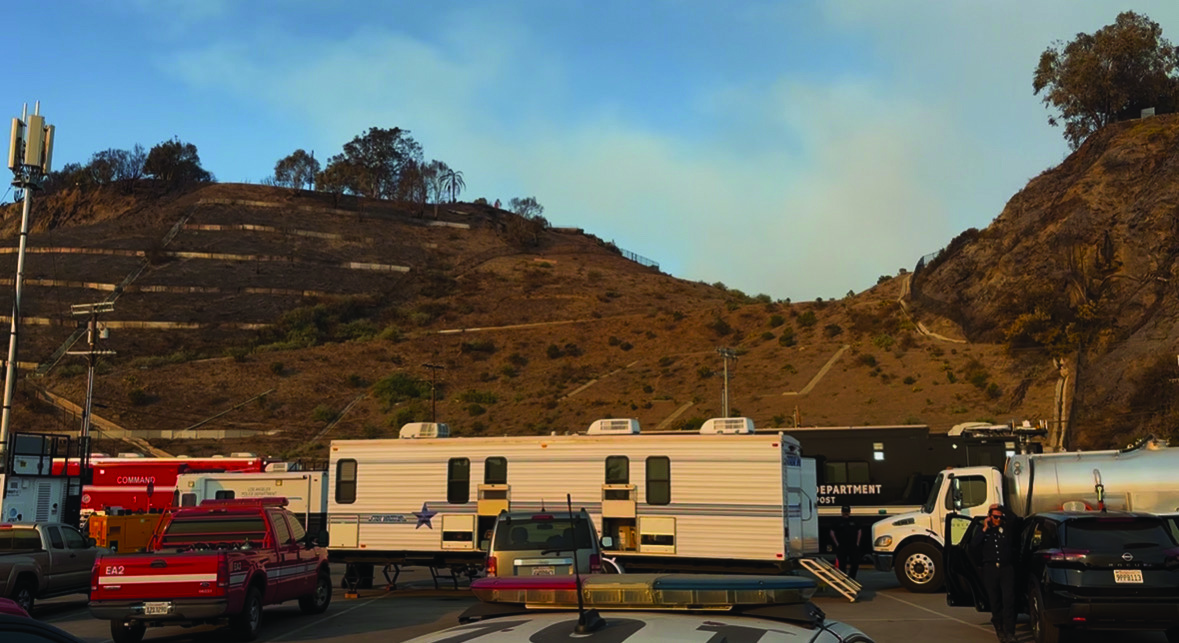
Firetrucks and equipment in California. Courtesy | Elizabeth Troutman Mitchell
Days after alumna Elizabeth Troutman Mitchell ’24 reported on the dismantling of volunteer fire-fighting units during her California fires coverage for the Daily Signal, the units’ social media sites disappeared.
The Daily Signal published Mitchell’s story Jan. 16, and national media outlets featured her story.
On Jan. 20, the website and social media accounts for a state fire response group she reported on — Twitter, Instagram, and Facebook — disappeared, Mitchell said.
After more reporting, Mitchell discovered California Gov. Gavin Newsom held “an emergency meeting” to address the situation brought up by her reporting.
“We’re all really happy that we can uncover a new angle about the fire situation and shed some more light about what the state of California can do in the future to keep the fires from getting so bad,” Mitchell said in an interview with The Collegian.
While reporting in California, a member of the California State Guard told Mitchell that a Newsom-appointed adjutant general of the California Military Department had dismantled the California State Guard’s Emergency Response Command, which consisted of two highly trained teams that would respond to help citizens during a wildfire.
“[The teams] were part of the State Guard, a military reserve force of volunteers that supports the California National Guard. The units were largely made of police officers, retired police chief, retired firefighters, and California highway patrol officers,” Mitchell reported.
Mitchell reported that the political leanings of the Newsom-appointed general predisposed him to discriminate against these volunteer units.
“[He] has a history of marching in LGBTQ pride parades and was investigated for alleged antisemitism against a subordinate,” Mitchell reported in her Daily Signal article.
Mitchell said reporting this government dismantling of the response teams was detrimental to citizens who lost homes and complained of the insufficient fire response. She said many people couldn’t access their homes or neighborhood due to traffic and road closures. The teams could have helped in these areas, she said.
As a reporter, Mitchell said she could access restricted areas, even if homeowners couldn’t.
“Members of the media could get anywhere by showing their press badges,” Mitchell said. “We took a tour with the fire department and saw active flames. There was terrible wreckage. In many places all that remained were fireplaces.”
News Producer at the Daily Signal Tim Kennedy, who traveled to California with Mitchell, said when covering natural catastrophes, it is important to hear from the individuals most affected.
“Elizabeth and I arrived in Los Angeles less than a week after the Palisades wildfire burned down most of the scenery along L.A.’s fabled Pacific Coast Highway,” Kennedy said. “We attended several wildfire victim town hall meetings. Of those we spoke with, many expressed frustration over the lack of transparency from local officials in the first week following the fires.”
Mitchell said she never anticipated the angle she uncovered, especially since she had not planned on traveling to California to cover the fires.
“My editor-in-chief asked if we had ideas for how to cover the wildfires,” Mitchell said. “I jokingly said we could go. She thought it was a good idea. Two days before we left, my co-worker and I were assigned the trip.”
Maria Servold, assistant director of the Dow Journalism Program, said Mitchell’s tenacity is one of her many qualities that make her a good reporter.
“I’m not at all surprised her writing is having an impact on the world in a good way,” Servold said. “She is a smart, energetic, hard working reporter, and I’m so happy to see her succeeding.”
Servold said Mitchell excelled during her time at Hillsdale, especially in her role as editor-in-chief of The Collegian.
“Editors have different qualities that make them great,” Servold said. “One of her great qualities is her nose for news. She has a good sense of what’s interesting and can quickly pull together a good story.”
Mitchell said she interned with The Daily Signal during her semester in D.C. for the Washington-Hillsdale Internship Program. The following year, she was a contributor to The Daily Signal. She then began a year-long fellowship with Daily Signal in June, and became a full-time reporter Jan. 6, Mitchell said.
Servold said she is delighted, but not surprised, to see Mitchell’s success as a reporter so quickly after graduation.
“We’re proud of all our graduates, but we are especially proud when so quickly after they graduate, they are doing such great work,” Servold said. “It’s bittersweet when people like her graduate, but we want our students to go out into the world and succeed. So it’s always fun to keep up with them and see how well they’re doing.”
