
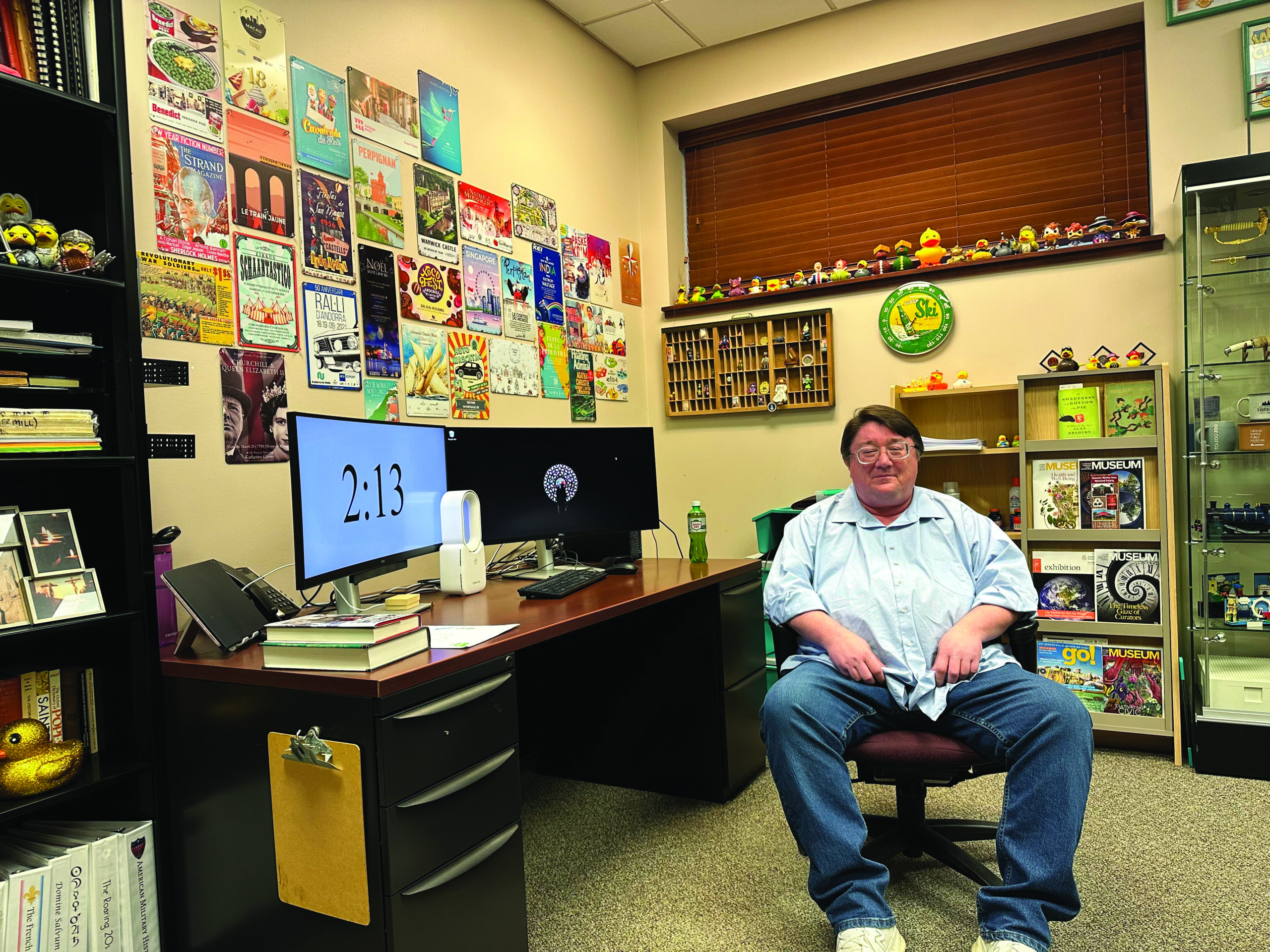
Stewart has a Lego set from a murder mystery, Lambert has a first edition of T. S. Eliot, and Wolfram has an impala head. Every Hillsdale professor adds something to his or her office to personalize it, but some offices stand out, thanks to their random assortment of collectibles and memorabilia.
Professor of History Dave Stewart’s office is a conglomerate of toys, class mementos, and historical artifacts. He’s arranged Lego sets throughout the room — Japanese architecture on a coffee table, Agatha Christie’s Orient Express in a glass case, and his own tinkerings on a bookshelf.
“The Orient Express was just a train, so I got all the people and made them to go with the book,” Stewart said.
All the sets connect to classes Stewart teaches.
“My son, for Christmas — because he knows I like the Far East, military history, and the 18th century — got me an 18th-century Japanese castle,” Stewart said.
He also builds his own Lego models, such as a model of the basement floor of Delp Hall, which sits on a bookshelf surrounded by Lord of the Rings-themed rubber ducks. So far, the model includes the offices of Associate Professor of English Dutton Kearney and Assistant Professor of German Jeffrey Hertel.
Stewart said he plans to keep building, but he “gets distracted a lot.” His next step is to build Professor of History Kenneth Calvert’s office.
“I could build that, or there’s a million other things I could do,” he said. “That’s as far as I’ve gotten with Dr. Calvert’s office: a little, angry Roman.”
Legos aren’t Stewart’s only toys. He has also “accidentally” collected more than 1,000 rubber ducks.
Stewart said the collection started about 15 years ago, when he was complaining to his mother-in-law that his childhood had been so hard, he “didn’t even get a rubber duck.”
“To me, it was just one of the many dumb things I say in passing,” he said. “The next day, my mother-in-law and my wife went to Walmart to buy groceries and normal stuff. While she was there, she saw a rubber duck, and she thought of me, so she bought it. When I came home, she said, ‘Here, stop whining,’ and she gave me this classic, standard, yellow rubber ducky.”
Stewart said he took the duck to his office the next day and stuck it on his desk without much thought.
“After Christmas break, a couple of students said, ‘Your duck looks so lonely.’ They had bought a couple of others and put them on the desk,” he said. “So then we had these three ducks sitting there on the corner of my desk. And then spring break, somebody went to Chicago and came back and said, ‘I saw this. And since you collect ducks, I thought you would want this to go with your other ones.’ And then it turns out that I collect ducks.”
Stewart said about half of the ducks come from students, and some come from family members. The Lord of the Rings ducks, which include members of the Fellowship, Sauron, and Saruman, came from Edward Gutiérrez, the former director of the Center for Military History and Strategy at Hillsdale College.
“The first year he was here for Christmas, he gave me half of the Fellowship, and then the next year, he gave me the other ones,” Stewart said. “He thought I should have something responsible and reasonable. If I’m going to have nonsense, it should be responsible nonsense.”
Stewart has other toys — a plastic Marie Antoinette with a detachable head, a stuffed rabbit that squeals, “I love you,” and a small gnome he named after Hillsdale College President Larry Arnn. But the favorite item in his office is a replica Spanish sword from his son.
“He joined the U.S. Army and served in Syria at a top secret base that Amazon delivers packages to,” Stewart said. “You get bonus pay when you’re in the army and you serve in a combat zone, so with his bonus pay, he contacted this guy in Toledo, who is, I think, a 16th-generation sword maker, and he commissioned that sword. It’s cool anyway, but that makes it cooler: it’s hand-forged by this guy whose family has been doing it for 600 years.”
The sword now hangs on Stewart’s wall framed by maps, one of which, Stewart said, could be from the 1760s.
Instead of decorating with swords and Legos, Assistant Professor of English Christina Lambert displays art prints, many of which are souvenirs.
“It’s such a great way to revisit places and have them in your landscape all the time,” Lambert said.
Lambert said collecting art began with photographs.
“I love these places, and I’d love to have them around me,” she said.
Three of her favorite photos sit on top of her bookshelf. The earliest image is a picture she took in Antalya, Turkey while on the Hillsdale College Honors Program (now called the Collegiate Scholars Program) trip her junior year of college; the other two are of Interlaken, Switzerland and Gordes, France.
Lambert also displays a photo from photographer Jamie Beck, who captured a series of still flowers every day during the COVID-19 lockdowns.
“It’s a very nice, artistic rendering of a time period that was tough,” Lambert said. “This is a nice way of memorializing it.”
Lambert collects and displays paintings as well as photographs.
“I was raised going to art museums, so now when I go, I love to collect a piece that really struck me,” she said.
One art print is of Claude Monet’s “The Seine at Giverny,” which Lambert said she saw while on a college trip to the Art Institute of Chicago.
“He’s looking at the mist on the water,” Lambert said. “I remember going with my friends and being really struck by it.”
Another Monet on Lambert’s wall comes from the “Water Lilies” display at the Musée de l’Orangerie in Paris, France. The long, rectangular print hangs above Lambert’s desk.
“It’s the most striking museum experience you’ve ever had, because they’re just huge,” Lambert said. “The walls are all these big oval rooms, and the paintings wrap around the walls, and you could be in there for the entire day, just like soaking in this 3D experience of the water lilies. My mom and I went a couple years back, and we both needed something to represent the largeness of it and experiencing it immersively.”
Lambert also displays her favorite icon, depicting the harrowing of hell, above her desk, as well as an 1899 reprint of Jane Austen’s “Persuasion.” The book originally released in December 1817.
“Some friends of mine got it for me,” she said. “The book was falling apart, and I didn’t know I was like, I want to be careful with it. So I sent it to get framed, and now it’s one of my favorite things in the room.”
Although she loves “Persuasion,” Lambert said her favorite piece is a Faber & Faber Christmas card print of T. S. Eliot’s “Marina,” a poem commenting on Shakespeare’s “Pericles.” In the print series, Faber paired a poet with a modern artist.
“I love this crazy, modernist art on the front cover, which you would not necessarily immediately associate with Eliot, but he was thrilled to work with this artist,” Lambert said. “It’s something you would send, and you would reflect on this modernist art and then the poem itself.”
She also has first edition copies of “Burnt Norton” and “Little Gidding,” the first and last poems in Eliot’s “Four Quartets” respectively. The poems were printed as thin paperbacks.
“If this was just a piece of paper that you got in the 1940s, you would be able to put this in your purse and carry it around in your bag and read it on the tube,” Lambert said. “Eliot is famously inaccessible, but I think the mediums teach us about a different Eliot that would be in the hands of people and they could read it on the go, reread it, and re-engage with it. It’s not all annotations and scholarly work. It’s people opening up ‘Little Gidding’ and just reading a poem over and over and over again.”
Like Lambert, the office of Gary Wolfram, professor of political economy, encapsulates some of his favorite things. But instead of paintings and literature, his office features hunting, running, and Westerns.
Wolfram mounted an assortment of hunting trophies above his door. The two heads belong to an impala he shot in South Africa and a deer he killed with a bow.
“I have a crossbow and a regular bow, and I used to also shoot with a rifle,” Wolfram said.
Wolfram also displays running memorabilia throughout his office. His track jersey from University of California, Santa Barbara, now more than 50 years old, hangs from a bookshelf.
“It still has dirt stains on it, because we used to run on dirt tracks back then,” Wolfram said.
Wolfram has shirts from past races, too, including the 1977 Boston Marathon. He said the Boston Marathon is one of his favorite races he’s run.
“In those days, it was all amateur, but Nike could give me my shoes and could pay for my expenses to go to run the Boston Marathon,” Wolfram said.
He said he finished the marathon “near the front” in 14th or 15th place.
Wooden plaques from the Michigan Trail Marathon hang above one bookshelf.
“I won the first seven of the Michigan Trail marathons,” Wolfram said.
In addition to his own running memorabilia, Wolfram also has the spikes of Henry Rono, a Kenyan long-distance runner who broke four world records in 1981.
“Henry Rono broke the world record in those spikes,” Wolfram said.
Wolfram also has a photograph of himself and his wife with Rono, taken when Wolfram taught at Washington State University, where Rono ran. Previous record holders also attended Washington State.
“I was training with them,” Wolfram said. “I was trying to qualify for the Olympic trials in the marathon, and I missed it by one minute, both in 1980 and 1984.”
Another of Wolfram’s favorite pastimes is watching Westerns, and his Western-themed decor ranges from movie posters to photos to a cowboy lamp.
One autographed photo is of Roy Rogers: a singer, actor, and rodeo performer who starred in about 90 movies from the 1930s–1950s.
“It’s signed because my aunt was on his bowling team,” Wolfram said.
Wolfram also has signatures from “The Life and Legend of Wyatt Earp” star Hugh O’Brian and country singers Garth Brooks and Clint Black.
“I named my son Wyatt after Wyatt Earp,” Wolfram said.
A poster of Wolfram’s favorite Western, “The Good, the Bad, and the Ugly,” hangs on the back wall of his office.
“There’s a three way gun fight in it, and I use that in my game theory part of my public choice class,” Wolfram said.
Wolfram also displays a jar of ashes from Mt. St. Helen, a floor-to-ceiling shelf filled with signed books, including autographs from economists Milton and Rose Friedman, and his undergraduate diploma signed by then-California Gov. Ronald Reagan. Under his desk sits another Western-style poster of Reagan facing off against Leonid Brezhnev, general secretary of the Communist Party of the Soviet Union from 1964–1982.
“There was a movie called ‘Bedtime for Bonzo,’ and they restructured it so it was ‘Bedtime for Brezhnev,’” Wolfram said.
