
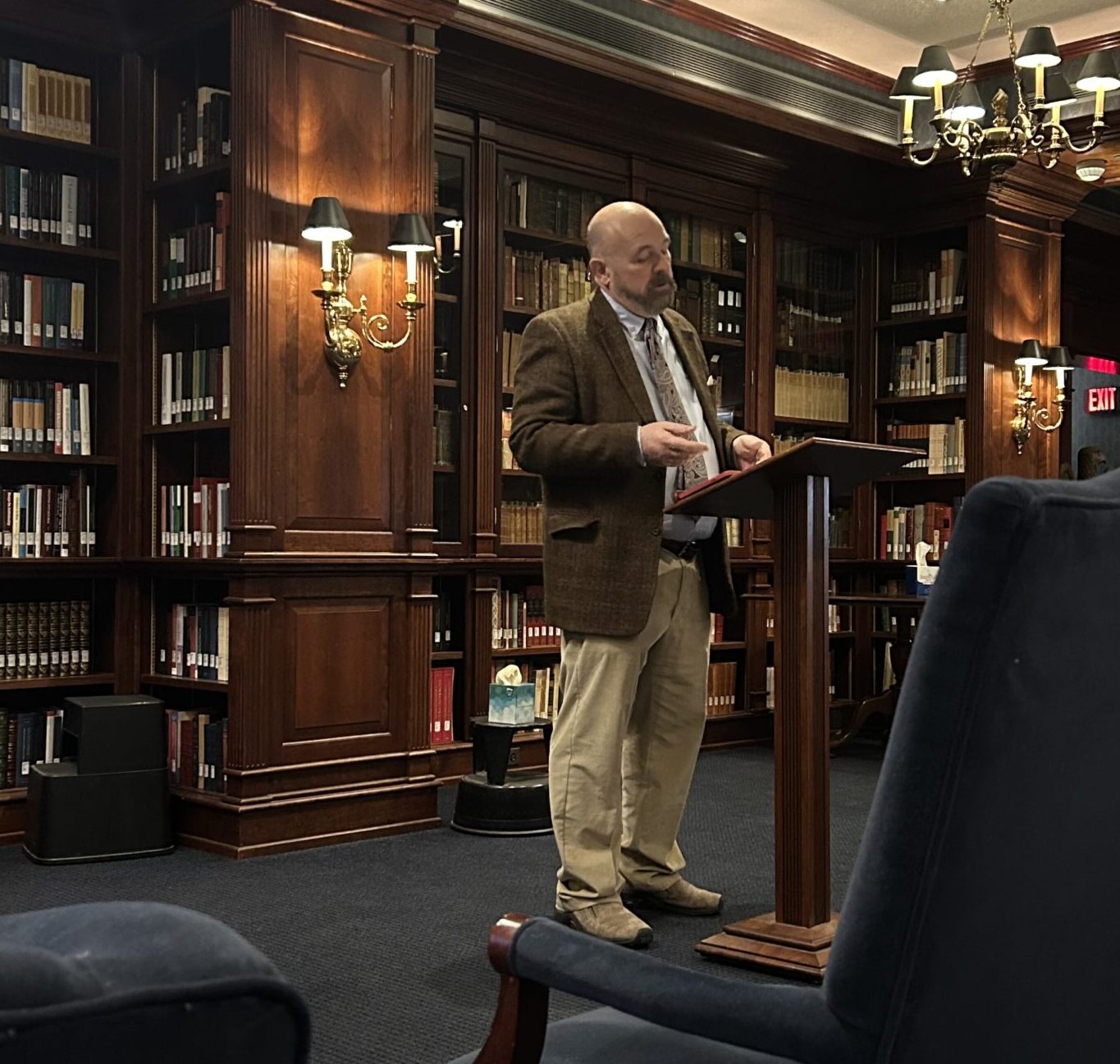
The Supreme Court has acquired too much power as the supposed referee of all constitutional disputes, Associate Professor of Government Bradley Watson said in a speech hosted by Career Services Feb. 7.
Watson, who teaches law and constitution for Hillsdale’s Van Andel Graduate School of Government in Washington, D.C., gave a lecture titled “Progressive Jurisprudence and the Crisis of Constitutionalism.” He said a modern understanding of the Constitution is shaped by progressivism, and it is the result of American philosopher John Dewey’s transformation of Charles Darwin’s model of natural selection into a social science.
“These doctrines have led to a very new view of constitutionalism that looks forward rather than backward,” Watson said.
Darwin’s ideas of natural selection were used to equate politics and jurisprudence with the natural sciences, Watson said.
“Together with their direct offshoot, social Darwinism and pragmatism had by the early 20th century coalesced into this powerful intellectual cocktail of progressivism which would radically influence the thought and the programmatic liberalism of a variety of political leaders,” Watson said.
According to Watson, incorporating these ideas led to viewing a society as something that must constantly change in order to survive. This idea, Watson said, challenged the Western belief that superior ideas were those that were static and unchangeable.
“All changes in the Greek understanding — the old Western understanding — were understood, according to Dewey, to be within the metes and bounds of fixed truth,” Watson said. “Nature as a whole comes to be understood as a realization of purpose. It has a telos, an end, and a purpose. That’s a big problem if you believe in change.”
Watson said these progressive ideas view society as an organism that must constantly change.
“To look backward for the social Darwinist to an old-fashioned, musty, dusty 18th-century constitution or any other fixed or otherwise obsolete standard of political ‘right’ reflects a kind of death wish,” Watson said. “Society can’t thrive by looking backward.”
According to Watson, these progressive ideas influenced the likes of presidents Theodore Roosevelt, Woodrow Wilson, and Franklin D. Roosevelt, as well as the jurisprudence of the Supreme Court, and continues to impact political and jurisprudence to this day.
“Progressive jurisprudence nowadays has largely divorced itself, rhetorically at least, from its Darwinian roots,” Watson said.
Today, political and social philosophies themselves have changed and expanded the meaning of truth, which Watson said means “truth” is now constantly in flux.
“The progressive intellectual synthesis always emphasizes evolution, experimentation, pragmatic and instrumental reason,” Watson said. “At some point, social Darwinism melds with that uniquely American philosophy, pragmatism, which suggests pragmatic experimentation to get to the next most interesting thing.”
Abraham Lincoln, according to Watson, believed it was necessary to look to the past in order to solve constitutional problems in the present day. Watson said this led Lincoln to agree with Plato and Aristotle in asserting that negative change in a society is always a possibility.
“For him, history is not destined to unfold in an ever more egalitarian democratic direction, because democracy itself, because of its indissoluble link with the passions, is always combustible,” Watson said. “Moral and political regress are as likely as progress, and perhaps more likely. Furthermore, there are certain fixed principles beyond which progress is simply impossible.”
Sophomore Jonah Swartz said Watson’s discussion of progressivism as a result of science was something he hadn’t considered.
“I enjoyed how he illustrated the development of progressivism as an intellectual idea, and not just a political idea — something that was underneath the political changes and something that swept in a lot more of an efficacious way,” Swartz said.
Watson said while many in power today want the ability to change the Constitution, it is important to the document’s integrity that it remain as the Founders intended, which junior Ashley Poole said she appreciated.
“I thought Dr. Watson’s delineation of the different views of history is important, where you have history as something to be moved by men, versus Lincoln’s vision of finite human nature that we can’t change like there are some unchangeable things,” Poole said. “We often don’t think about the unchangeable because it is uncomfortable, but that’s the central premise of a written constitution.”
