
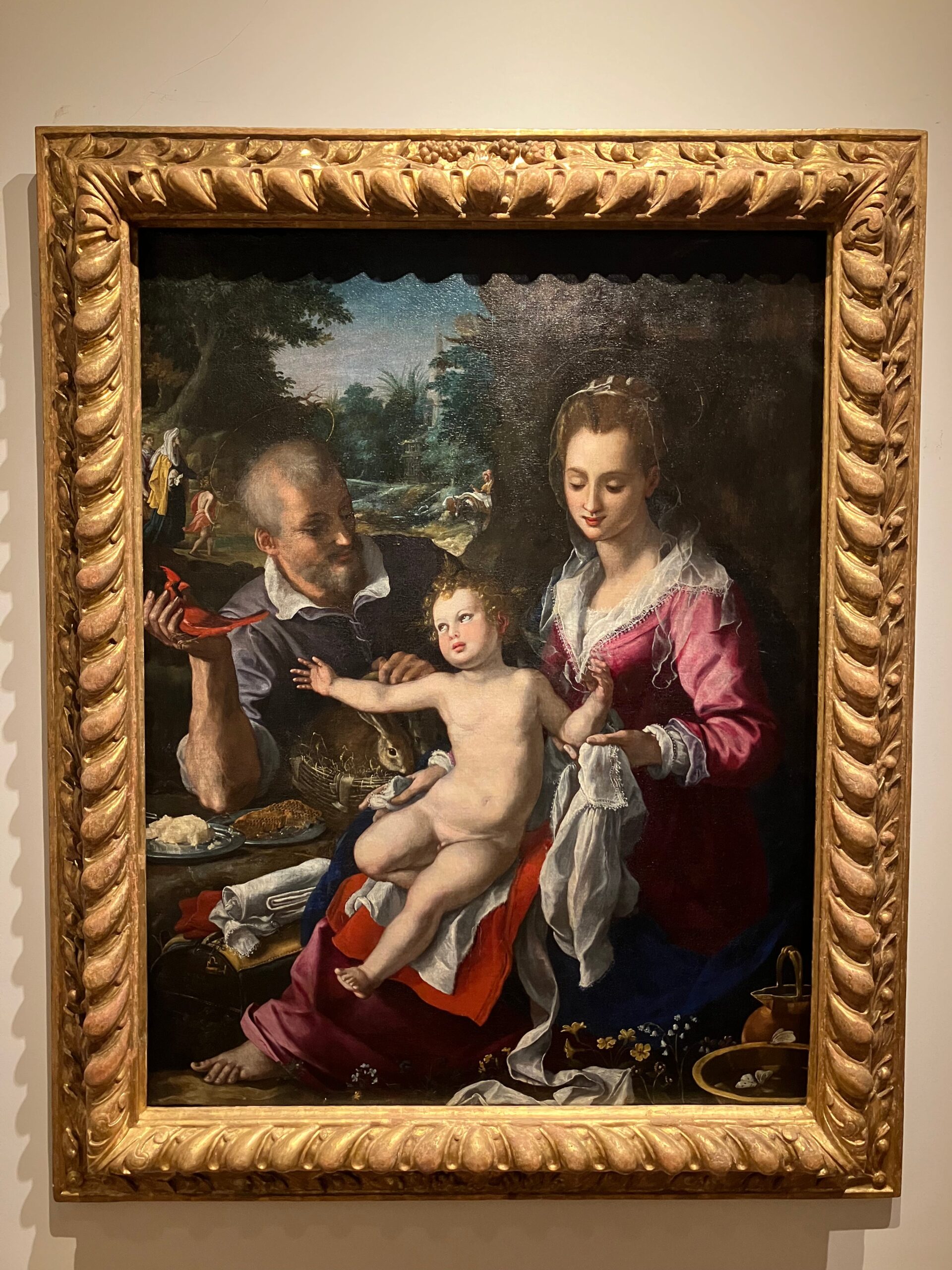
The Pisa Cardinalilio, by Allesandro Allori.
COURTESY | Thomas Brown
Thomas Brown solved a mystery of an old painting and a songbird after visiting an art museum in Portugal.
The painting, which depicts a bright red cardinal held in Joseph of the Holy family’s hand in the 1602 painting, is by Alessandro Allori called the “Rest on the Flight into Egypt.”
Brown began to wonder: how did the small bird end up in Allori’s European studio?
Brown, an art history lecturer at Rutgers University, presented as the keynote speaker at the Hillsdale College art department’s second annual art colloquium Feb. 8. He spoke about his research in a talk titled, “The Pisa Cardinalilio.” Following Brown’s talk, seniors Rachel Moeller, Emily Hardy, and junior Maggie McWhinnie presented their art research.
“My background made it easy to see that I was looking at something unusual, something whose existence I wouldn’t have expected,” Brown said. “I took some pictures and moved on, and the next day, I flew home to New York. It was only a few months later, but I began trying to answer the questions the painting presented me with.”
The questions were about the cardinal, which originates in eastern North America and parts of Mexico, and is clothed in deep red feathers and was named after the Roman Catholic clergy because of their similarly colored garments.
“From the age of 8 or so, I was a child bird watcher, always pestering my parents to take me to a nature preserve or wherever else I may be able to add a new species to my life list,” Brown said. “My favorite book which I read and reread was called ‘Collect: Ask for Birdman,’ a bird watchers account of an attempt to see 700 species in one year of birding in the U.S. and Canada.”
Brown said after seeing the painting at The Museu Nacional de Arte Antiga in Lisbon, Portugal, he researched Allori and the question of how a North American bird wound up in a European painting.
“There is not a great deal of scholarship on Alessandro Allori, who was a pupil of Angelo Bronzino and was one of the most prominent painters in Florence in the second half of the 16th century,” Brown said.
After years of investigating Allori’s correspondence, education, and background, Brown discovered the small bird had been shipped across the Atlantic to artists in either Pisa or Florence.
“The cardinal seemed grafted into the painting; its feet do not quite occupy the same place as the hand that holds it in a near grip. Still, Allori was given vitality. He could have seen it, either by visiting Pisa or else if the cardinal was sent on to Florence or to the aviary at Pratolina,” Brown said. “If he did not, he may have used as his source another drawing from life that has been lost. What is clear is that, unlike the Pietra Dura, Allori’s version is not based on ferocious watercolor. Allori is not known today for being attentive to birds, but he should be.”
Junior Claire Lashaway said Brown’s research was both inspiring and encouraging to continue her own art history research.
“He decided to focus on what was like searching for a needle in a haystack,” Lashaway said. “It took him close to a year’s worth of research — not just by staying close to the art object itself, but by digging into history and all the correspondence that went around and into that painting. It was very fascinating because I love seeing history link up with the visual art that comes from the time period.”
Assistant Professor of Art Christina Chakalova said the annual event is intended to provide students with the opportunity to present their scholarly work in a professional way.
“Primarily, there are so many students here who are thinking about graduate school, and it’s extremely important to have opportunities like that on your résumé,” Chakalova said. “When I ended up teaching here and having all these students do stellar papers, I felt like it was a shame to just grade that and put it in a drawer and nobody else gets to see that besides me.”
Lashaway said the colloquium allows students to express their research to their peers and experts in the art history field.
“The colloquium is intended to share all the findings of art history research, whether your specialty be in medieval art history or Baroque art history, it’s just a chance for anyone on campus or in any school that get in the U.S. or nationally to come together and present their papers and research and findings with each other,” Lashaway said.
Lashaway, who was on the student panel for planning the event, along with seniors Madelyn Bunch and Eleanor Vaughn, said the event featured three Hillsdale students who showcased their own art history research.
“We sent a call out to schools all around the U.S. and we also sent the call out to students on campus,” Lashaway said. “But this year, only students on our campus responded.”
McWhinnie, who presented on Thomas Cole’s landscape portrait and its contribution to Jacksonian America through developing national identity, said the colloquium was a good way to learn from other art historians.
“I thought it was great and I had such a fun time,” McWhinnie said. “It is a great addition to the art department, it’s such a good opportunity to bring a historian to talk about the piece.”
Lashaway said the colloquium was an opportunity to see how far one can go with just simple art analysis.
“The biggest takeaway is being inspired to continue on my art history research trajectory because I always found it fascinating,” Lashaway said. “It’s really awesome to hear somebody from a prestigious university showing us his methods and what he’s come to and then talking with us like peers.”
