
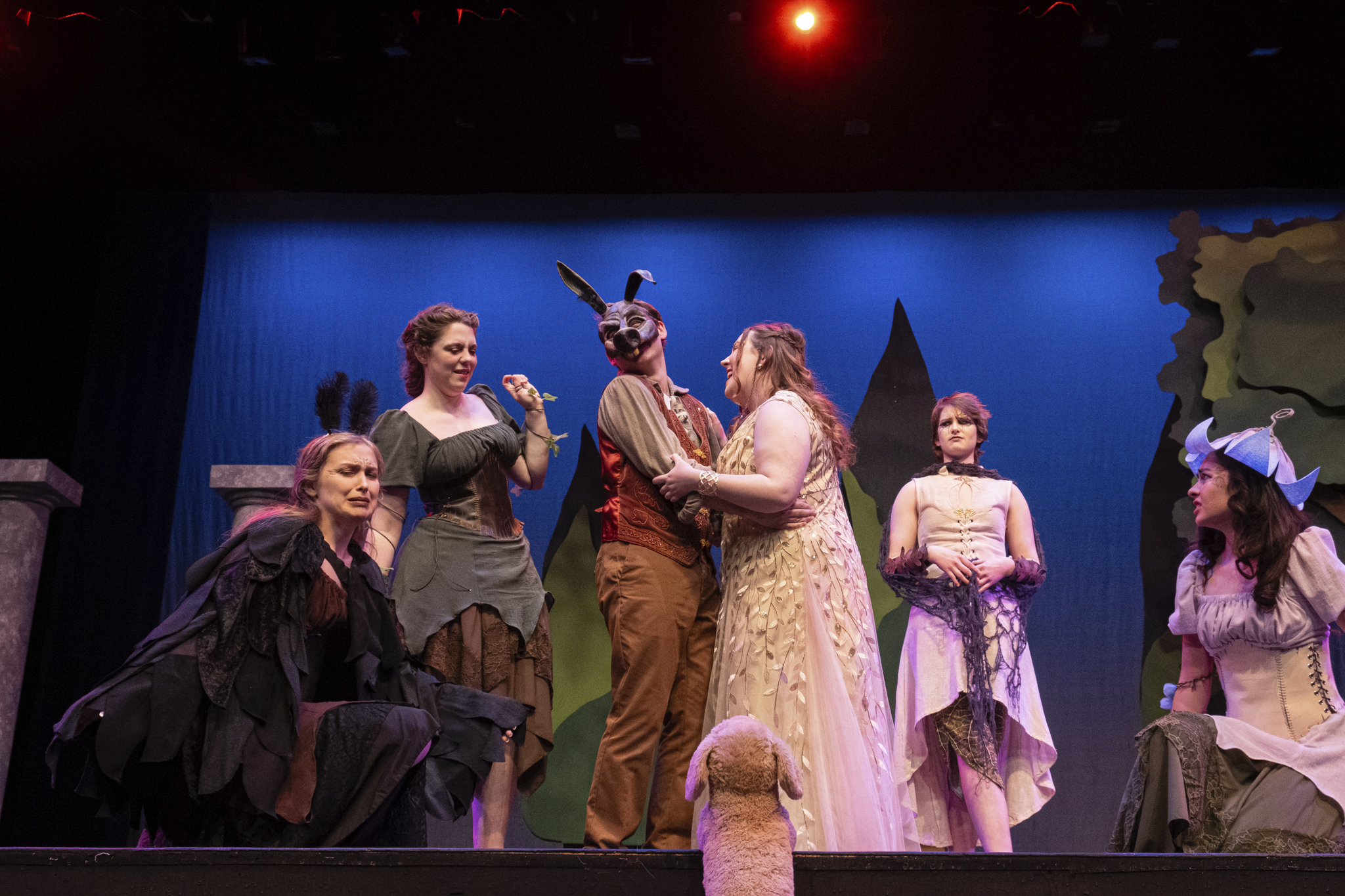
“A Midsummer Night’s Dream” will perform at 7:30 p.m. until Saturday March 1. They will perform a matinee on Sunday, March 2 at 2p.m.
When King Theseus of Athens tells the anxious lover, the beloved, and her disapproving father to “take time to pause” in Shakespeare’s “A Midsummer Night’s Dream,” the couple does not listen, sneaks out to the woods, and mayhem ensues.
In the woods, fairies play pranks, lovers and beloveds switch around, and it all culminates in a classic Shakespearian comedic ending.
Just as Theseus says to the lovers and father, so too does he say it to audiences. Take time this weekend to pause, head down to Markel Auditorium, and enjoy the Tower Players production of the Shakespearian performance as a respite from troubles up the hill.
The Tower Players premiered “A Midsummer Night’s Dream” last night and will perform again at 7:30 p.m. everyday through Saturday, March 1. On Sunday, March 2, they will close the show with a 2 p.m. matinee.
Christopher Matsos, director and chairman of the theatre department, said the play, first performed in 1595 in London’s Globe Theatre, is thought to be Shakespeare’s first as an established playwright.
“Even though it’s quite a light play in terms of its rich comic value,” he said, “it belies some heavier things, but I think people should expect to have a good time and to really laugh and enjoy the show.”
London in 1595 suffered bad harvests, flooding, and social unrest. With this context, Matsos said the play could be interpreted as a piece of escapism.
“I guess what I’m interested in about it is that, even though it might be considered a lighter piece, is there not great import in alleviating some of the stress of the world in that?” Matsos said.
The play certainly is light. Even the most serious characters, Theseus and Egeus, the king and disapproving father played by junior Aidan Christian and senior Nathaniel Privett respectively, lighten up by the end.
In the first scene, a confusing love square unfolds. Two male lovers, Demetrius and Lysander, initially both love Egeus’ daughter Hermia played by Marie Rohling, though Hermia loves Lysander. Helena, one of Hermia’s friends, is in love with Demetrius, though Egeus has arranged for Hermia to marry Demetrius.
Once the four flee responsibility in the woods, fairies enchant the two men with a love potion and they both start to love Helena.
Freshman Aidan Bauer and Marc Sherman ’24, who play Lysander and Demetrius, excellently play off the passionate lovers’ quick sway in emotions even though Sherman stepped in as an understudy less than a week before the first showing.
“We switched up a lot of movement and the way we speak to each other, but it’s worked out really nicely, which I’m appreciative of,” said sophomore Mara Seeley, who plays Helena.
Helena is Seeley’s first major role with the Tower Players, but it’s hard to tell by her performance. When she first got the role she said it was “absolutely terrifying.”
“We looked at the script, and Chris was like, ‘You’ve got three weeks to memorize everything,’” she said. “I was so scared immediately, because I talk so much and I was like, ‘I don’t know what I’m doing.’”
In one scene after the object of men’s affections has switched, Helena and Hermia begin an argument after many hurtful words have passed between the men and them. Seeley explained how she entered into the proper mindset for this scene.
“I think of one of my best friends from high school who had a boyfriend for about four years,” she said. “And I think if he started flirting with me really aggressively, how grossed out I would feel, and just how in shock I would be.”
Matsos said they worked extensively on this scene.
“They hurt one another. They say things out of their own desperation that they don’t really mean. And they’re also beguiled by fairy magic,” Matsos said. “It’s a long scene, and we’ve worked very hard for the actors to find that sort of bitterness in the relationships.”
The play contains three separate spheres of people: the high class, the fairies, and the low class called, “rude mechanicals.”
The fairies beguile the lovers in the high class, but also a character named Bottom — an eccentric character of the low class played by junior Kevin Pynes.
While the rude mechanicals are practicing a play they hope to perform for Theseus’ upcoming wedding, the mischievous Puck, a fairy played by Nina Morey, gives Bottom the head of a donkey as a prank.
Puck obeys the king of Fairies, Oberon, played by senior Mathieu Wiesner, with his own twists. Oberon, upset at Queen Titania, played by senior Emily Griffith, wants to prank her by making her fall in love with a beast. Puck decides the donkey-headed Bottom is the perfect beast.
“It’s actually so fantastic because Bottom is just this idiot who thinks he’s so good,” Pynes said. “I can just be as melodramatic as I want, just a complete idiot. Bottom has to believe he’s being sincere, but he’s stupid that what’s sincere for him can be just ridiculous.”
Pynes’ performance breathes a show-stealing life into the script, showing the great versatility that Shakespeare’s words can have on stage.
“You just can’t take any of the words for granted,” Pynes said. “You have to know what to do with all of them.”
Among the rude mechanicals’ troop are the two senior women, Kenda Showalter as Snout, and Fiona Mulley as Starveling, who have both had leads in past Tower Players productions.
“This is everyone’s last chance to see Emily, Kenda, and Fiona on stage in their college careers,” Seeley said. “Everyone has loved everything they’ve been in so far so I think this will be a really good closing show that everyone needs to make sure they see.”
