
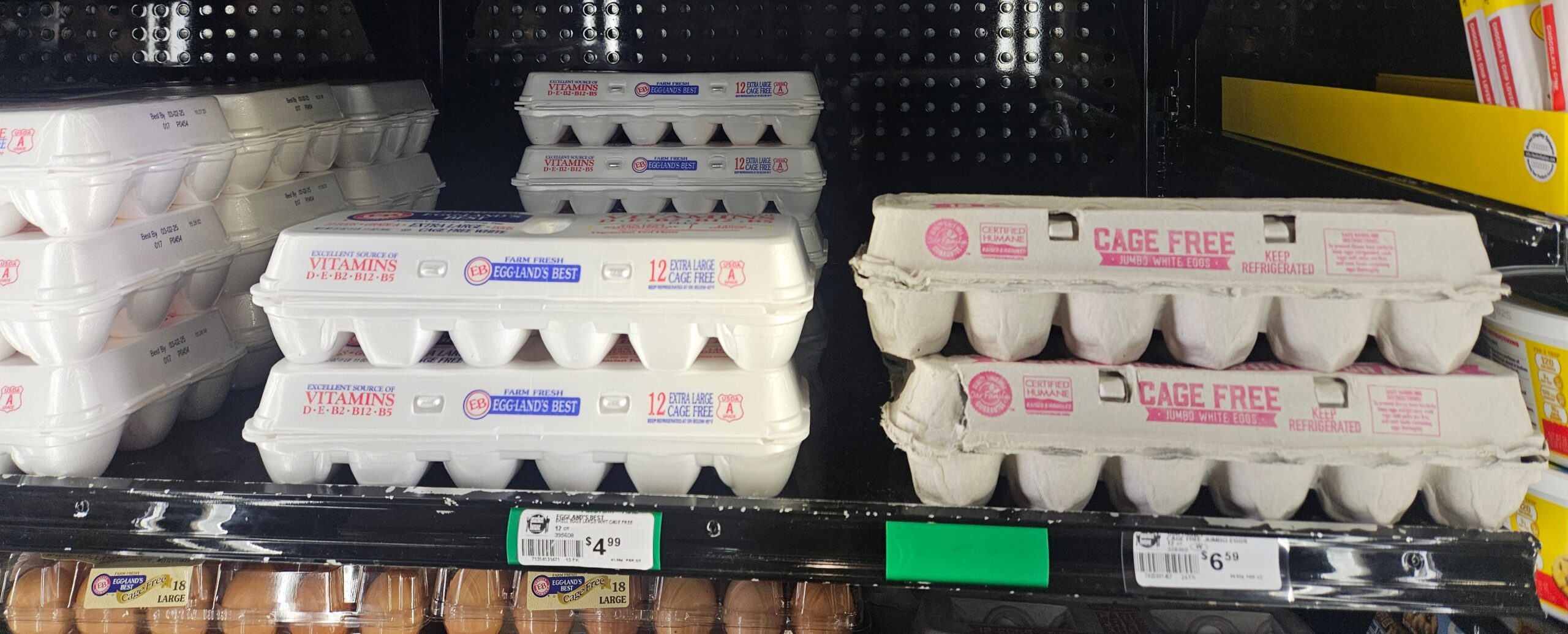
Egg prices have risen as much as two dollars a dozen, according to Brett Boyd. Christina Lewis | Collegian
For many Michigan residents, the new cage-free eggs law isn’t going to fly.
Since Jan. 1, all eggs from Michigan farms with 3,000 or more chickens must be raised cage-free. The cost of a dozen eggs has increased in tandem with the bird flu, leading some locals to wonder when prices will improve.
“Today’s costs are quadruple what they were five years ago. But, yes, we’ve seen eggs jump one to two dollars a dozen since the cage-free mandate went into effect,” said Brett Boyd, owner of Hillsdale Market House. “It started on Jan. 1, but rapid inflation started in early December.”
Two weeks ago, Boyd reported a dozen large eggs cost $4.08 for wholesale, and Market House sold them at $4.99 retail. As of last week, the Hillsdale Meijer also sold their store brand dozen eggs for $4.99.
“The market has really been fluctuating,” Boyd said. “We were $3.99 a dozen last week but with the increase in costs to over $4 a dozen, we had to move up. The egg market ‘cost’ changes happen once a week, but retailers will make retail changes almost every day based on what they have in inventory.”
One local politician, State Sen. Jonathan Lindsey, R-Coldwater, said he is looking into solutions to the egg crisis.
“I am currently drafting legislation to address the unnecessary regulations that drive up the price of eggs and look forward to sharing more soon,” Lindsey said. “If consumers want cage-free eggs they should always be free to buy them, but it is inappropriate for the government to dictate that those are the only eggs that can be produced and sold in Michigan.”
According to Hillsdale State Rep. Jennifer Wortz, R-Quincy, the Animal Industry Act was originally passed in 2009 as a space requirement for caged chickens. The bill expanded in 2019 to mandate cage-free eggs, but the Republican legislature delayed its implementation until 2025. The Michigan House chose not to extend the delay.
“It could have been [delayed], had the legislature wanted to bring up a bill to delay it, but that would have had to take effect before the end of last year, and even before then our stores and producers had started to prepare for the new rules,” Wortz said. “Now, our shortage of eggs can no longer be sourced from other states that don’t have this law.”
Wortz, who owns a small family farm in Branch County, says she would not have supported the bill. She cited that 6.5 million hens were euthanized in Michigan in 2024 alone to combat bird flu.
“I believe people should have the freedom to choose which eggs they want to purchase in the store,” Wortz said. “There is actually an increased risk of disease in a cage-free facility, and it’s quite possible that the avian flu is spreading more easily because the chickens are in larger groups than if they were in cages. There is also no data to suggest that a bird in a confinement barn is less stressed in cages versus no cages.”
Hillsdale County farmers have felt the effects of the new policy, according to Wortz.
“Egg producers knew this change was coming, so they’ve worked for the past several years to make changes within their barns to be prepared for the new law,” she said. “Unfortunately, in retail, there are some issues with wholesalers in my district who distribute eggs to both Ohio and Indiana, who do not have the cage-free requirement.”
The new law mandates all Michigan restaurants and stores sell cage-free eggs, leaving the responsibility to not only farmers but retailers. Boyd said many of his customers are expressing concerns over rising costs.
“I feel bad for the consumer,” Boyd said. “Things have settled some, but $4-5 a dozen is frustrating for almost everyone. This increase in the cost of eggs has impacted customers in our stores and in Sharon’s House of Pancakes as well. Customers repeatedly say they just want their farm fresh eggs back around $1 a dozen.”
Send tips to the City News team: collegiancitynews@gmail.com