
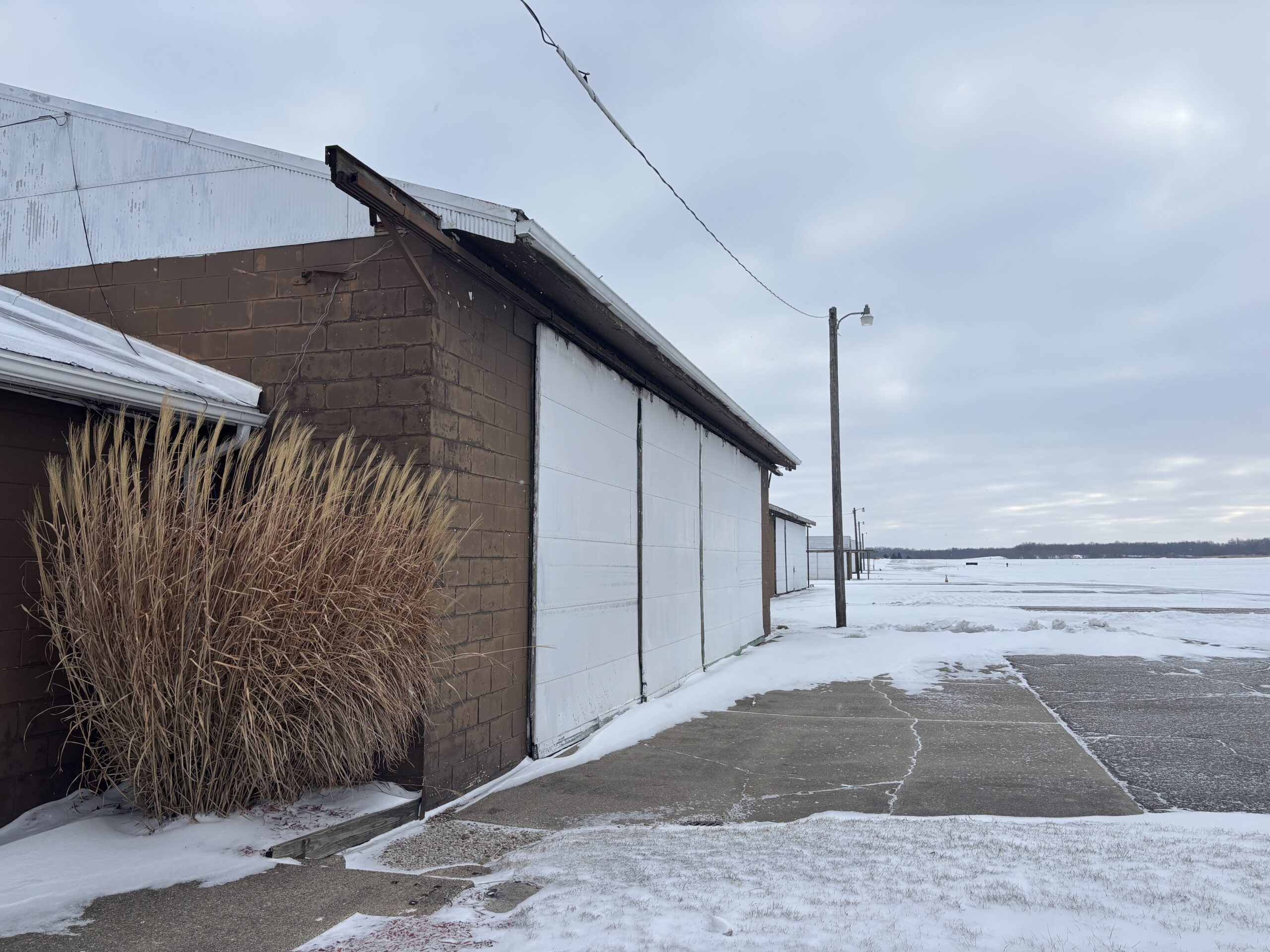
Hillsdale Municipal Airport T-Hangars house 5 T-Hangars per building. Jillian Parks | Collegian
The money will come from the airport’s improvement fund, not the city’s tax funds
The city council approved a $105,000 repair to the Hillsdale Municipal Airport‘s T-hangars in an 7-1 vote on Jan. 21, with Councilman Matt Bentley opposing the measure.
The money will be taken out of an airport improvement fund that has been saved up from fuel sales and hangar rent instead of the original proposal to withdraw money from the city’s general fund. The move comes as Acting Mayor Joshua Paladino aims to wean the airport off city tax money in the future, making it self-funded by revenue.
The hangars, or enclosed structures that house small aircraft, have not been repaired since they were built in the 1960s. Repairs will include replacing rotted wood on the exterior, rebuilding the doors, and repainting the structures.
“The T-hangars are in poor shape, and we need to fix them,” Hillsdale Municipal Airport Manager Ginger Moore said. “The reason why we could even get it at the price that we did is because [Hillsdale Municipal Airport Line Manager] Steve Boyd and his assistant [Ashley Kinsley] are going to do it themselves, which is a lot of work.”
All of the airport’s T-hangars are currently being rented with a consistent waiting list of about five to six people. Moore saud the money will cover the materials needed to repair the main building with three T-hangars and a maintenance T-hangar attached, the stand-alone corporate T-hangar, and three other buildings housing five T-hangars each.
“We actually had contractors come in here and quote just the main building and corporate T-hangar. I think it was $113,000 for them just to do the two buildings, not touching the other three,” Boyd said. “So we’ve got the price down.”
Boyd said he plans to have the new doors built by spring, so he can work on replacing the wood, painting the building, and rehanging the new doors come summertime.
“We’re hoping to have our grand opening on Sept. 14, which is the same day as our big fly-in day,” Moore said.
Over the past eight years, the airport has taken an average of $160,000 in property tax revenue a year from the general fund, according to Paladino. Moore said this goes toward wages, maintenance on the equipment, contract services, and utilities, among other things.
The airport brings in an average yearly revenue of about $250,000, which goes into an airport improvement fund that is saved to pay for a portion of projects, such as adding terminals and taxiways, that is needed to get grants.
Paladino said his ideal would be for revenue neutrality to sustain the airport to function on its revenue alone in the future, as the city should budget money for other priorities first.
“My expectation is that [city money] goes to things that serve the common good of the people,” Paladino said. “The folks at the airport, the city manager, the majority of council, make the argument that the airport serves a common good. I think there’s an argument for that, but it’s not anywhere close to the argument that roads or water quality or public safety serve a public good.”
Executive Director of the Hillsdale County Economic Development Partnership Sue Smith said she is skeptical that revenue neutrality would be possible for the airport.
“There are some things that are excellent assets, but are not necessarily ever gonna make a big profit,” Smith said. “We don’t have a community college, but most community colleges are an asset in a community, and they will never be self supporting because they are funded by millage, and then they have administrative costs that they get funding for.”
According to Aviation Specialist Hilary Hoose from the Michigan Department of Transportation, the Hillsdale Municipal Airport generates $3.9 million in local labor income and more than $12 million in local output, just as direct effects.
“I’d say 99.9% of the airports are not self sufficient, but it’s about the return to the community, what the community gets out of the airport, as far as money being invested back in,” Boyd said. “We have people flying here, investors, just to look at buying companies, buying this, buying that, here locally. That’s big bucks.”
Paladino said he understands that argument, but revenue neutrality would still be something he hopes to see the airport working toward over time.
“My point is if they can’t generate revenue to pay for their costs, then they’re not economically viable,” Paladino said. “I’m willing to work with it. Give it time. If it draws $30,000 from the general fund in one year because of a slow year, OK. It is what it is. But when it’s this consistent budget item that is preventing us from building the roads without special assessments, I think that’s a huge problem.” Send tips to the City News team: collegiancitynews@gmail.com