
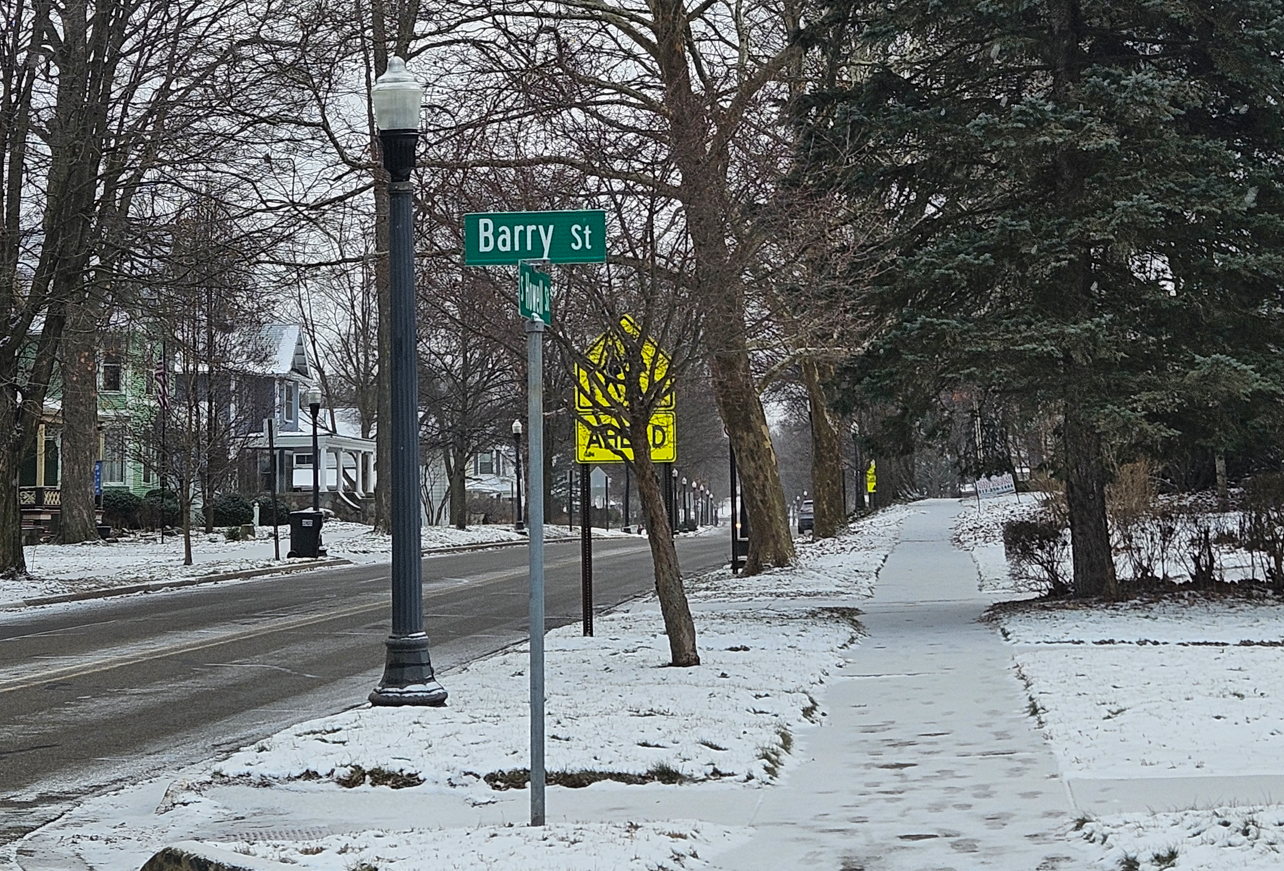
Barry Street residents sign petition to oppose SAD. Christina Lewis | Collegian
Barry Street homeowners have gathered enough signatures to opt out of the city’s road repair program that would charge each resident $5,000.
Unless a supermajority of seven out of eight councilmembers vote to override their opposition, Barry Street residents will become the second group of homeowners in Hillsdale to reject a “special assessment district,” which designates dilapidated roads for repairs. The city council will hold a public hearing on March 3 where they will vote on whether or not to move forward with the Barry Street SAD.
The city began using SADs to fund road repairs in 2021. Homeowners in a SAD are required to pay up to $5,000 to fund road construction in the district unless they collect enough signatures from other residents in the SAD to opt out. If homeowners are unable to pay this amount, the city imposes a $5,000 lien on their home for a 10-year-period with a 6% simple interest loan.
About 75% of the city‘s roads are in “failing condition,” City Engineer Kristin Bauer told the city council in October. Hillsdale City Manager David Mackie said SADs allow the city to undertake necessary road construction.
“Special assessment districts provide significant value by enabling the city to complete critical infrastructure repair projects that would otherwise be delayed due to limited funding,” Mackie said. “It’s important to note that city staff actively pursue every available grant and use state funding whenever possible to maintain and repair our public infrastructure. However, special assessment districts are typically recommended for projects requiring complete road reconstruction.”
While some city officials argue the SAD proposal will benefit residents and justify the costs, homeowners and renters on Barry Street have their doubts.
One homeowner, Timothy Polelle ‘19, a Ph.D. student at the Van Andel Graduate School of Statesmanship, started a petition against the Barry Street SAD and collected 19 signatures from his neighbors. For the city council to consider the petition, more than half — roughly 15 out of the 29 — of the homeowners on Barry Street had to sign the petition. Only one person declined to sign when Polelle asked, he said.
“Some councilmen and city staff have acknowledged that SADs like this do stink, but say they must continue indefinitely because other citizens have had to pay it in the past,” Polelle said. “In other words, since the city government has harmed some people unjustly in the past, fairness requires it to continue to harm others until everyone has been hurt.”
Polelle said he began the petition after Ward 4 Councilman Robert Socha suggested it to him and explained how it worked legally.
“Everyone on my street has a pretty low income, so I knew this was going to be very painful for everyone if no one did anything,” Polelle said.
Przemyslaw Grzesiak, a landlord on Barry St. said that if the city passes the SAD proposal, then he will need to increase his tenant’s rent.
“The SAD proposal is saddening,” Grzesiak said. “City council wastes money on superfluous projects such as the Municipal Airport which don‘t benefit the average Hillsdale resident.”
Socha said he does not believe the council will override Barry Street residents’ request to opt out of the SAD. But he also said SADs are currently the city’s best option for dealing with the cost of road repairs.
“Unfortunately, the city‘s infrastructure is in a desperate state and it‘s requiring some austerity to make some headway,” Socha said. “Even with these special assessments, we‘re still behind the eight ball. Hopefully we will continue to think and another solution will present itself. But in the meantime, the SADs are the only way that I see us getting some serious infrastructure projects completed.”
This is not the first time Hillsdale homeowners have voiced their concern over SADs. In 2021, Elm Court residents stopped the creation of a SAD for a proposed project in their area.
“As a result, the road portion of that project did not proceed, and the city shifted focus to other areas that did not oppose special assessments,” Mackie said.
Ward 1 Councilman Jacob Bruns, who had to pay the $5,000 fee for a SAD when he first moved to Hillsdale, said he is glad Barry Street residents were able to come together to collect enough signatures to oppose the SAD.
“The method, by which consent to SADs is ‘affirmed,’ is duplicitous in my opinion — assuming that, in the absence of any formal written objection, any given citizen in a given district is in favor of the assessment,” Bruns said. “I‘m not sure where this method came from, but it is precisely the opposite of what it ought to be; the burden of affirmation should fall on those who desire extraordinary action. The current method, by contrast, is designed to slip the assessments by unsuspecting residents.”
Homeowners Brandon and Autumn Traxler, who have lived on Barry Street with their family for five years, also signed Polelle’s petition.
“You‘ve seen Hillsdale, it doesn‘t really have the funds, and a lot of residents aren’t even middle class, a lot of them,” Autumn Traxler said. “So it’s hard, none of us have private jets here, so that makes no sense for us to utilize that.”
Brandon Traxler suggested the town allow a dispensary to open.
“They [the dispensaries] are giving out money to the cities that do have the dispensary note,” he said.
As a renter on Barry Street and voting member of the city, Jonathan Pollock said it would be better for the city to just tear up the road and leave it as gravel if residents cannot afford to maintain them, especially since Barry Street is not a thoroughfare.
“It‘s terrible to have to drive on rattly roads, but I would rather drive on a pothole road and not have a tax, an extra tax, levied to fix something that already should have been accounted for,” Pollock said.
According to Pollock, the city should establish a rainy day fund to maintain the infrastructure it built.
“There is a mismanagement going on at a higher level and their answer is to saddle the residents who already pay taxes with an out of the blue $5,000, an expense that if you can’t pay, they put a lien against your house.” Pollock said. “It’s criminal.”
Send tips to the City News team: collegiancitynews@gmail.com