
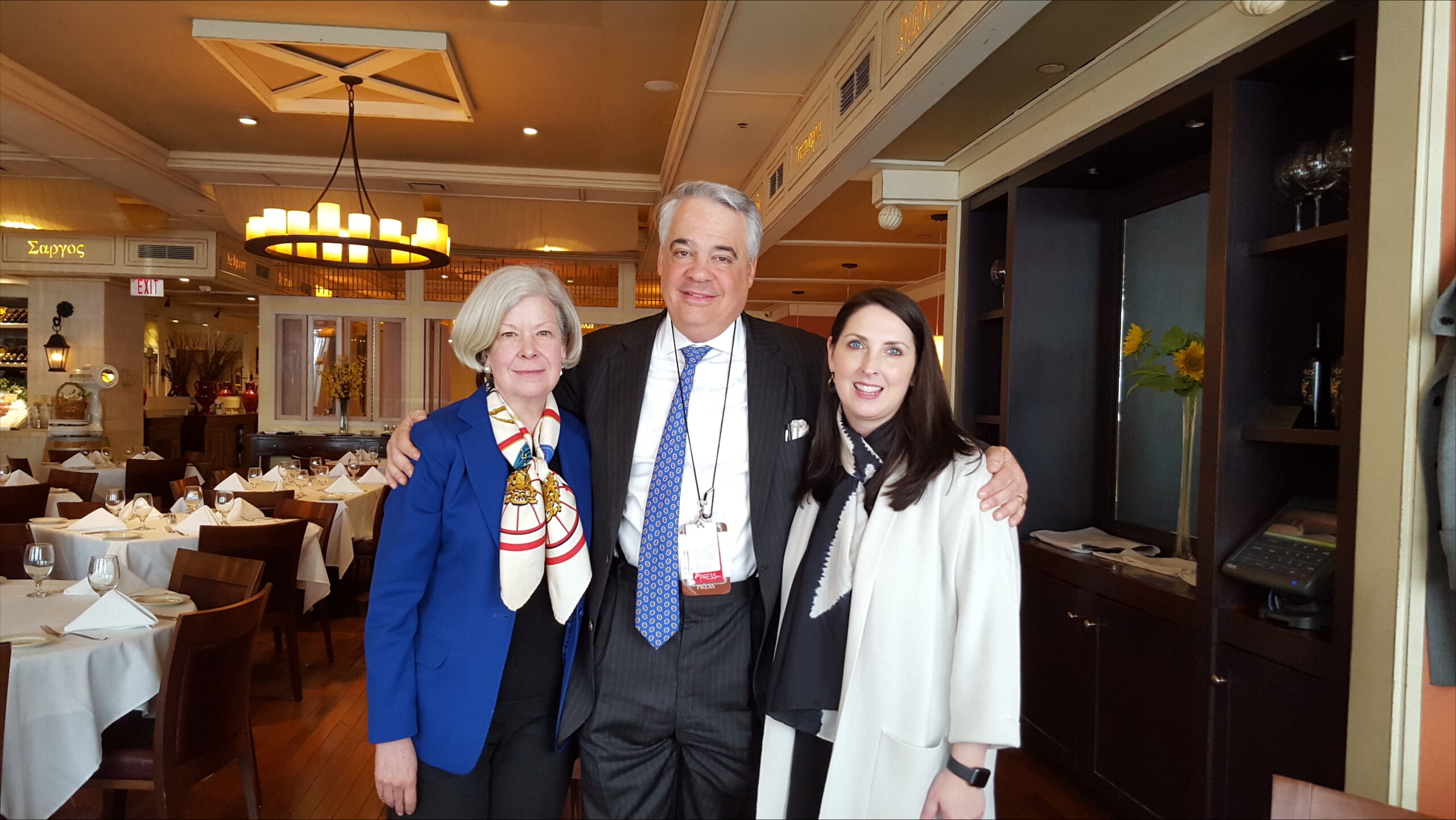
Colleen House (left) and John Gizzi (middle) pose former Republican National Convention Chairwoman Ronna McDaniel (right). Courtesy | John Gizzi
Journalist John Gizzi –“the man who knows everyone in Washington,” according to Newsmax – donated 23 boxes of his personal papers to Hillsdale College. These letters, emails, and other correspondence make up an anthology of conversations between Gizzi and some of the world’s most prominent figures.
“My late mother always told me that you write thank-you notes to people, and she’d be very cross if I didn’t have notes to my aunts for their gifts,” Gizzi said. “This is all my correspondence with people.”
Gizzi, a Newsmax reporter and White House correspondent, donated thousands of documents to the Hillsdale College Archives and Special Collection two years ago. In addition to his own letters, Gizzi donated the papers of his late wife, Colleen House, who was the first woman to run for Michigan governor.
Gizzi said he donated the documents to Hillsdale College out of both respect for the college and to honor House, his wife.
“I’ve always admired Hillsdale,” Gizzi said. “My wife is from Michigan, and she was an important figure in Michigan politics. I thought it would be a way of honoring her more than me.”
These documents are a physical representation of Gizzi’s vast network of connections. Gizzi owns 60 vintage Rolodexes, which contain business cards from 45 years of contacts, 50 states, and 90 countries. During his 45-year career as a DC political journalist, including a stint at the conservative publication Human Events, Gizzi rubbed elbows with international leaders like the prime minister of Greece and presidents such as Jimmy Carter, Ronald Reagan, and George H. W. Bush. Once, Reagan gave Gizzi a signed postcard to send to his wife, which he still has to this day.
“The last time I saw President Reagan, which was June of 1992, he told me, ‘Keep up the good work there,’” Gizzi said.
Tim Carney, a reporter for the Washington Examiner who worked with Gizzi at Human Events, said Gizzi is not only well-connected, but he will talk to anyone, even if he is politically or socially unimportant.
“One day, he said, ‘You can tell a lot about somebody by how they treat people from whom they don’t think they have anything to gain,’” Carney said. “I just remember that sticking in my mind, just thinking, ‘OK, how do I treat people? Do I only look for gain or do I try to help them out?”
Senior Micah Hart, who interned with Gizzi at Newsmax in the summer of 2022, said he admired both Gizzi’s professional skills and personal qualities.
“He is one of the most iconic journalists in D.C., not just because he’s a great reporter, but also because of who he is as a person,” Hart said. “He is one of the nicest people. He will remember everything about you. He still sends Christmas cards to my family.”
Gizzi said the donated documents contain letters from famous politicians, such as Vice President Spiro Agnew, a Republican who resigned his position due to tax-fraud charges in 1973.
Other documents detail some of Gizzi’s favorite controversies.
“I had one representative from Oregon, Peter DeFazio, who said I had a story wrong,” Gizzi said. “He said that I said he was re-elected with 52% percent of the vote. He said he got 54% of the vote, and that if I didn’t correct my error, he would take legal action. I basically wrote a story afterwards with the headline: ‘Human Events to DeFazio: Get Lost.’”
Hart said the documents represent the legacy Gizzi is leaving in D.C. as a conservative political journalist.
“I think it’s important that we have these documents, because he stands for all the values that we stand for,” Hart said. “It’s always good to have work from good, sound journalists who actually care about integrity and care about getting the facts and getting things right. And his work, whether it be personal work or political work in journalism, everything he does is beautifully done.”
Gizzi has made a mark in politics through his impressive connections, but his wife House, who died two years ago, trailblazed new paths for women in politics during her career in the 1970s and ’80s.
At age 22, House became the youngest woman to serve in the Michigan legislature in 1974. Her victory as a Republican candidate in her historically-Democrat district made national news, earning her an invitation to then-Republican National Chairman George H.W. Bush’s telethon, which was canceled last minute after President Richard Nixon’s resignation.
She went on to marry future governor John Engler, who she divorced years later, and run for Michigan governor herself in 1986. Although she lost in the primaries, she made history as the first female to run for the position, and was asked to run as the nominee for lieutenant governor.
“She was a seventh generation Michigander, and an important figure,” Gizzi said. “I still meet people from Michigan who remember her. Once, I was at Mackinac Island for their Republican conference, and I met then-representative Andrea LaFontaine from Macomb County. She said to me, ‘Hi John Gizzi, I’m the second youngest woman elected to the Michigan Legislature. I’m 23, you know, right after Colleen.’”
After she lost the gubernatorial race, House moved to D.C. to work in the George H. W. Bush administration and then later at the International Republican Institute.
“I remember I was brought to tears just because of how amazing this woman was,” Hart said. “She was heavily involved in Michigan politics for a while, and was known by so many people. People would come and visit her, like from Congress, and people in Republican spheres. They knew her because she was such a trailblazer in Michigan.”
Through her D.C. connections, House met Gizzi in 1987, who immediately fell in love.
“I wanted to marry her right away,” Gizzi said.
But House was initially less sure about her affections. Over the next 13 years, she rejected Gizzi’s proposals three times. It took a national tragedy, 9/11, for House to admit that she did not want to be alone. The political powerhouse couple married in 2002.
“Gizzi’s Law No. 1 says persistence overcomes resistance, so I persisted, and we were married, and had 20 beautiful years together,” Gizzi said.
Gizzi said House was always a take-charge person, but soon after she retired in the mid-2010s, he noticed she was starting to slow down.
“I started to get calls and notes about bills not being paid, and I learned fast that she had dementia,” Gizzi said.
Through a “caregiver from heaven,” Gizzi ensured that House was comfortable for the rest of her life. On Christmas Eve 2022, the day House died, Gizzi said he was talking to her about potential charitable donations when she said her last words.
“I went over and talked to her, and her last words to me were, ‘Thanks for all the time you spend with me,’” Gizzi said.
Gizzi said he thought this was strange because he was often traveling for work. But a little while later, House fell asleep and never woke up.
Hart said Gizzi’s love for House persisted until her final moments.
“They loved each other so much, and he cared for her so much,” Hart said. “He would always talk about her and always care for her. He had to be a little late to work because he was taking care of Colleen. That’s what he would do, because that was his wife and they were meant for each other.”
Now, Gizzi’s love lives in boxes of documents in the Hillsdale archives. Hart said that it is a huge deal that Hillsdale has these documents that represent the values of both Gizzi and House.
“Gizzi poured his life into his work, everything he did is written on these papers, and it’s a big deal and an honor for him, who has no real tie to the college, to give them to us,” Hart said. He could have given them to his alma mater, but he gave them to us, and that just shows that he loves the work we’re doing here.”