
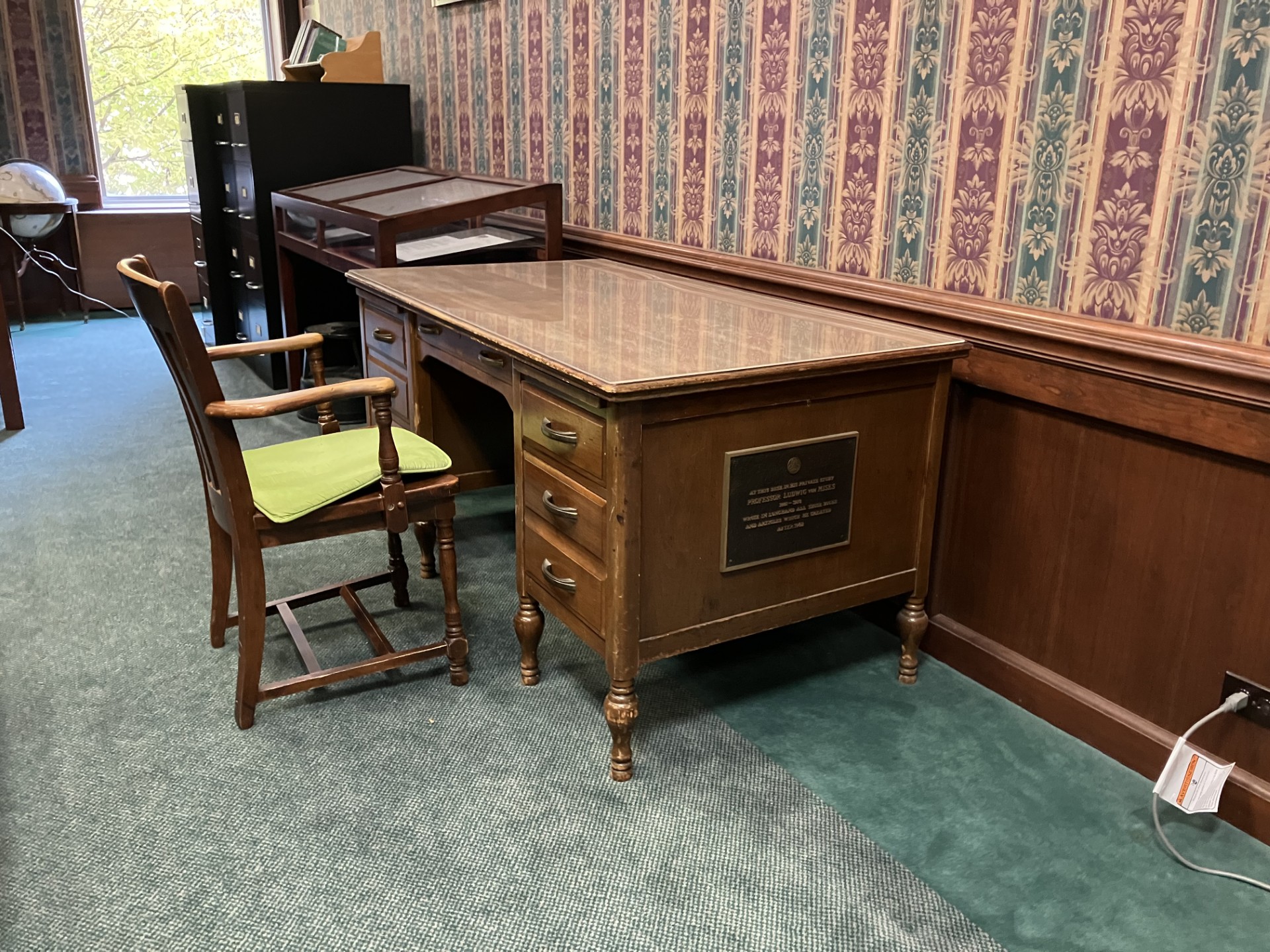
Von Mises’ personal work desk (post 1942) in Mossey L ibrary.
Colman Rowan | COLLEGIAN
The Ludwig Von Mises Room in Mossey Library was established to hold the personal library of Ludwig Von Mises, purchased by Hillsdale College, who escaped from the Nazis and emigrated to the United States during World War II.
Von Mises was a 20th-century Austrian economist. Hillsdale’s relationship with him follows from the purchase of his library after his death, and the trip of a Hillsdale professor into Moscow to discover lost documents of one of Europe’s greatest economic thinkers.
Senior Economics major Geert Ensing said the Von Mises collection is an important part of Hillsdale’s conservative tradition in free market economics, drawing students to Hillsdale — including himself.
“The reason I came to Hillsdale College was actually to study Von Mises’ work. I found out about the library and I found out they taught courses on Austrian economics,” he said. “His work is kind of considered more heterodox; it’s not necessarily the orthodox mainstream economics that you’re taught at the undergrad level, but his work still permeates a lot of modern theory.”
Von Mises was an important figure in the Austrian School of economics, which stresses the importance of individual agency in economic theory, Ensing said.
“He really persisted on the importance of the free market of individual human action and agency and how those relate to foreign societes, to forming the way the modern day world works,” he said.
Von Mises’ story began in the early 20th century according to Associate Professor of Economics Charles Steele.
“In World War I, he was in the artillery in the Austro-Hungarian empire, and of course then they lose, he comes back, and he’s a professor,” Steele said. “He’s not actually a professor at the University of Vienna, he was passed over basically because he was Jewish. There was a lot of antisemitism. He was a classical liberal and there was also a lot of opposition to that at that point. A lot of people thought Marxism was the wave of the future.”
World War I drove Von Mises to look into the causes of war, and particularly how to prevent it, Steele said.
“He thought there were classical liberal solutions to that. He also wrote on the issue of socialism and did groundbreaking work there,” Steele said.
As the Nazi Party rose to power, Mises planned to flee to the west.
“Twenty-four hours after they left, the Nazis moved into Vienna. Within 24 hours of that, they raided his house. He wasn’t there, but they seized his library and it was gone,” Steele said.
His library was brought to a Gestapo depot in Bohemia, where the Red Army recovered it in May 1945. Thus, according to Steele, even though it had been assumed lost by Von Mises, it was brought to Moscow and preserved.
Mises’s second library, collected in the United States, was acquired by Hillsdale.
“I believe it was purchased shortly after Dr. Mises’s death in 1974, and I believe it was a purchase from his widow. That’s been a little murky.” Library Director Maurine McCourry said.
According to McCourry, the collection is composed primarily of books. The collection consists of more than 2,500 items in 21 languages, including German, French and Hungarian.
“This was the collection that he built after he fled Nazi Austria,” Steele said.
The room also contains one of Mises’s own private working desks, purchased with the original collection in the 1970s. On the east side of the room is a bust of Mises, sculpted by Heather Tritchka ’98, who also sculpted the statue of Winston Churchill in the Grewcock Student Union.
Former Hillsdale Professor of Economics, Richard Ebeling, and his wife, Anna, rediscovered Mises’s original Vienna library when they visited Moscow in 1996, according to McCourry.
“He and his wife went to Moscow to see the archives — the Russians had them,” McCourry said. “The Soviet Union actually allowed them to make photocopies.”
Among the papers Ebeling discovered were World War I military records, letters and postcards to family, as well as correspondence with Friederich Hayek. The papers photocopied by Ebeling were brought back to the library in Hillsdale.
Steele said that for students wanting to familiarize themselves with Von Mises, he recommends “Liberalism,” “Omnipotent Government,” and “Economic Calculation in the Socialist Commonwealth.”
“If you want the full experience you sign up for my Econ 413 class, and you read ‘Human Action,’” Steele said.“We work through it. It’s a complete course in economics, and in some ways it’s the best course I’ve ever taught in econ.”