
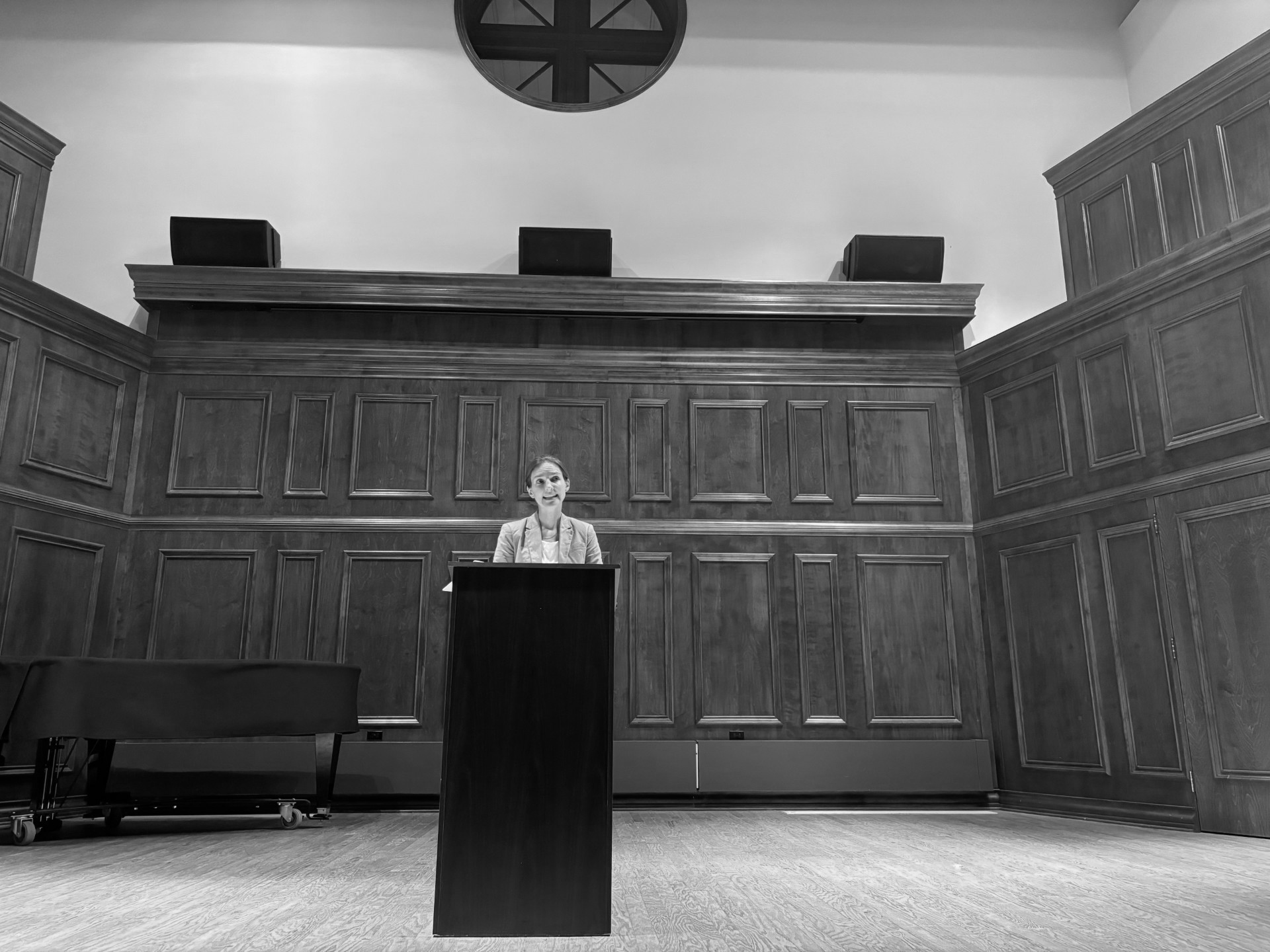
Melinda Nielsen
Aurelia Mayer | Collegian
Students should remember Lewis’ legacy, not only as a theologian and a writer, but also as an Oxford educator, according to Melinda Nielsen, a Hillsdale alumna and associate professor of classical literature at Baylor University. The lecture, “Education, Gift, and Freedom: C.S. Lewis’ Idea of the University,” was hosted Nov. 12 by the C.S Lewis Society.
“It’s too easy to forget, perhaps, that although he is best remembered as an author or theologian, Lewis spent the entirety of his adult life as a teacher, and his writing, whether explicitly or not, arises in that context,” Neilson said.
According to Neilson, Lewis derives his thoughts on education both from his own experience as an oxford professor and as an avid reader of Plato, Erasmus, John Henry Newman, and George McDonald.
When one examines both Lewis’ writings and intellectual concepts, two things become apparent, according to Nielsen.
“First, for Lewis, education, in its core, is a gift between persons, not a method, a curriculum or a community,” she said. “Teachers get what they have, but only contingently because the gift was first given to them.”
Quoting Lewis, Nielsen said that “teaching a child writing, you hold its hand while it forms the letters: that is, it forms the letters because you are forming them. We love and reason because God loves and reasons and holds our hand while we do it.”
Nielsen argued that at the end of education is a gift passed down to younger generations.
“Put the recipient in the state where he no longer needs our gift,” Nielsen said. “We feed children in order that they will soon be able to feed themselves. We teach them in order that they might not need our teachings.”
Nielsen explained to the audience how C.S Lewis distinguished education and learning.
“Schools, secondary high school education as well as middle school should be centers of education, as opposed to universities or colleges that provide the opportunity for learning. Education is the act of giving, while learning is the active quest for the truth,” she said.
Students who attended the lecture found Nielsen’s comparison between education and learning to be helpful in their understanding of Lewis, according to senior Maya Toman.
“I thought Dr. Nielsen spoke very eloquently and clearly about Lewis’ opinions on education,” Toman said. “I really appreciated the way she talked about the distinction between education and learning, because I hadn’t really heard that specifically explained in that way before, and it was so clear.”
Laura Nehlsen, a graduate student attended the talk, and said the lecture elevated her understanding of the purpose of K-12 education.
“The two worlds are very different for those of us interested in K-12 education,” Nehlsen said. “I find his natural insight into the importance of shaping goodness and the ordering that she mentioned earlier, should be what we’re about.”