
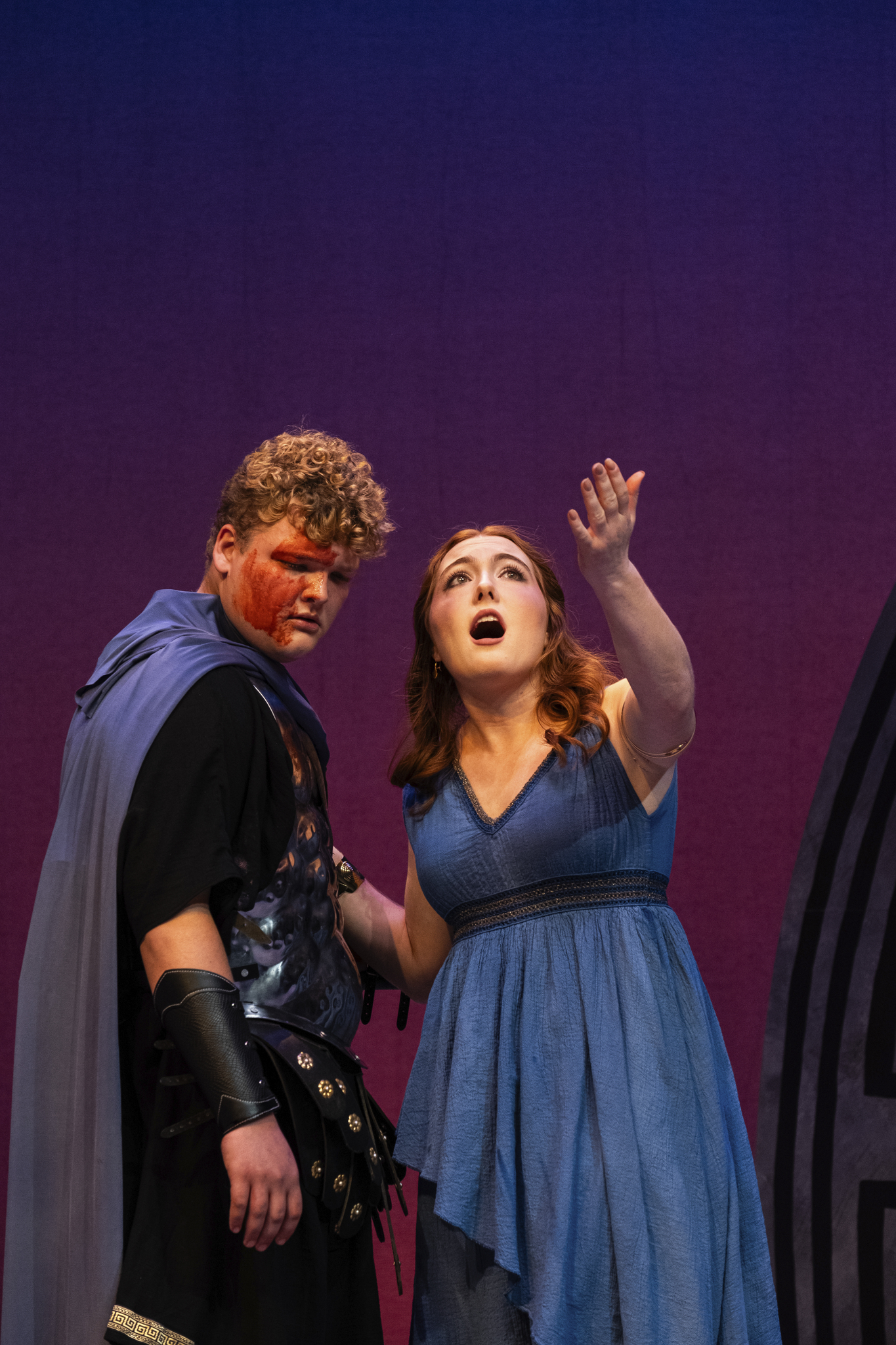
Christian and Gainer as Ajax and Tecmessa.
Courtesy | Kyle Johns
As anguished cries resound off-set, a capsule turns around and reveals the bloody and despairing Ajax, sitting among dismembered bodies of animals: This scene sets the predicament of Sophocles’ “Ajax.”
The Tower Players premiere 5th Century B.C. Greek tragedy “Ajax” by Sophocles this week with performances in Markel Auditorium at 7:30 p.m. on Thursday, Friday, and Saturday, followed by a 2 p.m. matinee on Sunday. The one-act play runs roughly 140 minutes and requires no ticket for admittance.
“Ajax is probably the greatest man in that army, greater than Achilles, not in strength, but in character,” said junior Aidan Christian, who plays Ajax. “That is what makes his downfall so tragic.”
The major set pieces consist of a large helmet that serves as Ajax’s tent, a telephone pole- sized spear, and a 20-foot-tall shield from which Athena watches mortals’ actions. A trail of blood is smeared across the floor of the stage.
The play takes place during the Trojan War, following Achilles’ death. Prior to the action of the play, the Greeks held a contest for his armor. Odysseus won and outsmarted the physically superior Ajax.
Enraged and thinking himself the more honorable and deserving, Ajax snuck off into the night to kill Odysseus and the leaders, but Athena enchanted him, and he mistakenly killed a herd of livestock.
The play opens as Ajax broods over his shame and hatred by his allies, and Athena tells Odysseus what has happened.
According to James Brandon, professor of theatre and director of the play, Ajax’s slaughter creates the tension of the play.
“I think the tension is: what do you do with a great person who’s fallen? Then in the second half, it’s what do you do with the memory of that person?” Brandon said.
Apart from the question of fallen greatness and what to do with the memory of that, Sophocles challenges his ancestors in what defines greatness itself.
“Odysseus is a hero that lives by his wits and his persuasiveness — that’s a new kind of hero,” Brandon said. “In fact, he’s a hero that more accurately reflects the Athenian audience that Sophocles is writing for.”
Brandon said he does not expect the audience to know the character Ajax as well as the original Greek audience would have, so before the show, he plays a recording of 12 professors reading excerpts about Ajax.
“The idea was just to establish Ajax as a hero,” Brandon said. “So if you’re there for the pre-show, even for five minutes or so, what you’re hearing is people talking about the positive attributes of Ajax.”
Christian captures the sorrow and shame of Ajax in a physical way and for most of the play is covered in the blood of the animals he killed.
“That hour-long process of turmoil and bargaining that he has to do with himself and everybody else around him is really taxing on the psyche,” Christian said. “This becomes taxing on the body in a way I didn’t expect going into the play.”
Ajax becomes more vulnerable as the play progresses, both physically, as he wears less armor with each scene, and spiritually, as he works through his crisis of character.
Ultimately, he fails by giving into his sorrow during the play’s most climactic scene.
“In order to fulfill a tragic arc, you have to have a complete character arc where your actions have their negative consequences, and you need to change and learn,” Christian said. “The thing about Ajax is that he doesn’t change, and he doesn’t learn.”
Christian said the death of Ajax and the redemption of his honor by Odysseus in the end is like a wave goodbye to the heroes of the “Iliad,” making way for the triumph of Athenian wisdom over brute power.
Junior Grace Gainer plays Tecmessa, the wife of Ajax and the mother of his son, who tries to convince him to overcome his shame and protect herself and his honor after his death.
“Tecmessa is a very internal role,” Gainer said. “She’s thinking a lot, and she’s playing her cards in a certain way. She’s genuinely emotional, but she’s also having to act in a certain way to get what she wants.”
Like Christian, Gainer said the role can be taxing at times but has really stretched her acting abilities in a positive way.
“This is definitely the most emotionally dynamic role I’ve ever played at Hillsdale,” she said. “It’s challenged me a lot to learn how to act on stage and then be able to quickly step out of that and just return to my normal everyday life, which can be hard sometimes.”
Sophomore Sophia Miller plays the leader of the Greek chorus. She said her role as leader is like being a priest.
“I’m like the mediator between the divine and the story and also the audience and the cast,” she said. “It’s kind of a tripartite role, which was really hard to balance, but I’m happy where it ended up.”
Brandon said despite its origins in antiquity, “Ajax” still speaks to modern audiences.
“I’ve been fascinated with ‘Ajax,’ and I feel there’s a lot to say about anger, anger management, and mental health,” Brandon said. “This isn’t a therapy play —I don’t have counselors sitting outside of the theater — but I do think it calls attention to things that are present, and that ‘Ajax’ is very recognizable. Even with the spears and armor and Greek gods floating about, I think it’s very recognizable.”