
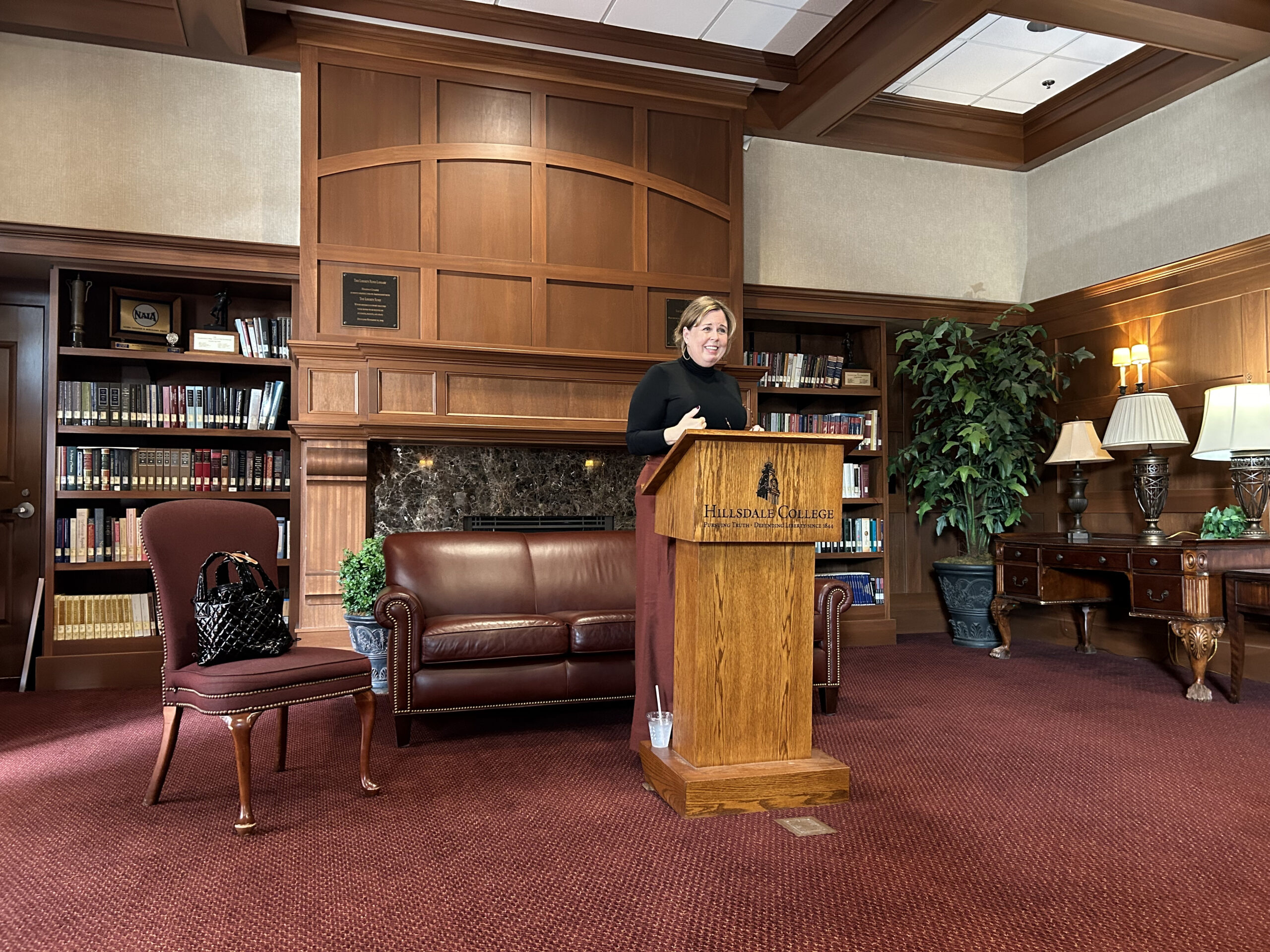
Scholar Kathleen Marks spoke on Toni Morrison, an author her mentor called the great African-American novelist, in a lecture titled “Toni Morrison’s Trilogy: Mapping Desire Lines to the Future,” Oct. 29.
Marks is the chair and associate professor of Arts and Humanities and director of Liberal Studies at St. John’s University. Marks discussed the 1987 novel, “Beloved,” and its Ohio setting during the antebellum era. In the novel, Sethe, a formerly enslaved mother, is haunted by the ghost of her dead daughter.
Marks said Morrison’s trilogy of “Beloved,” “Jazz,” and “Paradise” focuses on the ways love goes awry and gives haunting insights into the human condition.
“Morrison has a preoccupation with the ways in which we can harm ourselves, the ways in which we can sabotage ourselves, kill ourselves,” Marks said. “When Morrison became a literary star, her work was described as magical realism, a term she rejected, insisting that her stories were not magical, but simply real.”
Marks published “Toni Morrison’s ‘Beloved’ and the Apotropaic Imagination” in 2003. Marks said she returned to her scholarship on Morrison — an African-American author whose work largely concerned race — in the wake of the 2020 Black Lives Matter riots.
“I fear that she’s in danger of falling through the cracks,” Marks said. “Progressives want activists and not art, and conservatives are a little suspicious of her liberal views.”
Marks toyed with the urban planning concept of “desire lines,” defined by Merriam-Webster as unplanned paths favored by pedestrians over conventional travel routes. She connected it to the ghosts, spirits, and specters in Morrison’s writing.
“Morrison’s education at Howard and Cornell exposed her to the skepticism of academia, which sought to distance itself from the primitive or spiritual aspects of storytelling,” Marks said. “She always pushed back against such limitations, following her own desire lines and insisting that the spiritual and the real could go together, could coexist in her novels.”
Morrison is currently writing a new book, “Toni Morrison’s Trilogy and the Art of Narrative Revision,” about Morrison’s decades as an editor at Random House, her Catholic literary imagination, and approach to race histories. According to Marks, Morrison wrote her novels on yellow legal pads, in pencil rather than pen.
“This willingness to erase speaks to her courage as an artist,” Marks said. “Rather than list every crime against her people, Morrison is selective. Rather than embellish the stories of enslaved people, she is willing to erase because the editor in her, the reader in her, serves the art.”
Associate Professor of English Brent Cline teaches Morrison’s works in his course on post-1860 American literature.
“I think it’s always helpful to re-imagine works you’re very familiar with to help approach them new again,” Cline said in an email to The Collegian. “Thinking of ‘Beloved’ through Dante’s ‘Inferno’ or the gorgons helps me reconsider what ‘Beloved’ is.”
Senior Madelyn Hornell, who has studied “Beloved” in Cline’s class, said she enjoyed Marks’s analysis of Morrison.
“Toni Morrison’s prose just speaks for itself,” said Hornell.
Hornell said Marks focused on Morrison’s history as an editor and the idea of revision.
“It’s not revising history into what you want it to be, or what it ought to be, but what it actually is,” Hornell said. “It’s reading what is absent in history and reintroducing it into the narrative.”
For students interested in Morrison’s work, Cline said he recommends starting with “Beloved.”
“Sometimes the most famous deserves the fame,” Cline said. “‘Beloved’ is her greatest work. It’s as beautiful as it is troubling.”
Cline said reading “Beloved” remedies the danger of becoming numb to the horrors of slavery.
“Even though it’s perhaps the most profound attempt by any American writer at articulating slavery’s impact on the individual, the family, the community, and the culture, it’s just as much about memory and love,” Cline said.