
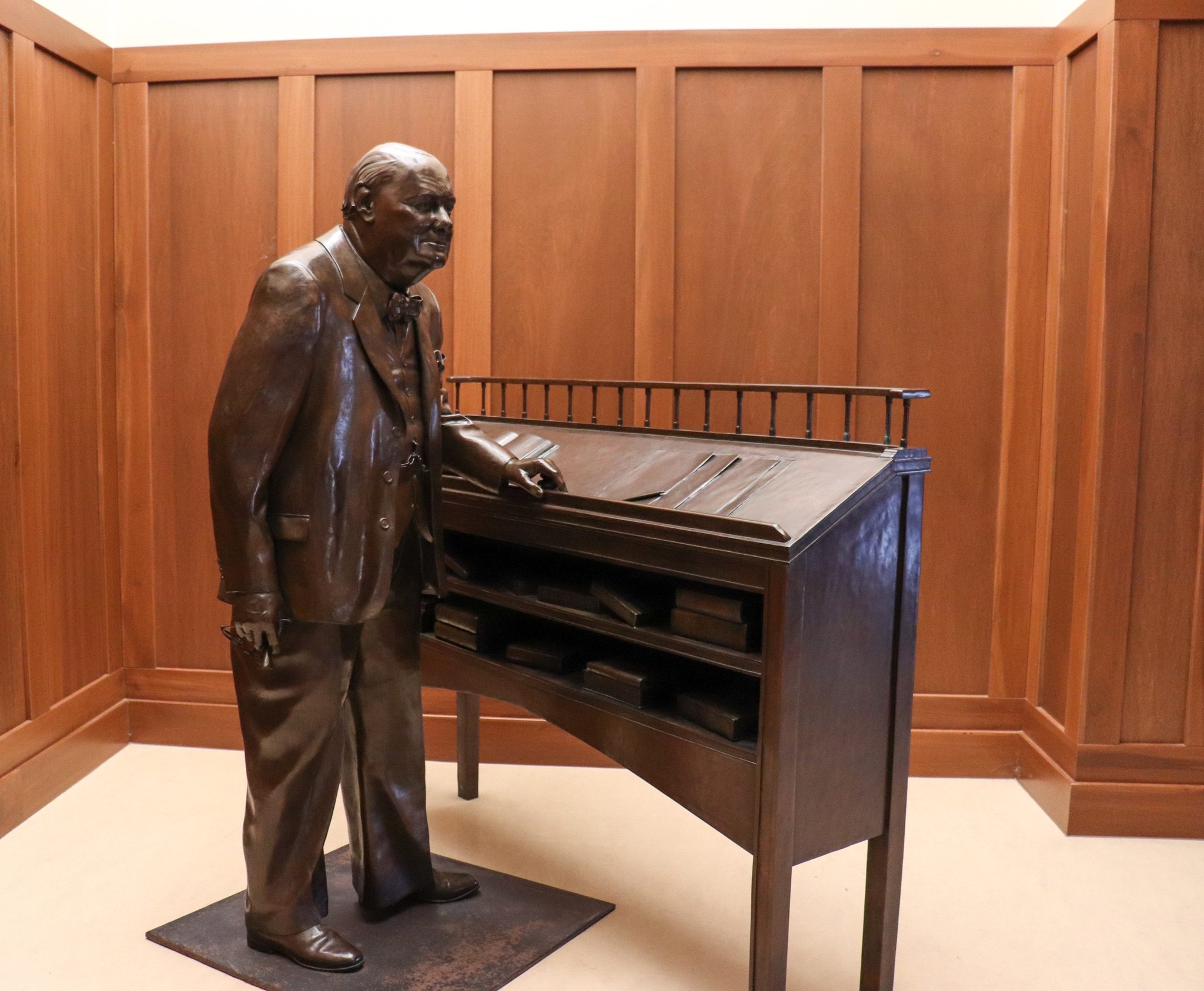
A statue of Winston Churchill stands on the Liberty Walk in the Grewcock Student Union. Olivia Pero | The Collegian
Winston Churchill is everywhere on campus: He has a statue in the Grewcock Student Union, he is the subject of artwork in the Searle and Dow centers, and a dozen students currently have fellowships named for him.
More than 400 unique, physical books on or by Churchill live in Mossey Library, from “Winston Churchill Painting on the French Riviera” to “Winston Churchill’s Illnesses 1886-1965” to “The Second World War,” a six-volume account that helped its author secure the Nobel Prize in Literature in 1953.
The college’s Churchill Project promotes scholarship and “propagates a right understanding of his record,” according to its website.
On top of all that, College President Larry Arnn met his wife, Penny, when they both worked for Sir Martin Gilbert, the official biographer of Winston Churchill, in the 1970s.
“His career is the longest and most consequential, and his writings are the most voluminous and serious of any modern statesman,” Arnn said. “Aristotle writes that to learn practical wisdom, one should look at those who have the reputation for having it. Then he names Pericles. The record we have of Winston is far larger than Pericles or any ancient.”
Churchill, the prime minister of the United Kingdom during World War II, was born Nov. 30, 1874, which means the 150th anniversary of his birth falls on the Saturday of Thanksgiving weekend.
Arnn used the occasion to write a tribute to Churchill that appears in the November issue of The New Criterion, a monthly journal of art and culture criticism. The campus, however, honors him everyday and almost everywhere, including online.
The Churchill Project’s website publishes two articles per week — with 816 to date — in five departments: 292 general, 243 book reviews, 115 FAQs, 94 resource materials, 72 “Truths & Heresies,” many by undergraduate Churchill Fellows.
“Churchill Fellows carry on Churchill’s legacy of hope through study of Churchillian strategy, his ability to understand his opponent, and willingness to sacrifice and inspire others to sacrifice for the well-being of the community,” said Churchill Fellow and senior Keara Gentry.
Whether students take classes that assign his books and speeches, or they are actively working on projects to disseminate his work, they reflect on the relevance of his words.
“In one word, I would describe Winston Churchill as hopeful. His speeches both during and out of war time recognize the gravity of the time while reminding that so long as goodness opposes evil, there is hope,” Gentry said. “In reflecting upon the current state of the U.S. — we face wars abroad, economic uncertainty, and internal division — I can think of no greater message to the American people. I believe Churchill would urge us to dare to hope.”
The college has also published and keeps in print Churchill’s official biography by Randolph S. Churchill and Sir Martin Gilbert. It includes eight narrative and 23 document volumes. Gilbert wrote about the importance of studying Churchill for The Churchill Centre’s journal, Finest Hour.
“‘Why study Churchill?’ I am often asked. ‘Surely he has nothing to say to us today?’” Gilbert wrote in 1991. “Yet in my own work, as I open file after file of Churchill’s archive, from his entry into government in 1905 to his retirement in 1955, I am continually surprised by the truth of his assertions, the modernity of his thought, the originality of his mind, the constructiveness of his proposals, his humanity, and, most remarkable of all, his foresight.”
The project also puts out Grand Alliance, a periodical print digest of leading articles, and is currently working on an encyclopedia of his greatest words, “Churchill: Master of Language,” that is likely to be published in January.
“We helped build and contribute to a rapid response team of scholars worldwide who refute misrepresentations of Churchill’s words and deeds to the widest possible audience,” said Richard Langworth, a senior fellow of the Churchill Project .
“The Churchill Day Book,” another ongoing project of the Churchill Project, is an online reference to Churchill’s whereabouts and activities on each day of his life.
“Undaunted by the fact that we need to account for 33,000 days, we have already posted 1928, 1935, 1940, 1941, 1943 and 1944,” Langworth said. “And after all, 1874 to 1890 or so will be shorter.”
Since it was dedicated in 2004, the college has boasted a statue of Churchill. Sculpted by senior admissions interviewer Heather Tritchka ’98, the statute shows Churchill holding a cigar in a pose chosen by Gilbert. At his lectern are 17 books Churchill either liked, wrote, or referenced, such as “Lays of Ancient Rome” by Thomas Babington Macaulay and Plato’s “Republic,” from a list compiled by Arnn, who is the author “Churchill’s Trial: Winston Churchill and the Salvation of Free Government,” published in 2015.
Tritchka and Arnn went back and forth about the statue’s elements, such as his laced leather shoes, his pocket watch on a chain, and his bottom button being undone.
“There are a lot of different sculptures of Churchill, and we wanted to show him more of an academic setting, so that it was more fitting for a college,” Tritchka said. “Dr. Arnn and I decided to put him at this lectern, because this is where he composed a lot of his speeches and his books, in front of this long lectern where he would walk back and forth and reference the books and then make notes.”
Black and white graphite drawings by Curtis Hooper line the Dow and Searle centers, as well as the library, offering another reminder of Churchill’s importance to the college.
“He has taught me and many others a lot about practical judgment, freedom, and justice, learning from history,” Arnn said. “His belief in freedom was oriented toward the highest expressions of it in thinking and art. These are good things to learn from a political man, because they show us how to behave as citizens and how to judge leadership.”
Churchill died on January 24, 1965, at the age of 90, meaning that less than two months after the sesquicentennial of his birth comes the 60th anniversary of his death.