
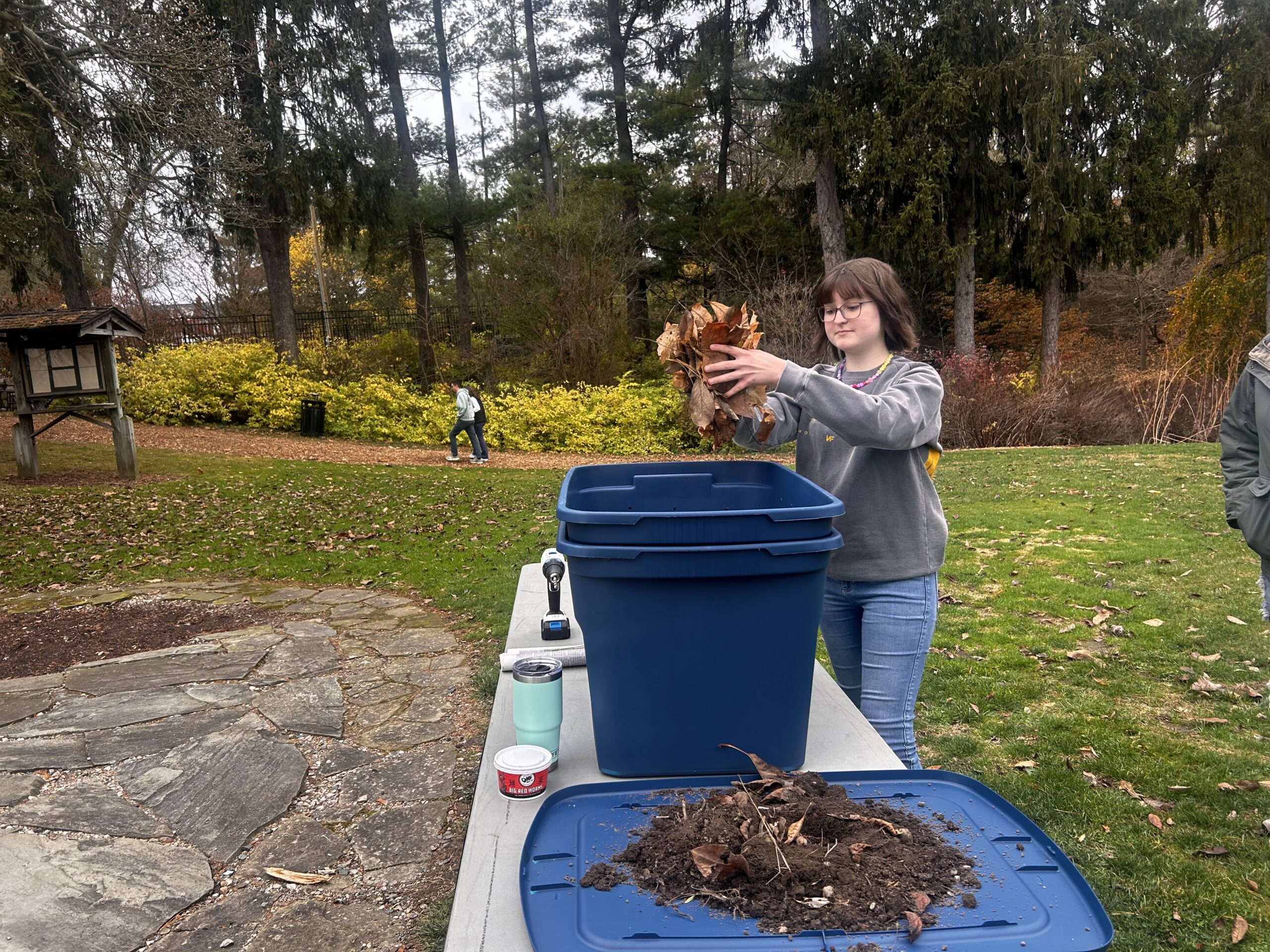
Junior Caitlyn Justice composts The Collegian in the Arb. Courtesy | Ameera Wilson
They didn’t eat the classic dirt ‘n worms dessert, but students dug their hands into real dirt and worms at a composting workshop hosted by the Hillsdale’s Conservation District and the Hillsdale College Conservation Club Nov. 16.
Hillsdale Conservation District Manager Ashe May taught the workshop, showing students how to create a stacked vermicomposting bin as well as the bin’s benefits and uses.
“Vermicomposting is a form of composting that uses worms as the binary driving factor of decomposition,” May said.
May explained the method of creating the composting bin and demonstrated the process of layering materials. For materials, May used dirt, leaves that students collected from Slayton Arboretum, and shredded Collegian newspapers.
Throughout the demo, May emphasized the importance of the balance of browns and greens in a composting bin.
“Your balance is going to be approximately 60-70% browns, and the rest is greens,” May said. “It’s important to maintain this balance of the greens and browns, and if you start stinking up the place, something’s wrong.”
May said “greens” refer to food scraps and green foliage while the term “browns” refer to things like dirt, leaves, and newspapers. Generally, May said, people should avoid using meat or dairy.
“When I was middle or high school, my dad started a compost pile in our backyard,” said junior and President of the Conservation Club Caitlyn Justice. “He was super into it and always talking about his browns and greens so it was really cool to know the back- ground information.”
During the workshop, May built an example composting bin, which she gave to junior and club Vice President Will Deaton.
“When the opportunity was presented that we could actual- ly build one here, I was totally on board with that,” Deaton said.
According to May, balancing the browns and greens is not the only vital ratio when it comes to composting.
“Water is incredibly important because if your worms are too dry, they can’t do their job. But if they’re too wet, they die,” May said.
May said part of the method to keep this balance is drilling holes into the compost bin allowing for excess liquids to drain.
“When you’re either constructing a bin or putting one in place you want to make sure that there is enough drainage,” May said.
According to May, composting is a process that requires the correct environment to be effective, including the right amount of material and water.
“I didn’t really know anything about compost and I didn’t think of moisture as be- ing a big deal,” junior and club treasurer Penelope Campbell said.
May’s tutorial included the type of worms one should use in their first composting attempt. “Red Wigglers are the ideal ones for this,” May said. “They compost really fast. You just start with a few of them, and it will take a little bit of time for them to fill out and establish in a bin. But once the conditions stay right for them, they will start multiplying and you will have an active colony.”