
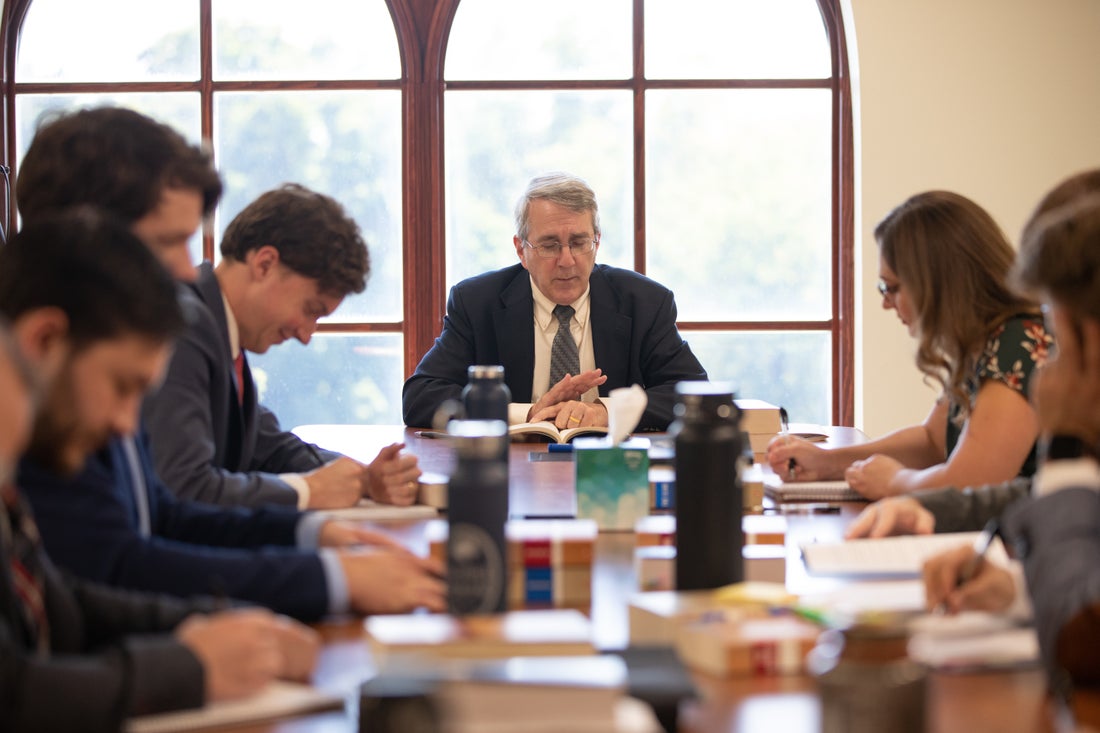
Professor of English David Whalen and graduate students of the classical education residential program convene in a classroom. Courtesy | Sara Gillett
The college will launch the Master of Classical Education Leadership hybrid program, its first degree including online learning, in summer 2025.
The newest addition to the Diana Davis Spencer Graduate School of Classical Education, the program is focused on the practical work of classical education at the K-12 level, emphasizing leadership in the classical classroom, school, and community. The application deadline is Dec. 15.
“Leadership, broadly defined, is not solely in one position of head of school,” Graduate School Dean and Professor of Education Daniel Coupland said. “In order for a school to thrive, you need to have good leaders at every level.”
Graduate School Program Coordinator Jaime Boerema ’22 said 11 students have matriculated from the in-person, on-campus Master of Arts in Classical Education residential program.
“There will still be nuance within our students’ choices, and our students will be equipped to go into any field within the world of classical education,” Boerema said.
One of the chief challenges for charter schools is the recruitment of capable, qualified teachers, said Associate Vice President for Curriculum and Professor of English David Whalen.
“As a college committed to the intellectual and cultural patrimony of the West and of America in particular, we’re well positioned to render young men and women knowledgeable and capable of stepping into a classroom with a clear understanding of their educational purposes and the proper content of that education,” Whalen said.
The hybrid program will take three years to complete and will follow a cohort model accepting 15-20 people this year. The spring and fall semesters consist of a fully-online course. Students will engage in an online apprenticeship during the winter and study for a week on campus in the summer. According to Coupland, the college created the program for those who wanted to continue working while completing a master’s program.
“We’ve always wanted to reach out and reach people who were not necessarily able to stop their lives,” Coupland said. “If you have people who are committed to classical education, who are working in classical education, you want them to continue that work.”
The impetus for the graduate school began with conversations between Coupland, Whalen, and Assistant Professor of Education David Diener.
“We actually had graduates of the college who were going to work in classical schools who were coming back to us and asking, ‘where can I go to study classical education at the graduate level?’ And then there was often, as a follow up question, ‘why isn’t Hillsdale doing this?’” Coupland said. “We wanted to have a residential program on campus here in Hillsdale, because that’s what we do. We bring people together in a room and have conversations about great ideas.”
Coupland said the classical school program stands out because of its integration of rich discipline-specific content into the field of education.
“It’s not just about the process of education,” Coupland said. “But at the same time, there’s an emphasis placed on the idea of education, broadly defined, not just the study of literature, not just the study of philosophy, but all those disciplines offering a perspective on what it means to be a human being.”
Chairman of the Education Department and Associate Professor of Education Benjamin Beier said he enjoys the combination of theoretical and practical conversation about education that occurs within the graduate classroom.
“We can be, in one moment, in a very theoretical philosophical conversation, and another moment be informing that conversation with, ‘when I was teaching fifth grade,’” Beier said.
Beier said his liberal education shaped him and oriented him toward what is good, true, and beautiful.
“It’s such a joy to give others a liberal education and such a joy to return to some of the really excellent books and artifacts that are nearly inexhaustible in what they have to offer us,” Beier said.
Coupland said the Hillsdale curriculum will be able to meet the great demand for quality graduate studies in classical education.
“We’ve been very, very thoughtful about this, and it’s been refined slightly over time, but we really like where it is,” Coupland said. “We know that much is expected of us, but we’re happy to accept that challenge.”