
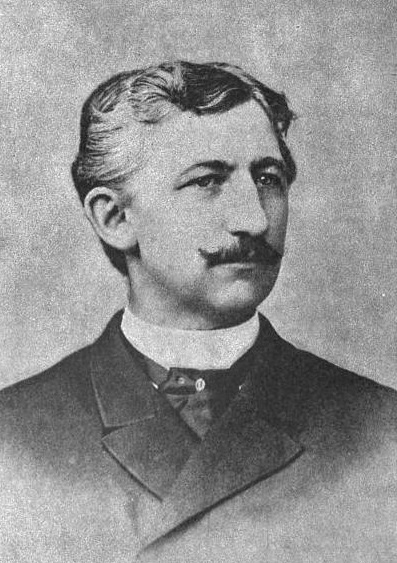
The state of Michigan celebrated its “unofficial poet laureate” and 1869 grad of the college, Will Carleton.
In 1919, the state pronounced Oct. 21 as a day dedicated to Will Carleton, establishing both a commemorative school holiday and a requirement for schools to teach at least one of his poems. This act was in effect until 1995 when the school code was changed and students were no longer given the day off.
Local references to Carleton abound, from Carleton Road, which runs through Hillsdale, to Will Carleton City Park in Hudson, where Carleton’s birthplace just east of the city is marked by a large rock.
One of Hillsdale’s schools, Will Carleton Academy, a charter school founded in 1998, was named after the poet. It still celebrates him by reciting one of his poems during opening ceremonies. Colleen Vogt, director of the academy, said they usually recite “Over the Hill to the Poorhouse.”
“Though it’s a more sad poem,” she said, “students get the chance to really understand the strong values like family and charity that Will Carleton believed in.”
His poem “Over the Hill to the Poor-house” first appeared in Harper’s magazine in 1871. It is told from the perspective of an old, poor woman, searching her mind for what caused her poverty as she walks to the poorhouse.
The Hillsdale poorhouse, now run by the Hillsdale County Historical Society, still stands at N. Wolcott Street just outside of Hillsdale. When it operated for its intended purpose, it was a last bastion of work and shelter for the homeless. Carleton used to visit it.
“Over there to the west, in Hillsdale, there stood in the old days a county poorhouse,” the Library of Michigan reported Carleton said after publishing the poem. “Sometimes, I used to visit the inmates there and hear their troubles. And sometimes I used to see old people … who had out their property in the hands of their children, passing up the road on their way to the poorhouse on the other side of the hill.”
The poem opens, “Over the hill to the poor-house I’m trudgin’ my weary way — / I, a woman of seventy and only a trifle gray —.”
The speaker, an old woman, contrasts her age with her condition. If she is old but only a trifle gray, then she hints that she has not been overworked — suggesting a life of comfort, not poverty. If her life has been comfortable then she has all the more reason to wonder why she must go to the poorhouse.
“What is the use of heapin’ on me a pauper’s shame? / Am I lazy or crazy? Am I blind or lame?”
She notes here it is not her physical condition that has caused her poverty, leaving her to go on and examine her life as she is not sure she deserves this fate.
As the poem goes on it becomes clear what has happened to this woman. She searches for answers by engaging her memory and recalling her youth. She remembers bearing and raising six children with her husband John — even if she does not do the best job, she loves them all the same.
John and her grow older and she says “Strange how much we think of OUR blessed little ones! — / I’d have died for my daughters, and I’d have died for my sons. / And God He made that rule of love; but when we’re old and gray / I’ve noticed it sometimes, somehow, fails to work the other way.”
The poem, now halfway through, turns. Everything that she loved and made her happy in her youth now disappears or turns away from her. First, as the above line suggests, her children become distant. Then her husband dies, and she is left alone with the youngest son in the house. That son gets married, and has children and they kick her out. She goes to her other children and eventually they all kick her out or do not welcome her, and she is left to the streets.
In the last stanza, she then returns to that first line “over the hill to the poorhouse…” but now has filled out her thoughts more: “God’ll judge between us; but I will al’ays pray / That you shall never suffer the half that I do to-day!”
She responds with charity, hoping that her children do not suffer the same fate she does. She recognizes “God will judge between us,” meaning though she feels wronged, she recognizes that maybe she has wronged her children. All she has left to do, as a woman with lots of love, is appeal to God, asking that he may prevent her children from suffering as she does by their own children.
Carleton presents both a complex human self-reflecting and the importance of family with this poem.
This week, Hillsdalians should reflect on and celebrate our greatest local poet by reading one of his poems.