
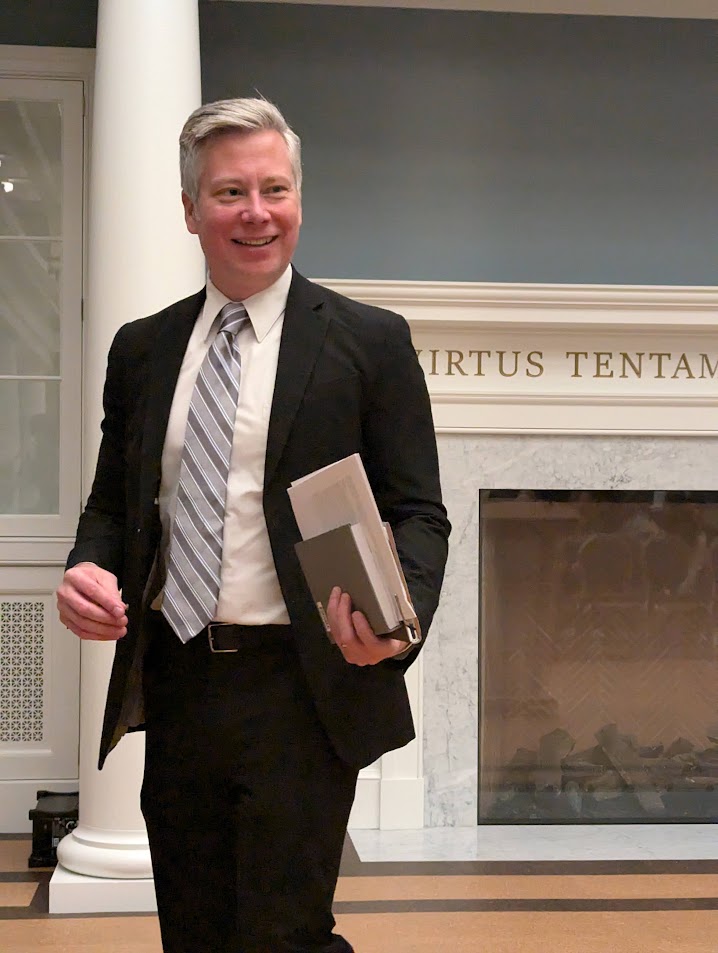
For poet James Matthew Wilson, the nature of his craft can be summarized by an alliterative list: making, metaphor, memory, and meter.
“If I could ask what poetry is, I’d have to be able to answer the question first of what it’s for,” Wilson said.
Wilson presented his lecture “On the Nature and Ends of Poetry: a Theory of Poetic Form and Function” to a packed Hoynak Room Oct. 10.
Following the spring release of his most recent published collection of poetry, “Saint Thomas and the Forbidden Birds,” Wilson met with students and faculty on campus for lectures, readings, and dinners. Coordinated by Associate Professor of English Dutton Kearney and Associate Professor of Classics and Chairman of Hillsdale’s Collegiate Scholars Program Eric Hutchinson, Wilson joined the legacy of the Visiting Writers Program.
“Student involvement in this visit was off the charts,” Kearney said. “I love bragging about our students and then seeing visitors’ surprise that, for as much as I’ve talked our students up, they are even better in person.”
Wilson used the classical tradition to map his exploration of the poetry, beginning with a section from Diotima in Plato’s “The Symposium.” Wilson’s chosen section states that the Muses give people melody and rhythm which then characterize poetry.
“We know that every artist performs the act of making for himself,” Wilson said. “But what she’s proposing here is that the art of the poet involves not only a master of the craft or discipline or the ability or virtue to making, but one that involves a certain kind of receptivity.”
The classic component that stuck out most to sophomore Olivia Gonzalez was Socrates.
“I enjoyed when Wilson talked about Socrates’ appreciation for poets and how poets bring the soul into a worldly heaven through metaphors, bringing that from above to earth and what is hidden into the world,” Gonzalez said.
Wilson presented poetry as twofold: an act of the maker himself combined with a gift from the Muses. The components of poetry do not exist separately, according to Wilson. They each fold into one another.
“Poetic meter, at the microcosmic level of the line of verse, orders our language according to a numerical principle that is reflective of and expressive of the macrocosm, the world as a whole,” Wilson said. “Meter is the source, the means, and the manifestation of memory, making things permanent and memorable. It is also the first metaphor. The metaphor that says ‘this word right here can be expressed in a finite form down here: in the work of poetry.’”
Wilson is the Cullen Foundation Chair in English Literature and the founding director of the MFA program in Creative Writing at the University of Saint Thomas in Houston. He’s the poet-in-residence of the Benedict XVI Institute as well as the scholar-in-residence at Aquinas College in Grand Rapids. Outside of the lecture hall, Wilson is the editor of Colosseum Books, and the poetry editor of Modern Age magazine.