
City News Team | Collegian
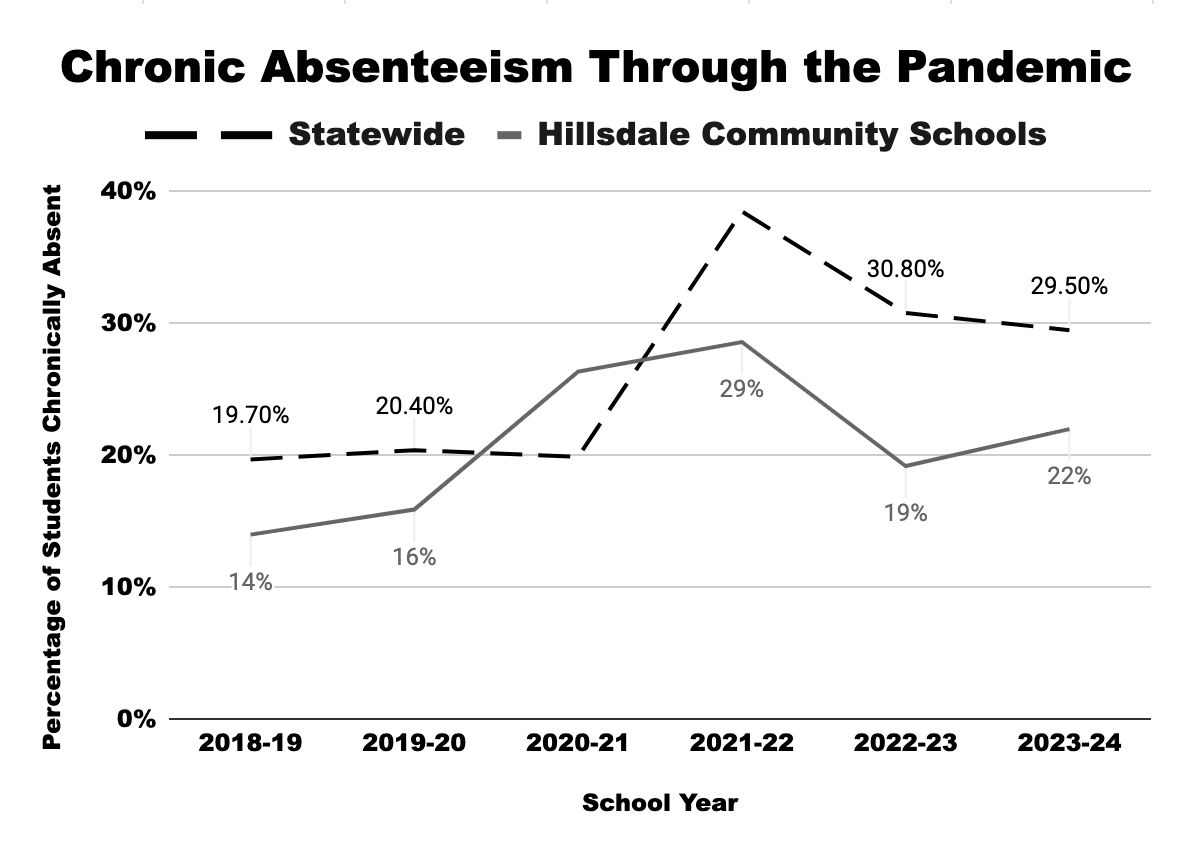
About 22% of students in Hillsdale Community Schools miss more than 10% of school days
Chronic absenteeism is lower in the City of Hillsdale’s public schools than in other Michigan districts, but the number remains higher than pre-pandemic levels in both cases.
About 22% of Hillsdale students missed more than 10% of school days in the last academic year, qualifying as “chronically absent” under state guidelines. Hillsdale Community Schools includes Bailey Early Childhood Center, Davis Middle School, Gier Elementary School, Hillsdale High School, and Horizon Alternative School.
About 30% of students statewide were chronically absent during the 2023-24 school year, 10% higher than Hillsdale students. That number is down across the state compared to its peak in the 2021-22 year, when it reached 38.5%.
Still, chronic absenteeism remains higher than before the pandemic, when about 20% of public school students were chronically absent in the 2018-19 school year. In the same year, only 14% of Hillsdale students were considered chronically absent.
Molly Macek, director of education policy at the Mackinac Center for Public Policy, said chronic absenteeism has been an issue for several years. But the pandemic exacerbated the problem.
“These numbers are incredibly concerning because they are still significantly higher than what they were pre-pandemic, which tells us that something happened,” Macek said. “There was perhaps a cultural change that happened in terms of the perception surrounding school.”
Hillsdale Community Schools Superintendent Ted Davis said the district communicates with parents and students to understand why students are missing school and to offer support.
Davis said he is unsure of the exact reasons why absent rates are lower than the state average because this is his first year working in Hillsdale County.
“I believe that many of our students live in close proximity to the school they attend,” Davis said. “They are able to walk to school and do not depend on a form of transportation.”
Davis said the district also notifies parents if their child is chronically absent.
“We will then follow up with phone call communication,” he said.
Davis said administrators have made home visits to talk with the parents to better understand the situation.
“I feel it is extremely important to understand the reasons why students are missing school,” he said. “If we understand, there is a better possibility we can help the students.”
Davis said Hillsdale Community Schools also works with the court system as a last resort to prevent absenteeism.
“When students don’t attend school, they tend to fall behind in their classwork and many times fail to make sufficient academic progress,” Davis said. “This puts them at risk for being held back and tends to put them at a higher risk of not graduating on time from high school or dropping out of school.”
Davis said the district relies on alternative school programs to help students succeed.
“We have had several students who were struggling to make academic progress and were off track for graduation for multiple reasons, including attendance issues,” he said. “The use of our alternative school program allowed those students to make academic progress and eventually graduate from high school.”
School districts in Hillsdale County are allowed to travel into neighboring districts to pick up students who take advantage of the alternative school program, allowing them to attend a different school. In other parts of Michigan, parents are responsible for getting students to school if they choose to attend a different school than the one in their district. By allowing buses to travel into neighboring districts, Davis said, it is easier for students to attend school.
Hillsdale Community Schools are showing a recent trend in increased attendance rates.
“According to Michigan School Data, graduation rates are improving each year since the pandemic,” Davis said.
Chronic absenteeism tends to be higher among urban districts, Macek said. Districts that have a higher poverty rate and a larger share of minority students were among those who faced the greatest learning loss from the pandemic.
“This is only going to contribute to the achievement gap between lower income and minority students and the rest of the population,” Macek said.
She said increased education options can help chronic absenteeism rates. Macek said virtual school might be a better option for some kids in the short term if physically attending school is difficult based on their residence. About 83% of families in the Hillsdale Community Schools district have broadband access, just lower than the statewide 87%.
Macek suggested using local and state money to secure private tutoring services or to cover transportation expenses.
“State and local dollars could be used to provide an education that might be a better fit,” she said.
Assistant Provost for Hillsdale College’s K-12 Education Kathleen O’Toole said the effects of lockdowns on education were devastating for students.
“You can think about how your own habits were disrupted by COVID,” O’Toole said. “Imagine if you were a child and you went an entire year without being in school in person.”
She also said spending time away from school can inhibit a young student’s development.
“It’s hard for a kid to be gone for a while and then have to catch up,” O’Toole said.
Send tips to the City News team: collegiancitynews@gmail.com