
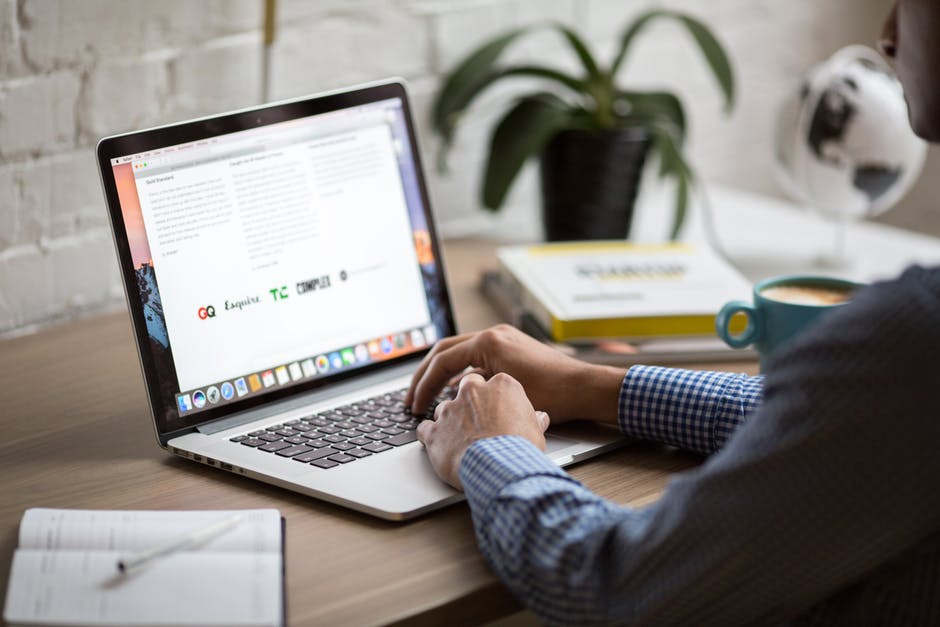
A student works at a computer. | Courtesy Pexels
While New York Post columnist Karol Markowicz was teaching a one-credit journalism course last semester, she noticed the lack of students using technology to jot down notes in class.
“I think Hillsdale is ahead of the curve on this kind of thing,” Markowicz said in an email. “You’re not staring at a screen in class, texting with your friends, checking social media, you’re focused on the teacher. It really showed.”
A 2018 Ohio University study shows that roughly 60% of students use laptops in the classroom. At Hillsdale, many professors have observed that few students choose to use technology in the classroom, even when it is allowed.
Many professors on Hillsdale’s campus frown upon the use of technology in the classroom. Not only does it increase the likelihood of students getting distracted, but it disrupts the spirit of the present discussion.
Cameron Moore, a visiting assistant professor of English, expressed his desire to keep students engaged during class.
“The classroom is a community. We’re learning together,” Moore said. “As soon as somebody has a screen in front of their face, it breaks the communal endeavor of the classroom.”
Moore admits the major benefit of using technology in classrooms is the added level of organization they provide. Rather than lugging around several notebooks and binders, students can keep all their notes in a single tablet.
Moore said notifications are tempting and distracting in the classroom.
“It’s so hard to resist other notifications that come up,” Moore said.
Mardi Billman, associate professor of chemistry, allows students to use technology in the classroom and has not noticed an increased level of distraction in her classes.
“Chatter and conversational tangents are far more of a common distraction in my classroom than laptops or iPads,” Billman said.
While the science and math departments at Hillsdale typically boast a higher number of students who use technology in the classroom, Billman said it is still a rare occurrence.
“Never more than three per class, usually,” Billman said. “For reference, my class sizes are somewhere between 40-50 students for general chemistry, so it really is a small proportion that opt to use devices.”
Norah VanWingerden, a sophomore biochemistry major, switched to using an iPad to take notes in class this year.
“As a STEM major, it’s just easier and more convenient,” VanWingerden said. “We have PowerPoints that the teachers give us and instead of writing down everything on the slide, you can import it to a notes app and write directly on the PowerPoint and follow along. I did it last year with paper, but this year the iPad is saving a lot of time.”
VanWingerden pointed out one major drawback to relying on technology: the cost. “Part of it is the cost,” VanWingerden said of the price of iPads. “They can be expensive.”
Hillsdale classrooms have naturally become a respite from the technology-obsessed society in which we live. While screens have proven themselves to be invaluable in many areas, students and faculty here at Hillsdale tend to prefer less technology-centered options.
“The benefit that they provide is maybe not worth the potential costs,” Moore said, “We spend so much of our time and pour so much of our energy into screens as it is.”