
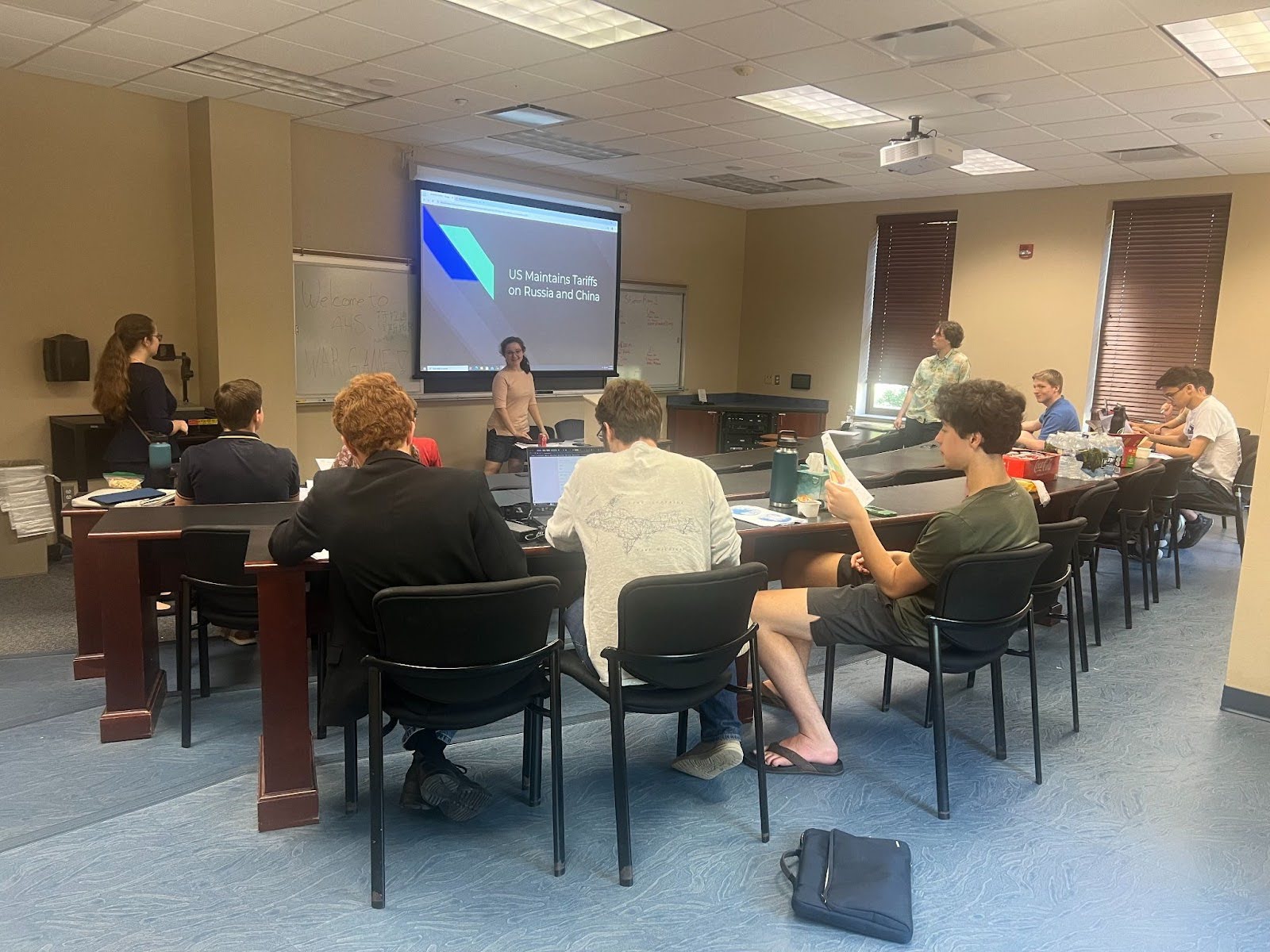
The Alexander Hamilton Society conducts games simulating wars between nations in Lane. Courtesy | Adriana Azarian
The United States and Russia prepared for a nuclear war on Sept. 14.
The Alexander Hamilton Society and War Gaming Club collaborated to host its bi-annual War Games event in a classroom in Robert M. Lane Hall. This semester, 11 participants formed teams representing China, Russia, a combined Denmark and Canada, and the United States as they negotiated territory in the Arctic. Each team represented their nation’s interests, according to sophomore Alex Mooney, secretary of AHS.
“We went back to 2023 and established an Arctic territorial agreement that most countries liked, but Russia didn’t, and China also had some other ambitions regarding that agreement, so that was our starting point for the tension,” Mooney said. “We got to change some things, so it included all domains in space that actually ended up being really important — cyber attacks, and the Ukraine war played into it.”
Part of the purpose of the game is to demonstrate how frustrating diplomacy is, according to junior Aras Kaufmann, president of the War Gaming Club.
Kaufman said this semester’s war games are comparable to Model U.N., where participants focus on nations’ dealings with other nations instead of battling with each other, as is typical in the War Gaming Club.
Sophomore Robert “Tripp” Keeton, who represented China, also said this semester’s war game was more diplomatic than last year’s military-focused game.
“I really enjoyed how quickly things kind of swapped from the start of the game. It really looked like it was just going to be China and Russia versus the U.S. and Canada,” Keeton said. “Then China started making deals with Canada, Denmark, and America. It was a very odd thing, but I’m just intrigued by how quickly things move.”
After each round of negotiations, players submitted their agreements to Mooney and senior Erin Osborne, president of AHS. Together, Osborne and Mooney made decisions in the “Situation Room,” sometimes using dice, to determine the results of the negotiations. At the end of the rounds, members revealed the ultimate outcomes on a slideshow.
“It’s having to juggle everyone’s interests, and then also trying to consolidate all the information and figure out what actually happens,” Mooney said. “It’s kind of stressful for everybody, but it’s a good experience.”
Mooney said war games help participants cultivate interpersonal and communication skills.
“By the end, everyone’s learned about all these different countries and their objectives and their capabilities and then also how to negotiate with people, how to figure out what’s going on, even when you don’t know there’s a bunch of covert actions and spy operations going on,” Mooney said.
After six rounds of negotiations, Russia split the disputed territory with Denmark and Canada, Russia and Canada cut off China from the Northern Sea Route and its research facilities, and Russia and the United States agreed to work to deactivate China’s satellites and prepare for nuclear war.
“People actually collaborated pretty well and were finding ways to agree on things,” Mooney said. “And then, of course, it ended in nuclear war, but that’s not very uncommon for this sort of game.”