
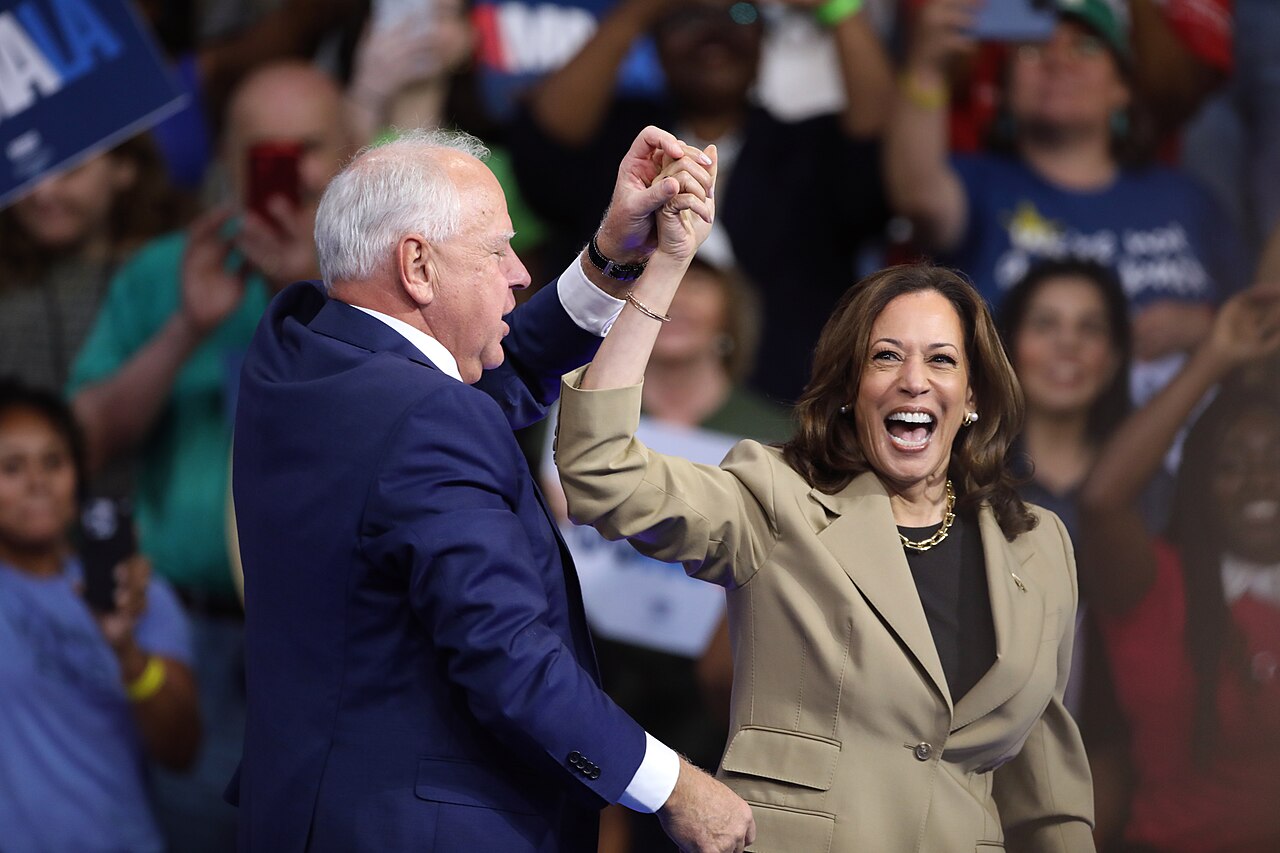
When I heard the new Democratic political strategy was to call former President Donald Trump and his running mate Sen. JD Vance “weird,” my first thought was: “Well, that’s weird.”
The attack first broke the news on July 24 when the account “Democrat Governors” made a post on X with a quote attributed to Gov. Tim Walz reading, “These guys are weird.”
Vice President Kamala Harris later threw out the term at her first fundraiser after President Joe Biden dropped out of the race. A few weeks later, she selected Walz as her running mate.
Of all the adjectives to use, of all the possible arguments they could construct, they decided “weird” was the best option. It’s so childish.
According to the Oxford Dictionary, weird means “suggesting something supernatural; uncanny.” This definition developed from the Old English which defined weird as “what the future holds.” This is more commonly referenced as “fate,” wrote John McWhorter in a recent New York Times piece.
In colloquial speech, however, “weird” has now lost almost all futuristic or supernatural connotations. Synonyms of ‘weird” include strange, abnormal, or unusual.
It’s funny to me that among adults — and so among all eligible voters — the word “weird” isn’t even insulting. I say I’m weird all the time. I talk in silly voices, I dance in the kitchen, I actually like school — yeah, I’m weird.
But among kids, “weird” is an insult. It’s a social judgment. “Weird” is a term third-grade bullies use, which is the first red flag. It’s immature, honestly.
Calling the GOP ticket “weird” is the perfect example of an ad hominem attack. It’s one of the fallacies you learn about in your middle school logic class. While both sides employ ad hominem attacks, this name-calling is especially strange because it cites no evidence.
Instead of citing poor policy or previous failings, this ad hominem attack targets Trump and Vance, on — well, virtually nothing. Frankly, this only weakens the Democratic ticket because their lack of argument reveals they have none.
Vance made this very claim in an interview with CNN that aired Aug. 11.
“I think what it is, is two people, Kamala Harris and Tim Walz, who aren’t comfortable in their own skin, because they’re uncomfortable with their policy positions for the American people,” Vance said. “And so they’re name-calling instead of actually telling the American people how they’re going to make their lives better.”
Harris and Walz can’t point to a strong economy, stable foreign policy, or a secure border to gain votes. Instead, they construct a strange and meaningless argument to try to win laughs.
This approach emphasizes personability over policy. Harris and Walz want to be the relatable ticket, the commoners. So they paint their opponents as weird.
This is where McWhorter’s argument is faulty.
“‘Weird’ pegs MAGA as a detour, a regrettable temptation that serious politics ought to render obsolete. Calling it “weird” is deft, articulate, and possibly prophetic,” McWhorter wrote in his article.
Using a colloquial term without any definition or specificity is not articulate, however. It’s confusing and pointless.
The same people who were calling Trump “Hitler” in July have now toned it down to simply calling him “weird.” Seems inconsistent. I can think of several adjectives that precede “weird” on a list describing Hitler.
Calls for unity caused Democrats to de-escalate their claims after Trump nearly died on July 13. They chose “weird” as a civil ad hominem attack. But they still remain mute on reasons why Trump is weird, so the attack is another bullet that missed its mark.
In response to this new strategy, David Karpf, strategic communication professor at George Washington University, praised Harris and Walz’s approach.
“I don’t know who came up with the message, but I salute them,” David Karpf said. “It frustrates opponents, leading them to further amplify it through off-balance responses.”
But Trump and Vance’s responses have been anything but “off-balance.”
Trump threw the attack back and then mentioned specific policies as weird.
“Nobody’s ever called me weird. I’m a lot of things, but weird I’m not. I’m upfront,” Trump said to radio host Clay Travis in an interview posted Aug. 1. “Who wants to have open borders, where prisoners and mental institutions patients are taken out of hospitals and jails and they’re let into our country? That’s weird. Who would want that policy? Who wants to quadruple your taxes? That’s weird. The whole thing is weird.”
In a Fox News interview, Vance said the name-calling doesn’t bother him.
“They can call me whatever they want to. The middle school taunts don’t bother me,” Vance said. “What offends me is what Kamala Harris has done to this country over three and a half years. ”
Vance knows how to discuss policy failure instead of name-calling. His response highlighted personal values that, on the “weird scale,” are hardly weird at all — like being a good husband and father.
“I think that it’s a lot of projection, frankly, Maria, from people who want to give transgender hormones to 9-year-old kids and want biological males to play in women’s sports,” Vance said to host Maria Bartiromo. “Look, I’m a husband, I’m a father, I’m happily married, and I love my life, and I am doing this because I want to be a good public servant who fixes the problems of the Democrats.”
In his response, Vance highlighted policy issues with which he disagrees. This is proper politics. Name-calling only raises the volume of public discourse and stalls the argument.
What’s even weirder is that the Democratic ticket has persisted in using the term. When I first heard of it, I thought “weird” usage would dwindle in a week’s time. Now, six weeks later, it’s still an attack. Using an elementary phrase is weak, but maybe that’s because no other strategy exists.
Michaela Estruth is a senior studying history.