
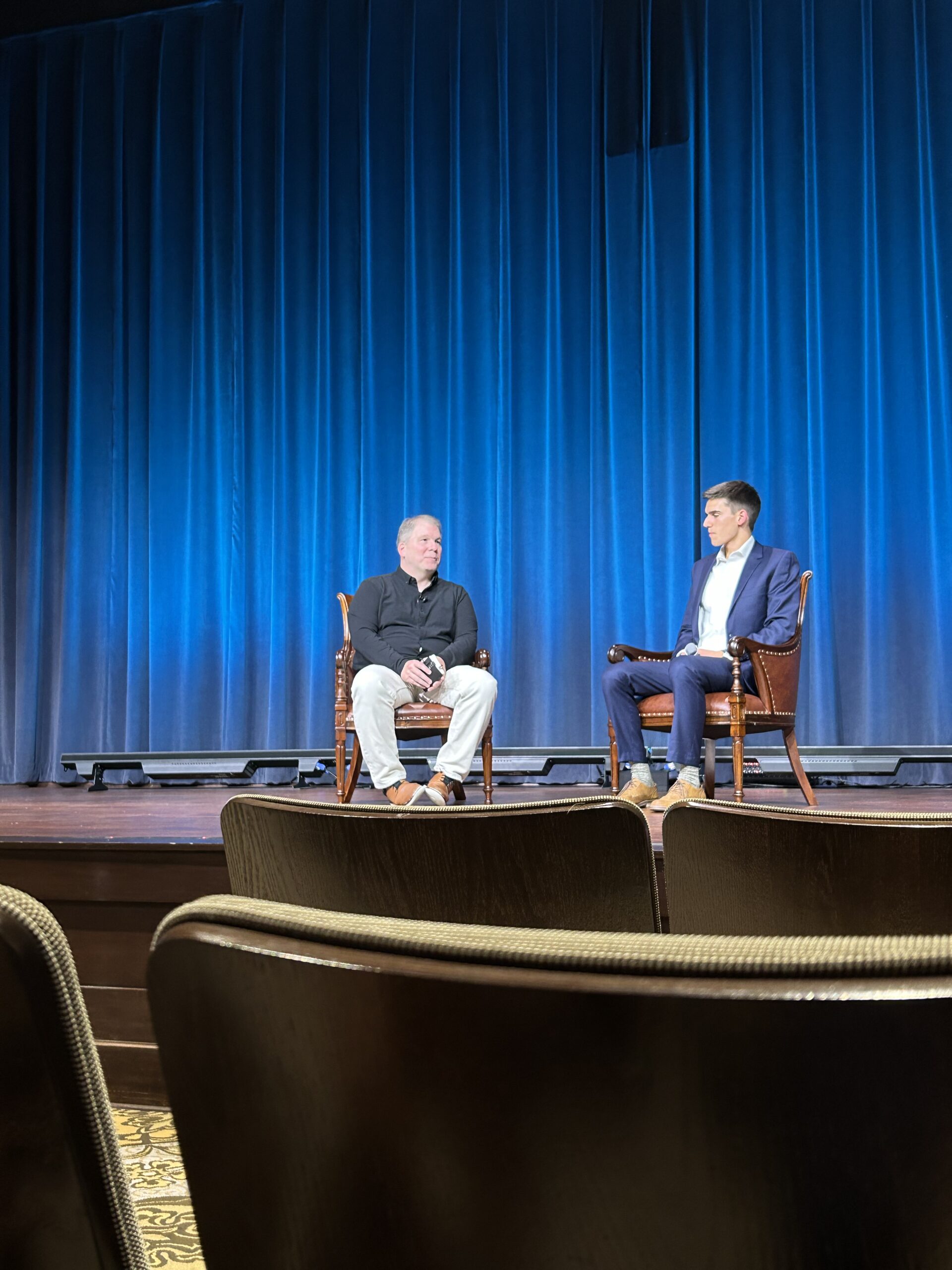
Christians are positioned to change culture’s perspective on sexuality, John Stonestreet, president of the Colson Center for Christian Worldview, said in a speech on Monday night.
Stonetreet’s speech, titled “The New Sexual Revolutionaries: How Christians Can Restore What’s Been Broken,” was hosted by Equip Ministries, a nondenominational ministry group on campus.
To first answer the question of sexual morality in society, Stonestreet said Christians are able to offer answers on sexual design that are upstream from thoughts on sexual morality.
According to Stonestreet, today’s culture has neglected the question of what the human body is made for: a question that must be answered if order is to be restored.
“This disconnection from purpose — to actually see the body as nothing more than a pliable canvas that we can do with whatever we want, because it has no inherent purpose, it has no inherent value other than what I assigned to — that is the new sexual ethic,” he said.
Stonestreet said this detachment, instigated by the sexual revolution of the 1960s, has continued to impact the way today’s culture views the human body.
“We’ve basically taken away all the rules, all the boundaries, all the fences, and said, ‘If you just go do whatever you want, follow your heart, you be you, do whatever you feel, you will have freedom and truth and prosperity and all that sort of stuff,’” he said. “And guess what? It did not bring the salvation that the sexual revolutionaries promised.”
According to Stonestreet, the beliefs championed by the sexual revolution have led to a culture separated from God’s design.
“We have a culture that is actually flailing in some really profound ways,” he said. “You can see this disconnection from purpose by looking beyond sexuality into things like the suicide rate and the so-called ‘depths of despair.’”
Now, Stonestreet said the church has a calling to demonstrate proper sexual morality by acknowledging God’s sexual design and reembracing what it means for humans to be made in the image of God.
“The opportunity now is to reintroduce this concept of purpose, this fact that our bodies and ourselves and human relationships have a God-given structure and a God-given design,” he said. “If we can actually live that way, not just by not crossing the rules that God gave us, but by actually embracing that God-given design for what it means to be human.”
Stonestreet said in order to effectively shape culture, Christians should demonstrate sexual morality by recognizing that sex, marriage, and babies are inseparable.
“We want to be sexually free, not only from our behavior, but from the God-given design of the universe,” he said. “The divorce of sex, marriage and babies as a package deal that is now prevalent, not just outside the church, but inside the church, is a terrible witness to God’s design. There is a better way.”
Junior Jake Hamilton said that he found Stonestreet’s speech to be optimistic for Christians and the church.
“I definitely liked his applications for the church today — that we need to bring a purpose to sex and that we should re-embrace the fact that we bear the image of God, and with that, the display of the Gospel in marriage,” Hamilton said.
Although Hamilton said he found Stonestreet’s views to be insightful, he is skeptical of the outcomes Stonestreet proposed.
“I’m unsure of the likelihood of a new sexual revolution,” Hamilton said. “I completely agree with the applications Mr. Stonestreet gave for the church and I’m glad the college received that message from him.”
Junior Mikey Berry said he enjoyed Stonestreet’s talk on what he said is one of America’s most pressing issues.
“Mr. Stonestreet gave a wonderfully thorough and enlightening talk, and I was delighted to have him on campus,” he said.
Stonestreet said the first step for the new sexual revolution to take effect is to recognize what God has created the human body for.
“We know that one of the reasons that God made what he did is to reveal himself,” Stonestreet said. “So our bodies actually tell us about God, and I think this is going to be a profound part of what it means to institute a new sexual revolution.”