
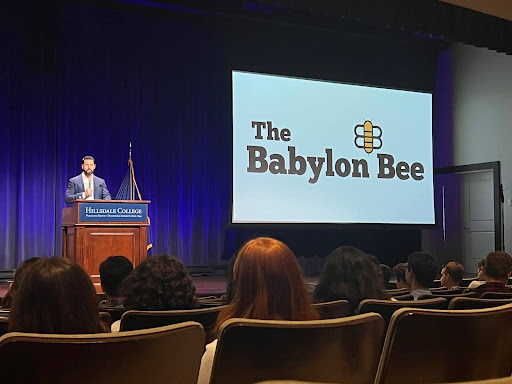
Babylon Bee CEO Seth Dillon speaks in Plaster auditorium. Courtesy | Jamie Parsons
The absurd has become sacred because it is not allowed to be challenged, according to Seth Dillon, CEO of the Babylon Bee.
Dillon spoke in Plaster Auditorium on Sept. 12 about the modern war between satire and Big Tech, emphasizing both the necessity of free speech and the role of satire in politics.
Dillon said, despite satire’s positive function, it is frequently misunderstood and targeted by tech companies, which threatens free speech.
Dillon began his lecture by debunking common assumptions about satirical content, saying the challenge of producing satire has increased despite how insane the world has become.
“Writing jokes that are funnier than what the Democrats are saying now is pretty hard,” Dillon said.
Dillon said the left’s increased absurdity has led people to believe the Bee’s satirical content is true. This prompted Facebook and Twitter to crackdown on fact-checking content posted on social media.
Dillon said the Babylon Bee was hesitant to release content, fearing it might get fact-checked, but continued to post jokes mocking ridiculous ideas.
“You have to be willing to pay a price for freedom or else you will lose it,” Dillon said.
The Babylon Bee was suspended on Twitter in 2022 after refusing to take down a post titled, “The Babylon Bee’s Man Of The Year is Rachel Levine.” The title mocked how Rachel Levine, a biological male, was recognized as one of USA Today’s women of the year in 2022.
“We can’t take this down even if it means getting our Twitter account taken down,” Dillon said he remembers thinking. “No one is fighting back against these rules.”
Dillon said tech companies fact-check satire in the media because no one opposes them.
The left challenges the Babylon Bee and other satirical websites, claiming their content is spreading misinformation, according to Dillon.
“The New York Times said we were ‘trafficking misinformation under the guise of satire,’” Dillon said. “But they are trafficking misinformation under the guise of journalism.”
While satire does not claim to be true, Dillon said satire tells the truth by challenging bad ideas.
Director of the Journalism Dow Program John Miller agreed with Dillon, complimenting him on eloquently expressing satire’s unique ability to expose lies, hypocrisy, and sanctimony.
“The unique ability of humor and particularly satirical humor to speak the truth about our lives and politics — I thought he had a good and cogent expression of that,” Miller said.
Dillon said humor has the ability to challenge absurdity because it has a way of getting through to people who don’t use logic to form their opinions.
“He said you can’t logically argue and reason with someone who is not using logic to form their opinions and so the only thing that’s going to get to them is a joke,” junior Hana Cobia said. “If someone is telling you two plus two is five, you can’t tell them ‘no, two plus two is four’ because they are so set on five.”
Miller also said humor is important to have in politics because it brings laughter to our lives.
“Laughter is human; it’s wonderful to laugh,” Miller said. “Politics right now is filled with humor, but it could always use more and better humor. The Babylon Bee I think is about the funniest thing there is right now. It is enjoyable just on the level of making us laugh, but I also think it often has important things to say about where we are right now.”
At the end of his lecture, Dillon called on the audience to build courage to push back against tech companies trying to censor their humor.
“Evil prevails when good men fail to act,” Dillon said. “Madness prevails when sane men decide to say nothing.”