
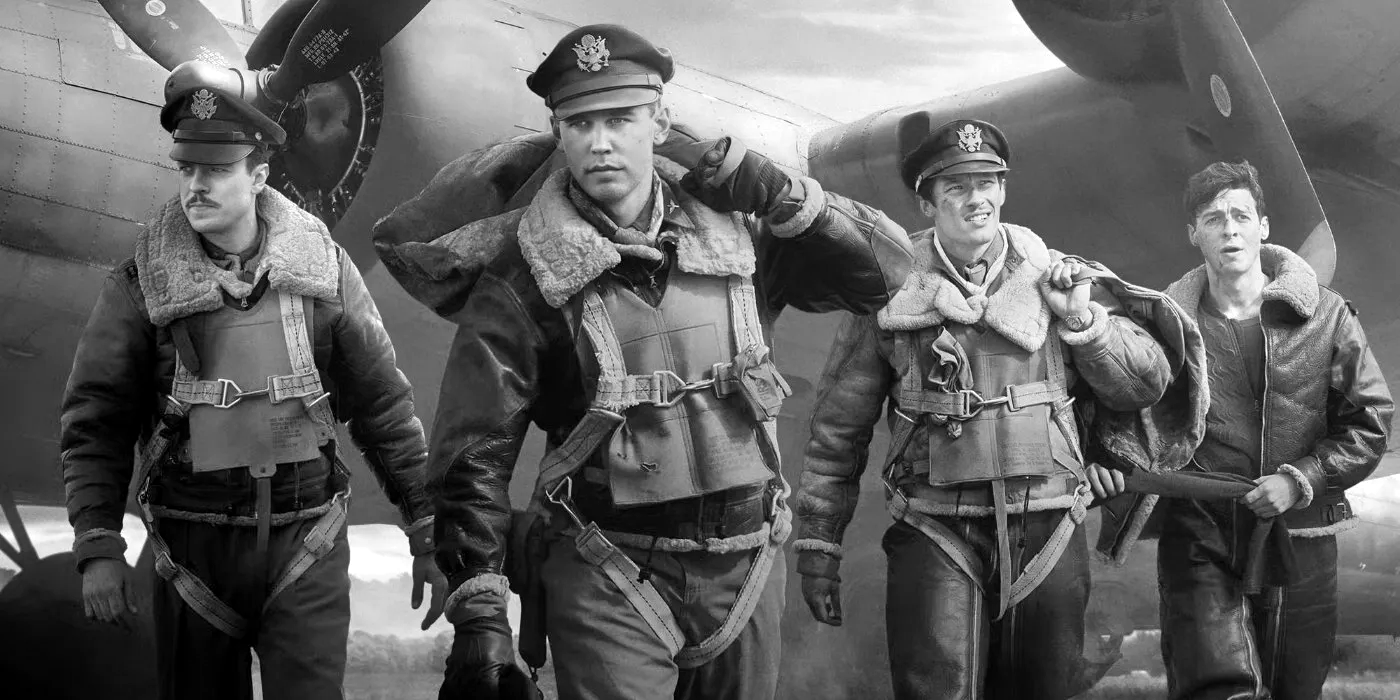
“Masters of the Air” has attracted the die-hard fans of HBO miniseries “Band of Brothers” and “The Pacific” after 10 years of anticipation. The show comes as the third World War II miniseries produced by Tom Hanks and Stephen Spielberg. It didn’t disappoint.
The long-awaited Apple TV+ series portrays the missions and struggles of the 100th Bomb Group, otherwise known as the Bloody Hundredth. The 100th Bomb Group’s nickname comes from its horrifically high casualty rate: in the span of four months, the 100th Bomb Group loses 77% of its original members.
The show narrows in on B-17 pilots Major John Egan (Callum Turner), Major Gale Cleven (Austin Butler), and Lieutenant Colonel Robert Rosenthall (Nate Mann) and navigator Lieutenant Harry Crosby (Anthony Boyle).
The series captures the bond that grows between the airmen in the frozen chaos of the air war over Europe. Stationed in England, the group flies continuously over occupied France and Germany, where they are terrorized by flak from below. “Masters of the Air” brilliantly captures the confusion aircrews experience as their tight formations are picked apart. Each time a B-17 is shot down, all 10 of its crew members die. The stark reality of the situation is difficult to capture on-screen: The action sequences in the show lead to some confusion as to who was hit and just how many planes went down.
During and immediately following the battles, viewers are left to take stock of the survivors. In one particular scene, Rosenthal discovers his plane is the only one to return to base. The crew wonders where the other bombers are. It takes a quiet sky and pieces of debris falling around them to solidify the fact that they are alone.
Later in the show, the Luftwaffe shoots down Egan’s plane and German soldiers capture him. During the march to a prisoner of war camp, Egan and other POWs are attacked by German civilians angry at the constant death brought upon them by American bombers. The scene reflects the violence airmen suffer after escaping their destroyed aircraft. Civilian attacks on airmen are a gruesome, yet common aspect of the air war we do not often consider because of their scattered nature.
The stunning cinematography and music contribute to the impact of the show. In the opening title sequence, the music highlights the array of emotions felt by the characters while including some of the most beautiful shots of the entire series.
“Masters of the Air” is one of the most well-done historical shows created recently. It avoids current politics, instead focusing on the characters and the challenge of flying under extreme stress and fear. Upon return to base, crew members are expected to act as if everything was normal, then return to what many airmen called “Hell,” the next day.
“Masters of the Air” fantastically captures the experiences of American bombers in a way that is captivating for all people, not just history buffs like me.
