
Fossil fuel. That is what Hillsdale College’s fledgling natural history museum became after a fire ravaged the college on March 6, 1874.
The cabinet of curiosities contained hundreds of specimens before the fire, including minerals, plants, bird skins, and fossil casts, according to an 1879 issue of the Hillsdale Herald, the college newspaper at the time. Only a few dozen were spared from the damage of the flames.
The bricks and bones of the museum perished — but the spirit of its curator did not.
Professor of Natural History Daniel Fisk, a man almost as eccentric as the specimens he collected, arrived at the college two years earlier with the resolve to start a natural history museum. The fire threatened to terminate his plans.
But according to his autobiography, Fisk saw the fire as an opportunity for rebirth.
“The professor had not seen all his beginnings of a museum melt into nothingness, and perhaps it was just as well, but his heart seemed broken anyway,” Fisk wrote. “But not so his resolution. Another collection, as well as another housing, must be the sacred task. So to that task, the next 12 years were tirelessly dedicated.”
Fisk reestablished the museum the day after the fire. By the fall of 1874, the museum had its own floor on Knowlton Hall, a new building dedicated to the natural sciences.
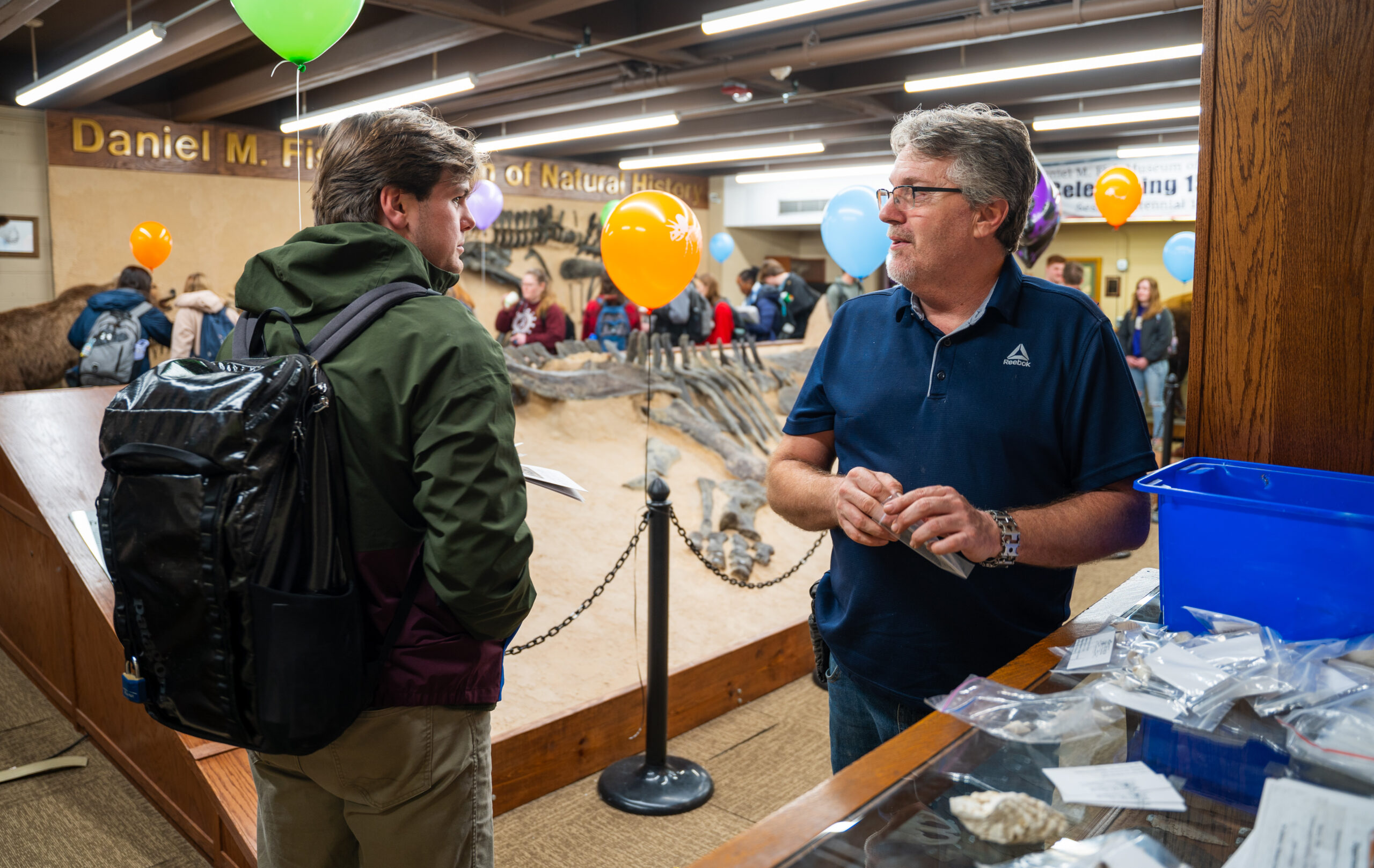
Fisk’s legacy lives on 150 years later. On March 7, 2024, lovers of natural history gathered in the Daniel M. Fisk Natural History Museum in Strosaker Science Center to celebrate its sesquicentennial anniversary.
The current curator of the museum, Professor of Biology Anthony Swinehart, said the celebration aimed to remind people of the museum’s history.
“This event is special because it represents the successful resurrection of the museum from the annals of antiquity,” Swinehart said. “It means that the labors of Dr. Fisk, past Hillsdale College presidents, trustees, faculty, students, and donors were not in vain.”
While visitors and students walk through the room every day, few know the destruction, loss, and challenges Fisk and Swinehart overcame to establish the museum as it is today.
With a new building, mission, and spirit, the museum grew after 1874 due to donations and Fisk’s own excavations across the United States. In 1879, the Hillsdale Herald praised the new museum.
“It is a matter of surprise and congratulation, on the part of returning absentees, to see a collection fully twice the size of the former cabinet, built up in five short years out of nothing,” an article reads.
The growing size and increasingly rare specimens caught attention outside of the college as well.
“Prof. McLounth, Ph.D., of Ypsilanti Normal School [now Eastern Michigan University], says of our college museum, that it is ‘the best museum in the state,’’ an 1880 issue of the Herald said. “By which he does not mean that it is larger than Ann Arbor [University of Michigan], but more available for study and better mounted.”
The museum’s greatest accomplishment during this time period was funding an expedition to South America. Between 1880 and 1882, Hillsdale College partnered with the Smithsonian Museum and Albion College] to commission a two-year expedition to collect rare specimens for their museums.
“We have hundreds of photos from the expedition, including pictures of shrunken heads, and natives and all kinds of things like that,” Swinehart said. “There were a lot of biological specimens, but there were also a lot of archaeological specimens, important specimens from what is called the Amerihome tribe and Marivaux pottery.”
Swinehart said the museum currently displays one armadillo, which he believes to be from the South American expedition.
But even an impressive collection would not satisfy Fisk. He asked the trustees to fund a new building solely to house the new museum.
“There never was a more promising chance to build up a great museum in this college than now,” Fisk said in 1885. “The next 10 years may see a little world of nature housed here for daily study that shall be not only a credit to the college but an immense benefit to all succeeding classes in science. Shall we have the museum?”
The trustees granted Fisk’s request to fund a museum, but no building was ever built.
According to Swinehart, Fisk left Hillsdale College in 1885 because he felt a calling to the pulpit, and he took most of the enthusiasm for the museum with him. Although one of his students curated the museum with some success, quality declined, and in 1910, the museum was once again damaged by a fire in Knowlton Hall.
Swinehart said the museum lost many specimens over the next few decades due to lack of care.
“Things started to not do as well. And especially if you start getting into the ’40s, ’50s, and ’60s, things really start to decline,” Swinehart said. “Sadly, most of the specimens were lost or stolen or given away. Things fell by the wayside.”
When the Strosacker Science Center was built in the 1960s, all science equipment was moved out of Knowlton Hall, and rare specimens were scattered across campus.
“A biology professor told me he witnessed people putting specimens like moose heads and stuff out on the lawn for people to take,” Swinehart said. “He said he saw them shoveling specimens out the third floor onto a dump truck to take to the dump.”
This was the dilapidated state of the museum when Swinehart, a young biology professor from Purdue University, arrived at Hillsdale College in the 1990s.
During his job interview, Don Toczek, a professor of biology at the time, told Swinehart about the former museum and the disasters it withstood. Swinehart said he knew if he received a teaching position at Hillsdale, he would restart the natural history museum.
“There were two things I pledged to do as a successful candidate,” Swinehart said. “One was to establish a biological station, which I did, and the other one was to bring back the museum.”
When Hillsdale gave Swinehart the position, he set to work fulfilling his promise.
Like his predecessor Fisk did before him, Swinehart began by digging through the metaphorical rubble of the museum. He searched the cabinets, offices, drawers, and halls of campus for odd-looking natural objects.
“I found a rock being used as a doorstop in Central Hall. I thought, ‘That’s not from around here.’ It ended up being a lava sample from the Sandwich Islands, which are now Hawaii. I went into Central Hall and I asked one of the secretaries where she got it. She said, ‘We don’t know. It’s been there for decades.’” Swinehart said.
Once he recovered the few specimens left of Fisk’s legacy, Swinehart acquired an old anatomy lab room in Strosaker to display the collection. On March 7, 2011, the Daniel M. Fisk Natural History Museum reopened for the first time since the 1960s with a name honoring its founder.
“Since that day, I have been not only gathering up what was left of the museum but adding tens of thousands of specimens myself. We are getting to the point where we are similar in quantity to what we had at one time and, in some cases, better in quality,” Swinehart said.
Swinehart estimates the museum now contains more than 10,000 cataloged objects from around the world and almost every geological time period. The collection includes specimens dug up here in Hillsdale, like several mastodon bones.
Unfortunately, Swinehart said only around 5% of Fisk’s original collection remains in the museum today. Some of these rare objects, like a giant clam cataloged by Fisk, are endangered species illegal to collect in the present day.
Though the museum collection was growing rapidly, Swinehart said he thought something was missing from the collection, the one thing that defines a natural history museum — dinosaur bones.
“When you think of a natural history museum, you think of dinosaurs,” Swinehart said. I never dreamed we could ever have a full dinosaur skeleton, but I thought at minimum we’ve got to have some dinosaur bones.”
Swinehart contacted a privately owned dinosaur dig site in North Dakota that allowed researchers to dig on the property for a weekly fee. He and his students began digging there every summer starting in 2009.
After Swinehart had established a relationship with the dig site and put in a request for a dinosaur, he got a call from the dig site.
“‘We’ve got an animal for you,’ the caller said. ‘An amateur found it.’ They promised it to Hillsdale, and it was delivered,” Swinehart said.
Swinehart and Hillsdale students finished digging up the herbivore Edmontosaurus Annectens, a species of duckbill dinosaur, in 2015. They affectionately named it Linda after the woman who discovered it, and brought it back to campus.
“What else can I add to the number one spot on my bucket list after that? This is too soon to check off number one,” Swinehart said.
The addition of a second dinosaur in 2018, Donna the triceratops, made the Daniel M. Fisk Museum the only museum in the state of Michigan to display two, real-bone dinosaur skeletons.
“There is no other place where you can see two real-bone dinosaurs,” Swinehart said. “Other places have cast bones, and I think University of Michigan has one, but Hillsdale can formally boast we have the most dinosaurs on display.”
Although it took 150 years, Swinehart has implemented Fisk’s vision to make a museum that inspires students to pursue an education in the natural sciences.
“Many of our classes will go to the museum and do some exercises that help with seeing what they’re learning in class,” Swinehart said.
The museum’s specimens have contributed to six published research papers, including one on a collection of rare fresh-water mollusks that would make most marine biologists jealous.
Swinehart said he often stops to admire the museum’s specimens and contemplate their history.
“I often just walk through the museum, and it’s become so commonplace that sometimes I just have to stop and remind myself, “Oh my God, we’ve got two mostly real-bone dinosaurs in here.”
