
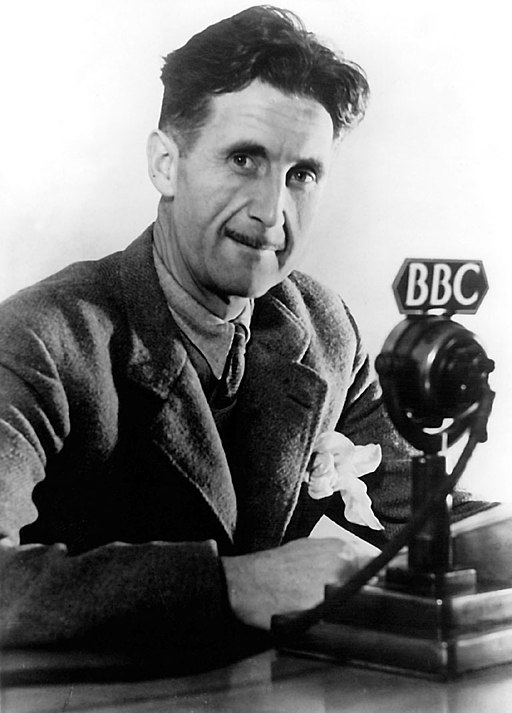
The question is not whether Hillsdale College should add George Orwell to the Liberty Walk, but why his statue does not stand on campus already.
The purpose of the Liberty Walk is not just to honor great men and women in history but, more specifically, “champions of freedom” who manifest “the importance of education to liberty,” according to the college’s website. Orwell more than fulfills these criteria as a man who spent nearly his entire adult life and career resisting the social and political forces of totalitarianism. People around the world know terms like “Orwellian” and “Big Brother,” even if they have never read Orwell’s novels or essays.
Born Eric Blair in 1903, he took the pen name George Orwell as a tribute to his upbringing in England; George is its patron saint and Orwell is a river near his boyhood home. His early essays condemned imperialism, which he witnessed close up during his first job as an officer with the Indian Imperial Police in Burma.
After quitting that profession in disgust, Orwell spent a year purposefully living in poverty, which he wrote about in his 1933 book “Down and Out in Paris and London.” Orwell identified as a “socialist” in the sense that he believed no one should live under tyranny, whether the tyrant was an economy that sees human beings as disposable or a traditional political dictatorship.
These experiences, along with his participation as a Republican soldier in the Spanish Civil War, cemented Orwell’s hatred of all forms of oppression, both from the left and from the right.
Orwell rebuked Soviet Communism’s false promises and true horrors in his 1945 novel “Animal Farm,” the book which propelled him to fame. But perhaps his best work, and the one most important to our politics today, is his essay “Politics and the English Language,” published in 1946. In it, Orwell describes the very battle institutions like Hillsdale are currently fighting most fiercely, involving the distortion of language and its political consequences.
When the definition of a word becomes muddled and malformed, he wrote, people lose their ability to think clearly. “Since you don’t know what fascism is, how can you struggle against fascism?” Orwell wrote. “[T]he present political chaos is connected with the decay of language.” If words can mean anything, then it becomes possible “to make lies sound truthful and murder respectable.”
This theme underlies his best-known work “1984,” a dystopian novel portraying a dictatorship that holds power because of its manipulation of political language. Published in 1949 (shortly before Orwell’s death), the book displays one of Orwell’s key themes: freedom, especially freedom of speech, is necessary to keep the human spirit alive.
The most striking element of the regime’s rule is how it has systematically changed the English language so that the citizens have no words to articulate ideas about liberty, beauty, or rebellion — concepts that would constitute “thoughtcrime.” Without the vocabulary, they can’t even think about these things.
The character O’Brien, a member of the “Thought Police,” lays this out to the protagonist Winston Smith during an interrogation: “Don’t you see that the whole aim of Newspeak is to narrow the range of thought? In the end we shall make thoughtcrime literally impossible, because there will be no words in which to express it.”
In the end, Winston’s spirit breaks through this method; as Orwell summarized in his famous essay, when “thought corrupts language, language can also corrupt thought.”
George Orwell is the most influential voice against tyranny in recent history. He understood that an easily controlled and corrupted populace cannot be free. He showed how quickly politics can devolve into despotism. Just as the writer permanently carved his stance against tyranny into political thought, the college should honor the man behind the legend by adding his statue to the Liberty Walk.
