
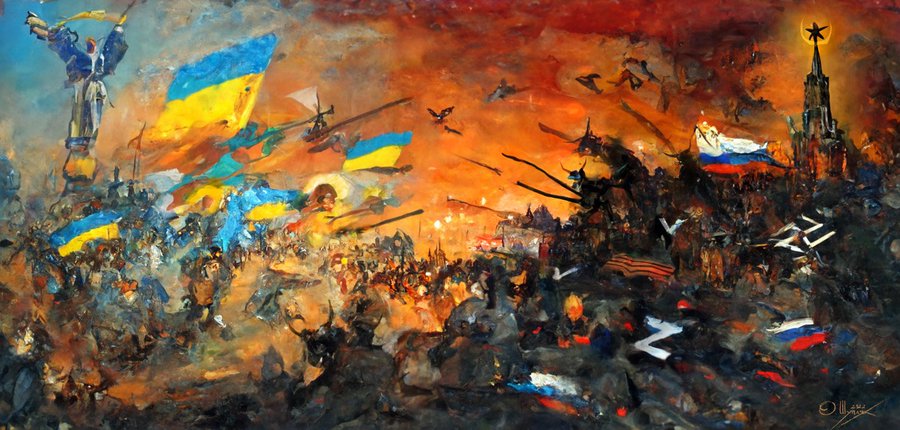
After the Russo-Ukrainian War, the Ukrainian people will either follow a Western model or a Soviet model, said Joel Gehrke ’11 in a lecture hosted by the Dow Journalism Program Feb. 5.
Gehrke spoke on the connections between the Russo-Ukrainian War and the works of J.R.R. Tolkien, as well as the overall implications of the war on the Ukrainian people and culture.
“They talk about problems as if it really matters if they are wrong,” Gehrke said about the people of Eastern Europe. “They have to manage downside risk in a way that Western Europe does not.”
As a foreign affairs reporter for the Washington Examiner, Gehrke spent time traveling in Poland and Ukraine in 2022, where he noticed many references to Tolkien among the Ukrainian people.
“I am over there, and I notice that Twitter and the information space is full of Tolkien references. There’s people calling Russians Orcs,” Gehrke said. “I then realized that this is not a one-off thing, and it’s not new for people in that part of the world to refer to Russia as Mordor.”
On a trip to Maryland, Gehrke was practicing Russian in the backseat of an Uber when the driver heard him and struck up a conversation.
“Revo, a Soviet Red Army veteran, explained that under communism, if you work, the KGB comes and takes your stuff,” Gehrke said. “America is a place where the system is not defaming your character.”
While investigating the role Tolkien plays in Ukrainian culture, Gehrke discovered a project in Lviv to translate Tolkien’s work and military manuals.
“This philosophy professor at the local university started a publishing house in 2000 on what he calls ‘a mission to return Ukraine to the Western Civilization,’” Gehrke said.
Freshman Josiah Jones said he was happy Gehrke did not bring up the views of political leaders directly.
“Based on my time in Ukraine, I have yet to meet anyone who differs from the views expressed by Mr. Gehrke,” Jones said. “They are developing more pro-West views because they know that they will be back in a Soviet Union situation if they lose. That is why they fight so hard and why Ukraine didn’t fall in three days like everyone thought they would.”
Gehrke said journalist and author Anna Politkovskaya, who spoke out against Russian corruption and war crimes, influenced him in his views and writing regarding Russian tactics.
Politkovskaya was found dead in an elevator on Oct. 7, 2006, after continual criticism of Vladimir Putin and the Russian Federal Security Service.
“Politkovskaya was actually shot on Oct. 7, which was actually Putin’s birthday, so some view it as a birthday gift,” Gehrke said.
Freshman Megan Li said she was shocked that situations like Politkovskya’s still occur as if the Soviet Union still existed.
“We tend to think the things done by the KGB — or now the FSB — are only done in dystopian novels or in the past, but the reality is that things like that are still happening,” Li said. “We need to be aware of these things and also appreciate the system we have.”
Attendees gained a better understanding of the unseen aspects of the Russo-Ukrainian War, Li said.
“Mr. Gehrke gave us a good, powerful reality of the war through his stories and time near Ukraine,” Jones said. “He brought humanity to it, as well as a good view of journalism.”
