
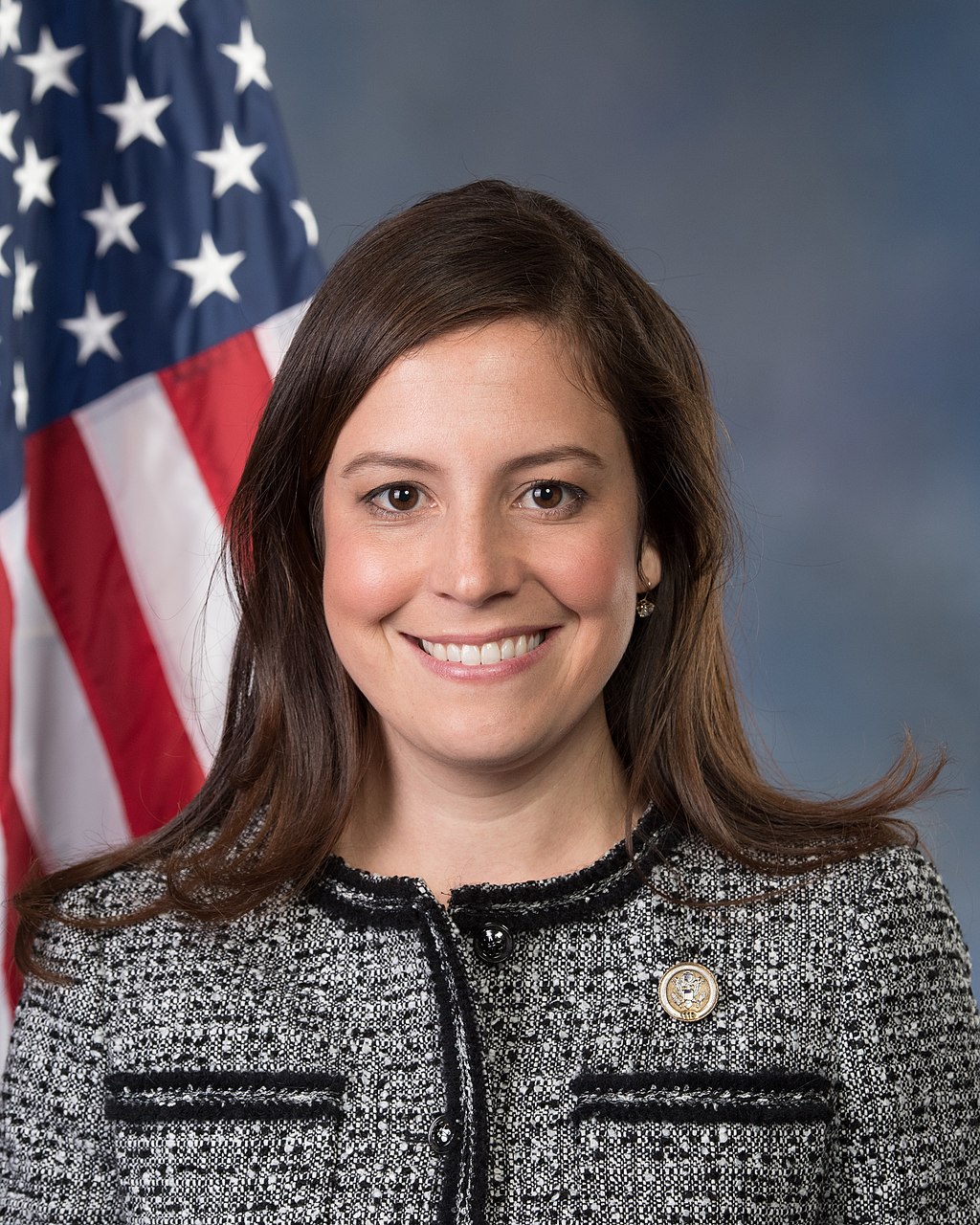
Former president Donald Trump is in all but name the GOP’s presumptive nominee for the general election. Soon, he will need a running mate, and his best option is House GOP Conference Chair Elise Stefanik, R-N.Y.
Stefanik, 39 years old and the mother of a 2-year-old son, has risen to prominence since former Rep. Liz Cheney of Wyoming lost that leadership post. She is respected by both the caucus rank-and-file and Trump’s staunchest supporters.
Stefanik has been vocally supportive of Trump’s past administration, and she’s actively campaigned on his behalf in crucial primary states. More recently, she has entered the political arena’s culture wars, in this case, regarding antisemitism at elite colleges and universities. She grilled former Harvard University President Claudine Gay during a congressional hearing, pushing Gay to the point of resignation. By taking up and publicizing that fight, Stefanik proved she does not fear hot-button issues.
Although the VP’s political repertoire is always important, a Trump pick’s assets might depend less on what he or she would add to the ticket than on whom the candidate would avoid upsetting. Neither moderate and independent voters nor the Trump base should feel particularly alienated by the choice. This primary has renewed tensions between those two groups, and the pool of contenders Trump could draw from without adding to that turbulence has shrunk as a result.
Plenty of Republican politicians have already crossed the line with Trump by opposing the direction of his populist movement. This is why former Vice President Mike Pence — with whom Trump had a very public split in the aftermath of Jan. 6, 2021 — could not realistically make a comeback.
Former South Carolina Gov. Nikki Haley is in the same boat. Being Trump’s only opponent left in the primary, some pundits have proposed that her presence on the ticket could demonstrate conservative unity and end the infighting between the populist and establishmentarian factions within the party. Her strong credentials and political prowess are compelling positives, but they simply do not outweigh the negative context of her campaign existing as opposition to Trump.
Although a show of unity would undoubtedly be a positive for today’s fractured right, it would only work if conservative voters could quickly forget (or forgive, depending on what kind of conservative they are) Trump’s attacks against Haley. The former president has made amends with foes on his side of the aisle plenty of times before, but it’s not clear that the façade of a rekindled friendship could translate to an effective partnership — especially when it’s one as crucial as the vice presidency. This primary is now a proxy for the ongoing ideological showdown within the GOP, and it would be counterintuitive to expect Republican voters to accept a sudden truce between the individuals whom they’ve come to see as inseparable from the ideas their bases of support espouse.
VP contenders that are already fully integrated into the MAGA brand wouldn’t be ideal on this ticket, either. Vivek Ramaswamy is perhaps the most relevant example of this. The charismatic businessman has already proven himself to be a capable orator and accentuator of Trump’s populism, and those traits would likely help the Trump campaign maximize base turnout in key swing states. Even so, his presence would not temper any of Trump’s emotional extremes that moderate Republicans find concerning. Although a Trump-Ramaswamy ticket would surely prove electrifying on the campaign trail, it could actively harm the sense of party unity that the prior options would seek to cultivate.
Some kind of middle ground seems best, given the obvious drawbacks with each extreme. Trump ought to choose someone who has an amicable relationship with the MAGA movement but who has not sought the spotlight quite as boldly as he himself does. Such a running mate would balance the ticket while still preserving the momentum Trump needs to get his base out to the polls.
It is for those reasons that Elise Stefanik may be one of his strongest options. Her active support of Trump and MAGA has not gotten in the way of her other relationships within Congress and conservative politics. Her loyalty is not self-destructive, and that degree of allegiance might be for the best if conservatives want 2024 to be an election in which Republican voters demonstrate the same.
