
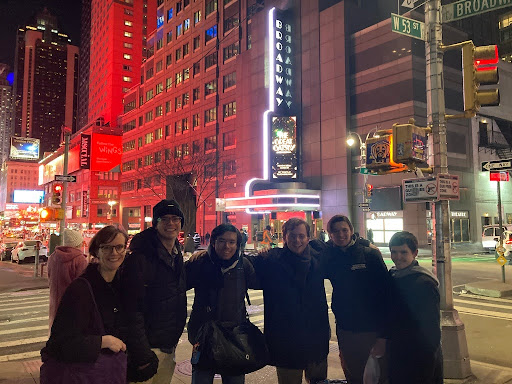
After hours of driving through a snowstorm, passing time with conversations in Latin and listening to Latin audiobooks, members of the Mensa Latina club of Hillsdale arrived in New York City, ready to participate in a spoken Latin conference.
The Paideia Institute at Fordham University hosted the conference, titled “Living Latin in New York City” from Feb. 16-18. It featured talks spoken in Latin, Greek, and English, all based on the theme “Technology in Antiquity.”
Sophomore David Cathel said he really enjoyed speaking Latin the whole weekend.
“I think the Paideia Institute points us toward, perhaps, a more comprehensive pedagogical model, which I think is great. I hope their plan succeeds,” he said.
Associate Professor of Classics Patricia Aeschliman said they arrived in Manhattan much later than they had intended.
“We wanted to give the students an immersive experience,” Aeschliman said, “so we decided that we would speak Latin for the full 10 hour car ride. I think they enjoyed it.
The group listened to an app that has audiobooks in spoken Latin once it got late.
“We listened to the letters of Pliny, then we listened to the letters of Cicero, and then we listened to the letters of Seneca. So we were really on an epistolary journey at that time.”
Despite the added time from the snow and the late night arrival that led to a lack of sleep, Aeschliman said the car ride turned out well.
“That was actually one of the most fun parts, just spending time with each other getting to know each other in Latin in the car,” she said.
The conference itself featured some of what Aeschliman called the country’s, if not the world’s, best Latinists.
The list of speakers included University of Kentucky professors Terence Tunberg and Milena Minkova, who are part of the United States’ only fully immersive Latin program.
Additionally, YouTuber Lucius Ranieri spoke. Renieri runs the channel “Scorpio Martianus” which has many miscellaneous videos mostly spoken in Latin.
Greek speaker included Christophe Rico who founded the Jerusalem based Polis Institute, one of the foremost institutions in the revival of ancient Greek, Latin, and Hebrew.
The conference was mostly teachers, junior Matthew Tully said, but many kinds of Latin speakers of all levels of proficiency were present.
“There were all kinds of people there,” Tully said. “High schoolers, teachers who were looking to introduce some spoken elements into their classes, professors, college students. There were also people who were just interested in the language. And that’s just amazing to me.”
Interest in Latin has persisted in the modern age, though the language is far from its natural element, according to Tully.
“The people who speak Latin try at length to use Latin roots and make words that mean new things out of those roots,” Tully said.
This has caused some problems for Latin’s vocabulary, which has had to adapt to technological changes, Tully said.
“There’s a great example of this from the people who translate things into Latin for the Pope,” Tully said. “They have a word for “tweet.” And the word for tweet is breviloquentis which means something like a short saying.”
This vocabulary obstacle was overcome by the Latinists at the conference, as Aeshchliman noted.
“There are not essentially agreed upon ways to speak about those things,” Aeschliman said. “But it is a good question because when talking about a space shuttle or a specific program within NASA, there aren’t really agreed upon terms for these in Latin. So the speaker kind of made them up. So he just explained what the program was called and he gave it a Latin name, but others might have given it a different Latin name.”
For the whole weekend, the members of the Mensa Latina club never stopped speaking in Latin even outside the conference.
“We were at this fancy Italian restaurant and we’re just speaking Latin to each other and it was just a normal conversation,” Cathel said. “It’s always mind blowing to be able to do that.”
The conference attendees subdivided into groups based on experience.
“They put everyone in a group depending on how much experience they have with Latin and with spoken Latin,” Aeschliman said. “So whether you’re at an intermediate reading level or a beginning speaking level, you’ll be put with people who are similar in abilities, and they go to different sessions together and then you get to choose talks that you attend.”
Cathel said the conference improved his spoken Latin skills.
“We were having a discussion about what’s true and what’s not true in respect to this academic talk, just like we would English,” Cathel said. “And you know, when you do that, it’s really hard to say that a language is dead.”
