
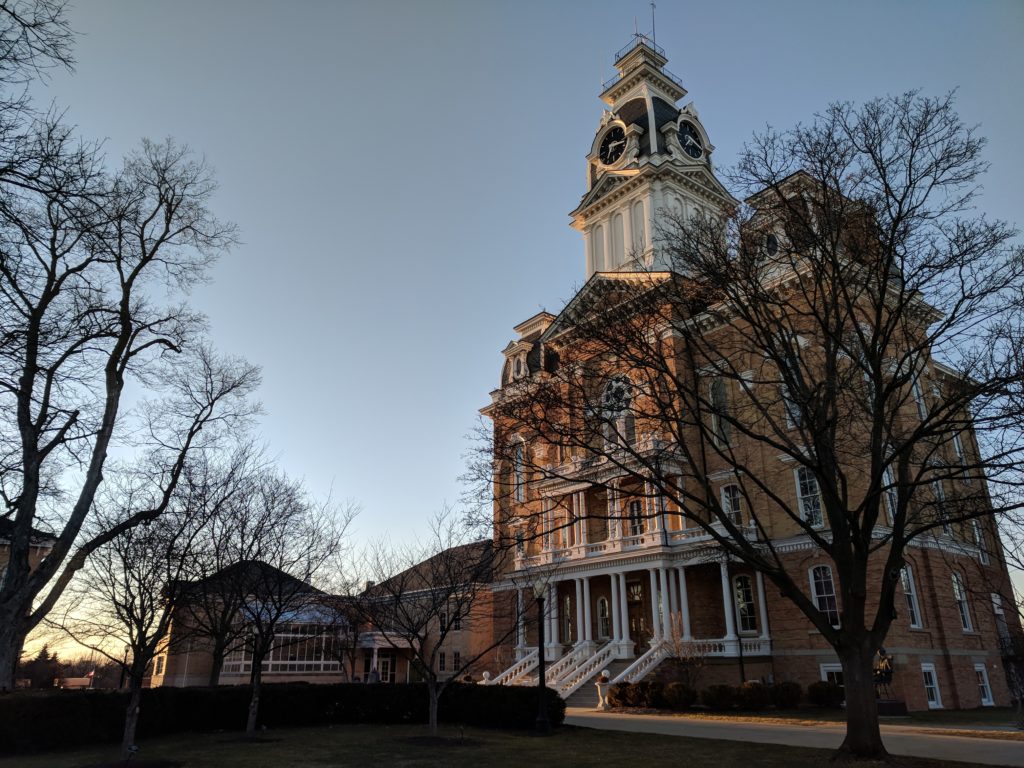
A sexual-assault lawsuit filed last year could threaten Hillsdale College’s religious freedom by placing its policies under the authority of the federal government, legal experts say.
Two women, a current junior and a former member of the class of 2024 who has since transferred, claimed that students at Hillsdale face “an unusually high risk of sexual assault” because the college does not comply with Title IX, which seeks to prohibit discrimination based on sex.
“This is no accident: Hillsdale does not accept government funding in a misguided and ineffective attempt to avoid its obligations under Title IX of the Education Amendments of 1972,” reads the lawsuit, filed on Oct. 25 in the U.S. District Court for the Western District of Michigan.
The lawsuit claimed that Hillsdale’s tax-exempt status is a form of federal financial assistance.
The plaintiffs’ accusations mischaracterize Hillsdale’s culture, policies, and procedures, according to a statement from the college, which also insists that it is exempt from the regulations of Title IX because it does not accept federal funding.
“Subjecting Hillsdale and all charities to comprehensive federal regulation would convert them from the pursuit of goals to compliance with rules, rules made for other purposes than those of the charity,” Hillsdale College President Larry P. Arnn told The Collegian. “Our goal is to help young people grow to be excellent people through higher education. The Department of Education has a thousand goals other than this, some of them contradictory to this.”
If Hillsdale loses the case, the federal government will become the ultimate authority on a number of issues, according to Mary Margaret Beecher, executive director and vice president of the Napa Legal Institute, a public-interest law firm that focuses on religious freedom.
Even though the lawsuit against Hillsdale does not specifically target a religious issue, Beecher said it concerns who has authority over Hillsdale’s governance.
“The lawsuit’s fundamental question is, ‘Who’s in charge here?’” Beecher said. “Is the government in charge? Or are religious institutions free to govern themselves in accordance with their beliefs?”
The Obama administration altered Title IX guidelines in 2011, compelling schools to adjust their procedures, making it more likely that students accused of sexual assault would be found responsible for their alleged actions.
In 2021, the Biden administration expanded the definition of sex to include “sexual orientation and gender identity.” If Hillsdale was forced to comply with Title IX, it might have to permit male students to use female bathrooms and play sports with either sex.
Title IX’s religious exemption would still apply to Hillsdale, but an ongoing case is challenging the right of institutions to govern themselves according to their religious beliefs.
In Hunter v. U.S. Department of Education, the Religious Exemption Accountability Project, an LGBT activist group, is suing to prevent students from using tuition grants, student loans, and any other federal financial assistance at schools exempt from Title IX that operate according to traditional beliefs on sexuality.
REAP’s self-proclaimed mission is to prevent religion from “serv[ing] the interests of white Christian supremacy” and make it “contribute to human flourishing, affirmation of LGBTQ+ youth, and racial and reproductive justice.”
A ruling that places Hillsdale under Title IX’s jurisdiction could reach far beyond rural Michigan. Other religious institutions, from higher education to secondary and elementary schools, would risk losing their religious freedom.
“What Hillsdale is fighting for here is a principle that is very important for institutions all over the rest of the country, and institutions far from the educational field, because everyone should push for their independence,” Cato Institute Senior Fellow Walter Olson told The Collegian.
Hillsdale General Counsel Bob Norton warned that all nonprofit organizations could be subjected to administrative regulations that would change with each presidential administration.
“This is not a partisan issue; any nonprofit organization would be affected,” Norton said. “This would be at best, onerous and costly for nonprofits, and at worst, it would destroy them. One of the greatest strengths of American society is that we as citizens retain the latitude to solve our problems together, outside of government interference. This civil society and our very freedom of association as Americans is at risk.”
Whether Title IX applies to schools that do not receive federal financial aid was put to the test in Buettner-Hartsoe v. Baltimore Lutheran High School Association. Beecher’s Napa Legal Institute filed an amicus brief in support of the defendant.
“These cases are kind of motivated by an interest in having the federal government oversee religious institutions, even the way they’re living out their religious beliefs,” Beecher said.
In Buettner-Hartsoe, former students sued their private high school, alleging the school had not adequately addressed complaints of sexual assault and sexual harassment. The school argued it was not subject to Title IX due to not receiving federal assistance. A judge for the United States District Court for the District of Maryland rejected the high school’s claim, holding that because the school received a federal tax exemption as a non-profit organization, it was subject to Title IX. The case is currently on appeal, and the outcome would not immediately affect Hillsdale College, which is in a different jurisdiction.
Yet it would create a precedent that other courts could follow. “It’s essentially the exact same issue that’s going on with Hillsdale right now,” Beecher said. “The question of whether tax exempt status gives the government supremacy over institutions, policies, and internal documents.”
Olson said that Title IX was never written to hinge on tax status.
“It was written to apply to a much smaller, narrower group of institutions,” Olson said. “If some court were tempted by the [plaintiff’s] argument, it would have to consider not only that things have been set up the other way for a very long time, but the results would be to destabilize the tax environment not just for Hillsdale College individually, but for many, many other institutions.”
Although the college is not subject to Title IX, its policies meet its standards, Norton said.
“Outside counsel hired by the college conducted a thorough and vigorous investigation in the case of both plaintiffs,” Norton said.
If the court determines that Hillsdale’s tax-exempt status qualifies as federal funding, Hillsdale would likely also be required to comply with Title VI of the Civil Rights Act, Beecher said. Schools under Title VI are required to try to collect and report demographic information on students including race, which Hillsdale currently does not document.
“Certain laws have power over anyone who receives federal financial assistance,” Beecher said. “If it’s determined in one context, that federal financial assistance includes 501(c)(3) status, it’s going to have this domino effect on all the other statutes that use that term.”
The change could threaten Hillsdale’s independence, even if its practices don’t violate Title VI, said Devon Westhill, president and general counsel for the Center for Equal Opportunity, a conservative civil-rights think tank.
“Once you begin to have the government entangled with enterprise, it becomes less independent,” Westhill told The Collegian. “You have less control over it. And you’re subject to the whims of the political winds, and that changes all the time.”
As an independent institution, Hillsdale should be free from government influence, according to Westhill.
“Any entanglement with the government really is a corruption of what Hillsdale is trying to do,” Westhill said.
